Subjects





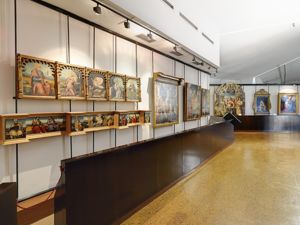
It was necessary to wait until the early 16th century to witness the formation of a local pictorial school whose greatest exponent was Pietro Cavaro, a member of a family of Cagliari painters active for over a century in the workshops of the Stampace district.
Pietro Cavaro trained in Barcelona, passed through Naples and then returned to Sardinia, where in 1518 he signed the Villamar Altarpiece, his masterpiece, in which he is aware of the news of Italian Renaissance painting.
In the north of Sardinia, on the other hand, emerges the personality, still anonymous, of the Master of Ozieri, who around the middle of the 16th century introduced into his painting the same mannerist ways found in the altarpieces of the Cagliari school of Stampace, painted at the same time.
Also important, between the 16th and 17th centuries, is the wooden sculpture enriched by the technique of “estofado de oro”, which involves gilding in leaf, the superimposition of colors that are then scratched to bring out gold, highlighting geometric or floral patterns imitating precious fabrics.
For the spread of baroque art in the seventeenth century, religious orders born in the Counter-Reformation played a leading role, among all the Jesuits who introduced the new language in their churches.
During the seventeenth century, the Sardinian cathedrals were modernized, renewing the interior decorative apparatus in precious polychrome marbles inlaid with the help of Genoese and then Lombard craftsmen. However, the production of sumptuous golden wooden altars of Iberian tradition, made by Sicilian craftsmen, bells and Sardinian women to replace pictorial altarpieces, lasted a long time.
With a few exceptions, it can be said that the island did not know the expressions of the Italian Renaissance in architecture, if not mediated and combined with the Gothic-Catalan language in original ways, which become the tradition of Sardinian stonemasons both in religious construction, characterized by adherence to mannerism, and in civil architecture.
Finally, from the end of the 16th century onward, the effort to defend Sardinian villages from barbarian incursions was significant, taking the form of the construction of an effective system of coastal towers.
Update
Images
Video

Year : 2010

Results 2 of 39749
View All


 Facebook
 Twitter
 LinkedIn
 Whatsapp

 Print
Print
 E-mail
Comments