Subjects





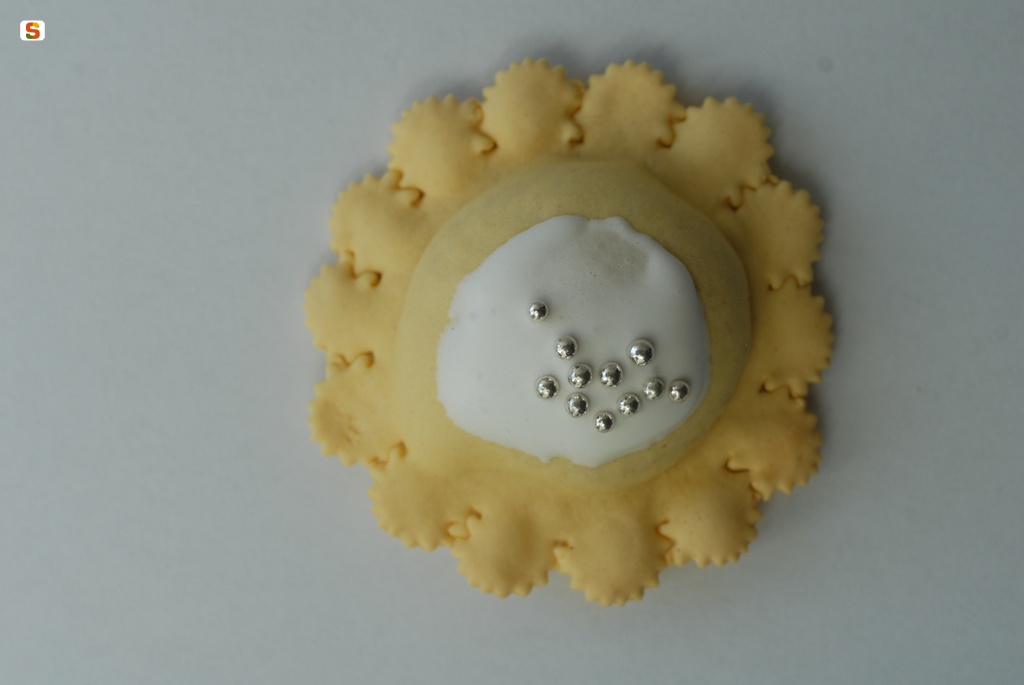
*Pirikitos*—also known as *pirichittus* or *piricchittus*—are small, round, sugar-glazed cookies. Originating in southern Sardinia, they are now found throughout the island and are officially recognized as a Traditional Agri-food Product. Their widespread availability in the island's artisanal pastry shops makes them one of the most accessible and recognizable Sardinian sweets, despite the simplicity of their recipe.
*Pirikitos* come in two versions: *is pirichittus prenus* ("filled"), which have a dense, slightly soft interior; and *is pirichittus de bentu* ("of the wind," or hollow), made using a technique similar to choux pastry, resulting in a light, hollow structure. While both types share the same exterior glaze, they differ in texture, volume, and dough preparation. The filled version is the most common and the one most frequently documented in home-baking traditions.
The dough for *pirichittus prenus* consists of flour, eggs, oil or lard, leavening agent, salt, and lemon zest; a small amount of sugar may be added to the dough, though the sweetness comes primarily from the glaze. The eggs and fat are blended into a smooth mixture, into which the flour is incorporated until a firm, pliable dough is formed that can be worked by hand. This dough is divided into portions, rolled into ropes, and cut into uniform pieces. After baking, the finished shape is that of a small cylinder or a flattened sphere, measuring approximately three to four centimeters.
Glazing is the most delicate step: granulated sugar is dissolved in water—flavored with lemon zest or orange blossom water—to create a specific type of glaze known as *a mesu filu*. The name refers to the empirical test used to determine when the syrup is cooked correctly: when held between the thumb and index finger, it must form a flexible, semi-transparent thread about half a centimeter long before breaking. The cookies are added to the pan with the hot syrup, then quickly removed and separated before the glaze crystallizes.
Bibliography
Dolci in Sardegna. Storia e tradizione. Nuoro, Ilisso, 2011.
G. Marongiu, Mandigos, gustos e licanzas. Selezione di ricette della tradizione orale della Sardegna. Vol. 1, Cagliari, Agenzia LAORE, 2020.
Mandorlicoltura in Sardegna. Le varietà autoctone della Sardegna. Cagliari, Agenzia LAORE, 2021, pp. 40-57.
S. Paulis, Dolci in Sardegna. Nuoro, Ilisso, 2024.
Update
Images


 Facebook
 Twitter
 LinkedIn
 Whatsapp

 Print
Print
 E-mail


Comments