Subjects





Despite its name, Pecorino Romano is the leading figure in the Sardinian cheese industry. Its roots trace back to Roman antiquity—it is mentioned by Latin authors and was part of the legionnaires' rations—yet its deep-rooted presence on the island is a more recent development.
It was not until the late 19th century that this cheese began to establish itself within the island's dairy sector, effectively becoming its flagship product. Its commercial success was driven by the abundant supply of sheep's milk and an 1884 decree by the Mayor of Rome prohibiting *pizzicaroli* (traditional grocers) from salting Pecorino in their city backrooms. This prompted cheesemakers from Lazio, Tuscany, and Campania to relocate production to the island, initially operating out of small, mobile facilities known as *caselli*.
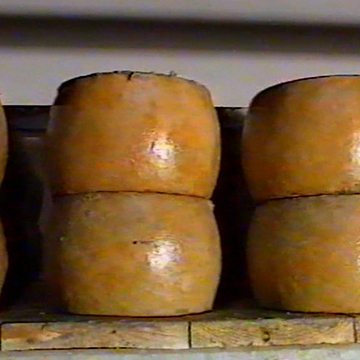
Pecorino Romano is a hard, cooked-curd cheese made from whole sheep's milk sourced from the designated regions—Sardinia, Lazio, and the province of Grosseto—and coagulated using lamb rennet paste. The cylindrical wheels feature a thin ivory or straw-colored rind (sometimes coated) and a white or straw-colored paste that is cooked, hard, and compact. Its flavor—mildly piquant and savory in the table-cheese variety (aged at least five months)—becomes intense in the grating variety (aged at least eight months).
Recognized in the 1951 Stresa Convention, granted Designation of Origin status in 1955, and awarded Protected Designation of Origin (PDO) status at the European level in 1996 (EC Reg. No. 1107/96), the cheese is safeguarded by the *Consorzio per la Tutela del Formaggio Pecorino Romano* (Consortium for the Protection of Pecorino Romano Cheese), established in November 1979 and based in Macomer.
Bibliography
Formaggi di Sardegna, a cura di M. Venusti. Regione Autonoma della Sardegna – Agenzia Laore, 2010, p. 11.
A. Guigoni, Il formaggio nei presidi Slow Food: marchi di qualità, in Formaggio e pastoralismo in Sardegna. Storia, cultura, tradizione e innovazione. Nuoro, Ilisso, 2015, pp. 653-664.
M.L. Di Felice, Modernizzazione e crisi dei sistemi tradizionali di produzione. L’impatto dell’industrializzazione sul comparto lattiero-caseario tra Ottocento e primo Novecento, in Formaggio e pastoralismo in Sardegna. Storia, cultura, tradizione e innovazione. Nuoro, Ilisso, 2015, pp. 77-88.
A. Pirisi, I formaggi tradizionali e a Denominazione di Origine Protetta, in Formaggio e pastoralismo in Sardegna. Storia, cultura, tradizione e innovazione. Nuoro, Ilisso, 2015, pp. 199-262.
P.G. Spanu, Dall’età fenicio-punica all’Alto Medioevo, in Formaggio e pastoralismo in Sardegna. Storia, cultura, tradizione e innovazione. Nuoro, Ilisso, 2015, pp. 29-40.
Update
Video


 Facebook
 Twitter
 LinkedIn
 Whatsapp

 Print
Print
 E-mail


Comments