Subjects





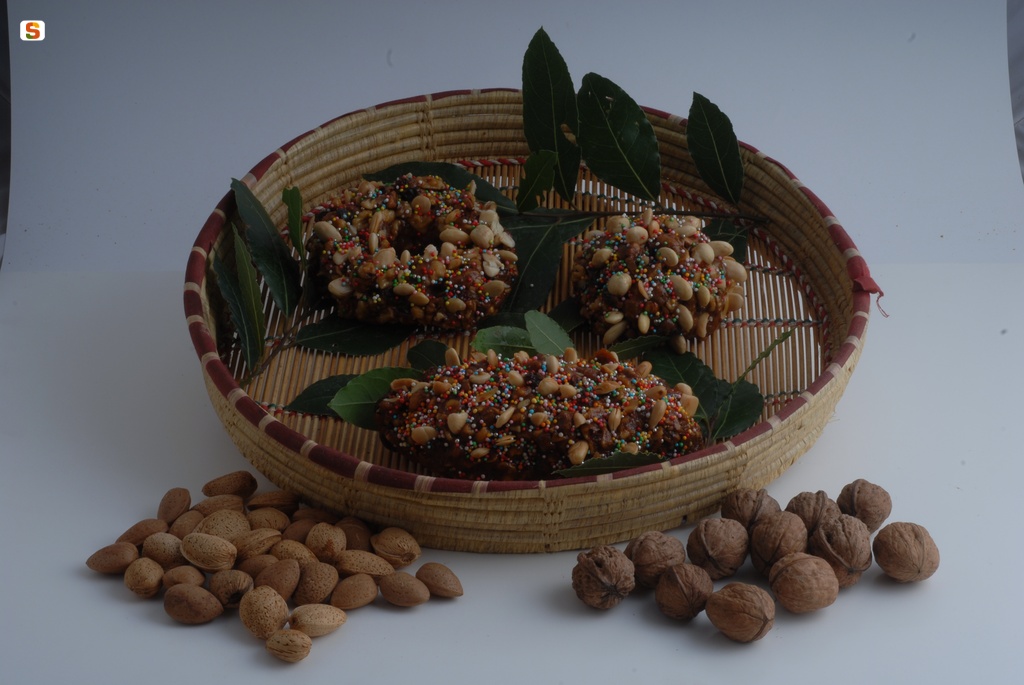
*Su pani 'e saba* (or *pan di sapa* in Italian—also known as *pane 'e mele* in areas where honey replaces or supplements the cooked grape must) is a naturally leavened sweet bread made with *saba*, a thick syrup obtained by slowly cooking unfermented grape must, and flavored with dried orange peel and spices. *Saba* is the oldest sweetener in Sardinian cuisine, predating the widespread use of sugar; its inclusion in the dough testifies to the product's ancient roots within the region's agro-pastoral culture. Production takes place primarily in the autumn, coinciding with the grape harvest that yields the must for the *saba*. Consumption is generally associated with All Saints' Day and All Souls' Day; the bread was traditionally prepared to welcome the spirits of the deceased during their nocturnal visits on the holiday, left on the table as an offering, or shared with neighbors as an act of remembrance. In some parts of the island (such as Meana Sardo and other towns in the Barbagia region), however, the bread is associated with Easter.
The dough consists of flour, sourdough starter, *saba*, dried fruit and nuts (walnuts, hazelnuts, almonds, raisins), and wild fennel seeds, with proportions and additional ingredients varying widely according to local custom. The *saba* is warmed and mixed with the flour and sourdough starter, creating a dark-colored dough with an intense aroma. Natural leavening takes between twenty-four and forty-eight hours, during which the dough rests, covered, in a *panili*—the traditional Sardinian bread basket. Baking is ideally done in a wood-fired oven at a low temperature for over an hour. While still warm, the pastry is dipped in *saba*, drained, and garnished with *mompariglia* or *tragea* (colored or silver sugar sprinkles). It has an exceptionally long shelf life—up to two months in a cool, dry place—a characteristic that historically fostered its large-scale production and widespread distribution.
Bibliography
M. L. Wagner, La vita rustica della Sardegna riflessa nella lingua. Nuoro, Ilisso, 1996.
Pani. Tradizioni e prospettive della panificazione in Sardegna. Nuoro, Ilisso, 2005.
Dolci in Sardegna. Storia e tradizione. Nuoro, Ilisso, 2011.
G. Marongiu, Mandigos, gustos e licanzas. Selezione di ricette della tradizione orale della Sardegna. Vol. 1, Cagliari, Agenzia LAORE, 2020.
S. Paulis, Dolci in Sardegna. Nuoro, Ilisso, 2024.
Update
Images
Video


 Facebook
 Twitter
 LinkedIn
 Whatsapp

 Print
Print
 E-mail


Comments