Subjects





Empress Helena (248-329 A.D.), mother of Emperor Constantine, is venerated as a saint by both the Latin and Greek Churches. Converted to Christianity, she visited the places of the Passion of Christ, discovering, according to hagiographic tradition, the True Cross. Therefore, the iconography represents it associated with the Cross, together with regal attributes (the crown, the scepter and the mantle). His feast day is celebrated by the Latin Church on 18 August and by the Greek Church on 21 May. Quartu, of which Saint Helena is the patron saint, boasts the possession of a relic of the Lignum Crucis, authorized in 1844 by the archbishop of Cagliari.
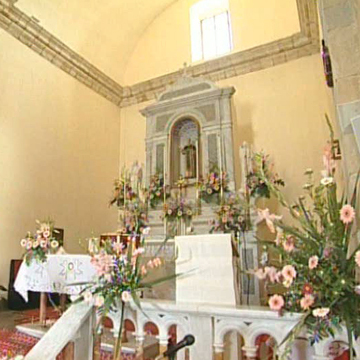
Saint Helena is celebrated by the people of Quartet mainly on two occasions: 21 May, according to the Greek Orthodox calendar (and not 18 August, according to the Latin one), a legacy of Byzantine influence, and on 14 September, for the feast of the Exaltation of the Holy Cross. The Byzantine ancestry of the cult of the mother of Emperor Constantine in the Campidanese area is also evidenced by the phytonym lillu 'e Sant'Aleni, relating to a white lily, whose bloom in the month of May coincides with the period of the celebrations of the Saint according to Eastern worship.
The spring festival dedicated by Quartu to his patron saint, now reduced to the religious sphere only, was once much more solemn, preceded by a four-day preparation. It was an irresistible call for “foreigners and travelers”, attracted by the richness of the ceremonial apparatus that included at the opening of the procession as many as two hundred yokes of oxen mudaus (adorned). This is how Vittorio Angius describes it, under the heading “Fourth” of the Historical and Statistical Commercial Geographic Dictionary of the States of H.M. the King of Sardinia (1833-1856). Other information about the characteristics of the festival of May 21 in the first half of the 19th century can be obtained from the report of the trip to Sardinia that Antoine-Claude Pasquin, known as Valery, printed in 1837. The French writer counted 3000 people who arrived “on foot, on horseback, and even by car, because the road is passable.” He also reported the presence of “eight huge breads made with cooked wine and honey, artistically sprinkled with sweet garnishes” placed at the four corners of the pedestal on which the statue of the patron saint of Quartu was placed. Among the uses of the sumptuous ceremonial apparatus that struck the aforementioned Enrico Costa, at the beginning of the twentieth century, is the “curious custom (common, on the other hand, to many Campidano villages) [...] of making the horse walk backwards by the one who carries the banner in front of the simulacrum of Saint Helena. It would seem that the polite horse intends to give a lesson in good faith on that day to the slutty oxen, who preceded the pious mother of Emperor Constantine.” This custom, a sign of reverence for the Saint, is reflected in Quartese verbal folklore, as documented by an informant born in 1923, in the phrase you comment on cuaddu 'e Santa Aleni (or ~ Corpus Domini), 'to do like the horse of Saint Helena (or ~ Corpus Domini) ', in the meaning of going backwards. The September festival was even more impressive, “with an immense influx of men and women from neighboring lands and Cagliari, and a great race of barbers, and polledri, the most famous, because the prizes proposed tend to be very long and valuable Palii.” In addition to the many visitors, the event also attracted authorities and illustrious figures, such as the future king of Sardinia, Carlo Felice, Duke of Savoy, for the festival of 1800.
Today, on the occasion of the patron saint's day in September, a suggestive procession crosses the streets of the city. The simulacrum of the Saint is placed on a wooden cart pulled by oxen and decorated with ferns and roses. At the foot of the statue there are four panis de saba pintaus and jars of basil (< Greek 'king'), a regal plant, worthy of an empress
Update
Video


 Facebook
 Twitter
 LinkedIn
 Whatsapp

 Print
Print
 E-mail


Comments