Subjects





Sardinian, the language still spoken today in Sardinia, especially in inland villages, is a Neo-Latin language.
This helps us to understand, more than any other consideration, how intense the influence, not only linguistic but also highly cultural, exerted by Roman rule on the island was.
Writing was certainly one of the most powerful communication tools used by Rome to exercise its control over an empire that grew exponentially day after day.
In fact, only writing could allow the management of a political-administrative apparatus adapted to the innumerable needs generated by the vastness and heterogeneity of the conquered lands.
Latin then became a sort of common language within the empire.
The countless written testimonies received by us are therefore very precious to us. Thanks to writing, in fact, we are able to integrate the gaps that archaeological investigation is unable to fill. At the same time, we are able to perceive what “self-image” those men and women who decided to entrust some testimony to writing wanted to leave, comparing it in many cases with archaeological data, which sometimes confirms, sometimes refutes the reliability of the written text.
From the registrations we also obtain very important information not only on the specific legal 'status' achieved by each urban center, but also on when this' status' had been acquired.
As far as the history of Roman Sardinia is concerned, useful information is obtained from Latin sources.
A first, important source concerns the urban organization of the island: it is the “provincial formula” that belongs to the third book of the “Naturalis Historia” by Pliny, the scholar who died during the famous eruption of Vesuvius in 79 AD.
Other information then comes from Ptolemy's “Geographia”, written around 170 AD, which, however, dates back to
Update
Images
Texts

Author : Mameli, Giovanni
Author : Mameli, Giovanni
Results 2 of 1014808
View All
Video


 Facebook
 Twitter
 LinkedIn
 Whatsapp

 Print
Print
 E-mail
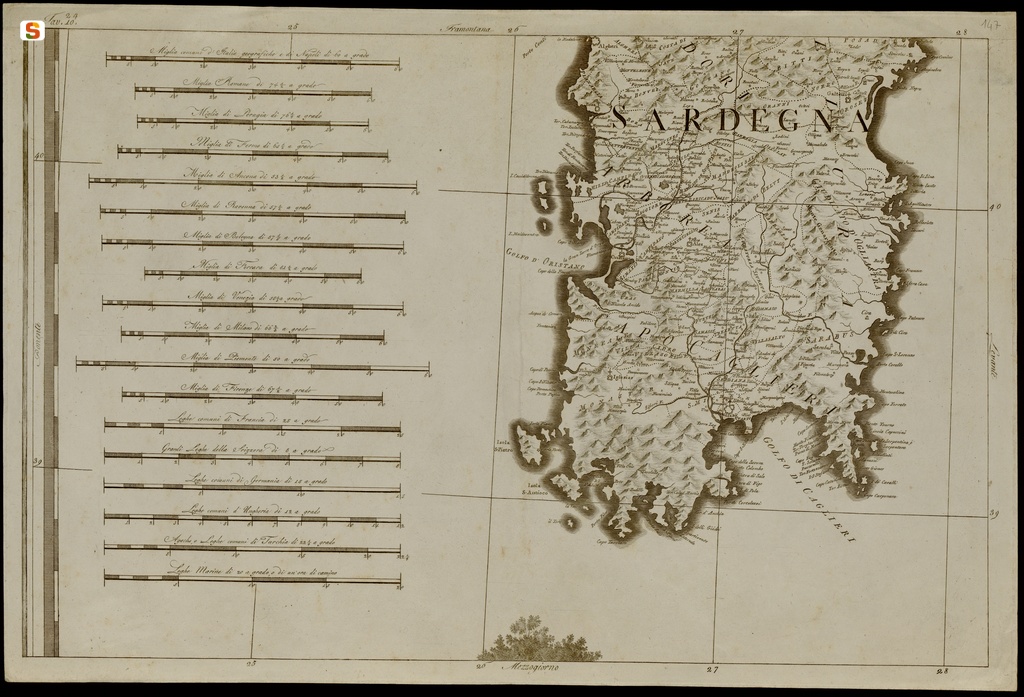
![[Sardegna], tavola 10 di una carta generale dell'Italia non identificata](https://dam.sardegnacultura.it/DAM/iiif/2/2c8d13bf-6f0b-4216-bc6b-53363279210b/full/300,/0/default.jpg)
Comments