Subjects




The decorative activities affecting bread are expressed in the Sardinian language with the verb to paint or fry, also used to indicate any exorative activity also practiced in other craft fields: for example linna pintada (carved wood), ferru fròriu (wrought iron).
The painting or froridura was achieved through the plastically imprinted shape through simple manual action, or through scissoring, punching, finishing obtained with tweezers. In some cases, the most experienced women were able to create paper shapes to be superimposed on the dough, to make complex shapes.
Other decorative motifs could be obtained by impression, through coins, filigree buttons, bread marks carved in wood (pintapane or pintaderas). The latter, in addition to performing a decorative task, responded to a need for practical order, when they imprinted the initials of the landlady on the surface, so that in the case of cooking in a public oven it would be easy to distinguish the breads of the same owner.
A chromatic decoration could be obtained by diluting a quantity of saffron powder in water, so as to obtain a natural dye that, depending on the degree of dilution, could range from red to orange, to more or less intense yellow. The solution was applied with a stick, or even better with a thin thread of straw. Breads subjected to such a kind of decoration are, for example, Su pane 'e Santu Tilippu by Cauglieri; the coccoeddus de su crispesu by Orroli; sa lòriga with saffron dots, in s'arrèula by Ussassai. Instead, Mamoiada's cocones chin apples appear homogeneously yellow, whose yellow color is not due so much to honey, contrary to what it would seem to be possible to infer from the name, but to the saffron dissolved and mixed with the mixture. Finally, in Bortigali, the votive breads dedicated to Saint Mark are bathed in water and saffron, a process that gives
the ritual food an intense yellow color.
A particular polishing process, called iscadhare/ischedhare, served to make the breads kneaded with the best flours even more aesthetically valuable: halfway through cooking, they were extracted from the oven, exposed to water vapor and baked again. This procedure was used to make the surface shiny.
Another decorative method consists in the affixing of whole almonds, as, for example, in Atzara's bread 'e sapa.
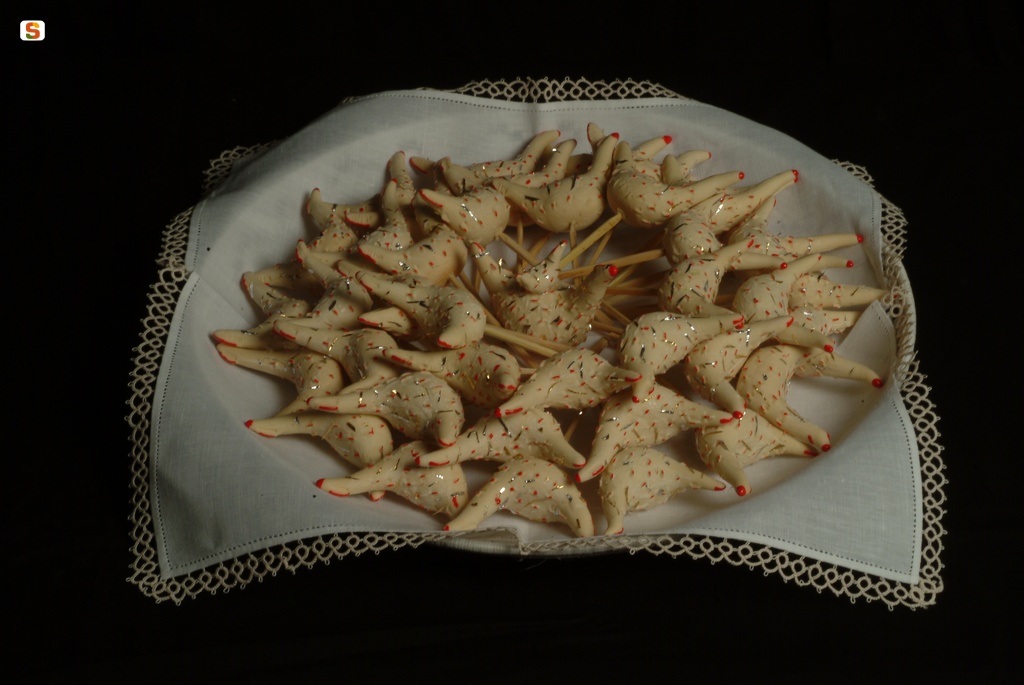
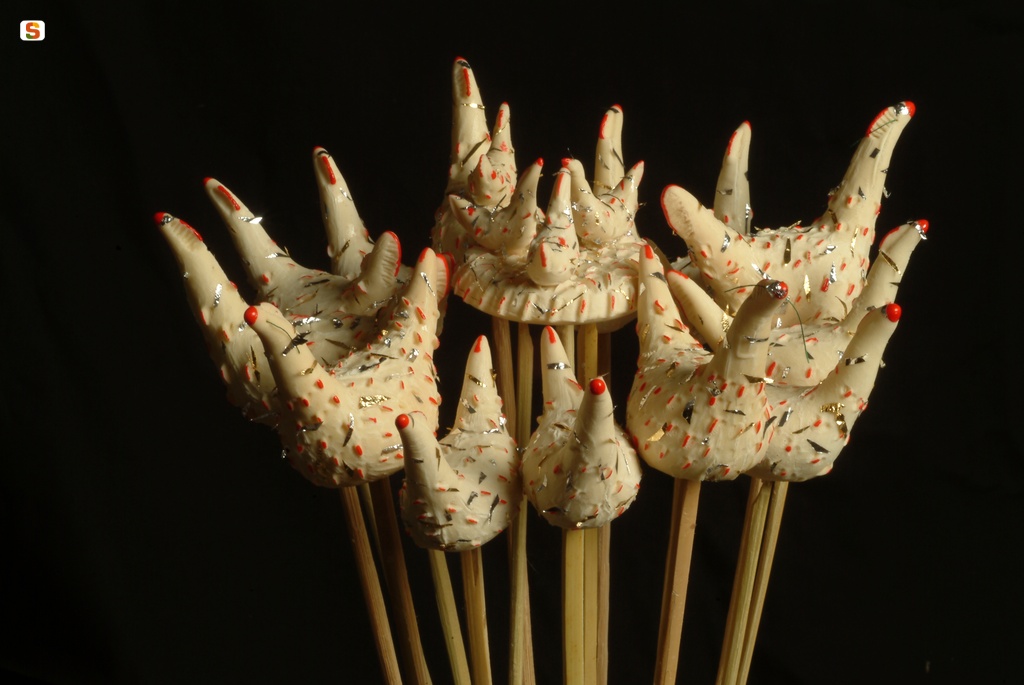
In su pani 'e saba by Quartu Sant'Elena the decorative function is performed by the application of s'indoru (gold leaf for food use) and sa tragera (colored devils)
Update
Images
Video


 Facebook
 Twitter
 LinkedIn
 Whatsapp

 Print
Print
 E-mail


Comments