Subjects





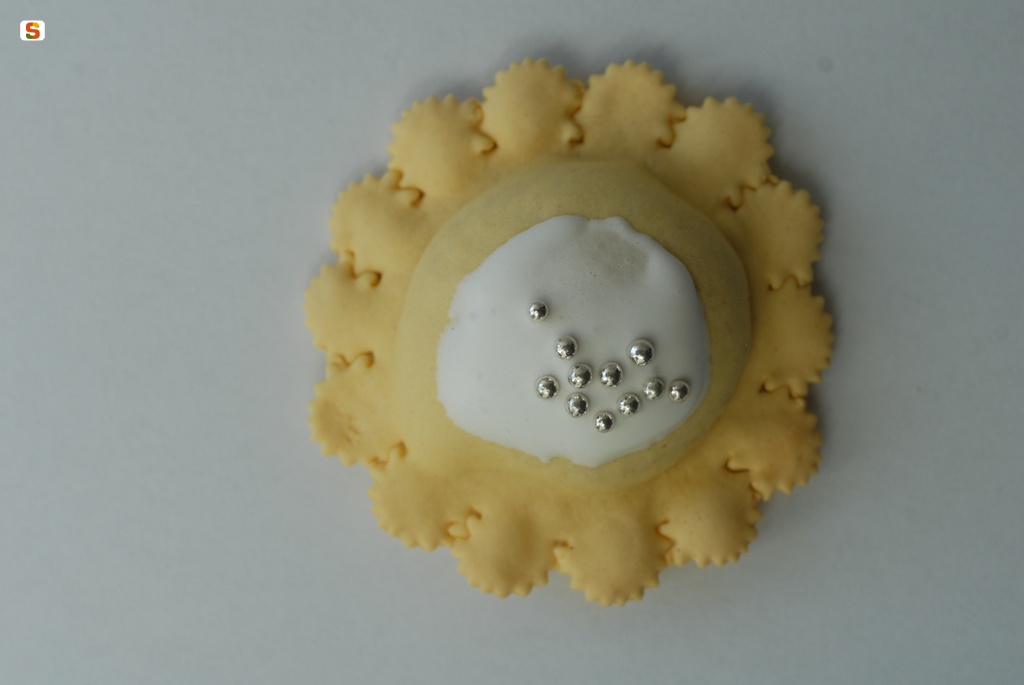
*Copulettas* are among the most popular ceremonial pastries in northern and central Sardinia, with Ozieri (a town in the Logudoro region of the province of Sassari) serving as the main production hub. The name most likely derives from the Latin term *copula*—and its Romance derivatives signifying union or a bond—directly reflecting the pastry's function: historically known as the "wedding pastry," *copulettas* are also served at baptisms. The initials of the bride and groom or the baptized child are often inscribed on them, turning the pastry into a personalized item. They are officially recognized as a Traditional Agri-food Product.
The pastry consists of three elements: a thin dough casing, a soft almond-based filling, and a white glaze coating. The dough—made from flour, lard, water, and salt (sometimes with a little sugar)—is rolled out into sheets and used in two different ways depending on local tradition: in the Ozieri version, two sheets of dough are sealed together like a ravioli, whereas in other areas, a mold is used to hold the filling like an open shell. The filling is composed of eggs, sugar, ground almonds, and lemon zest; its final soft, airy texture is achieved by incorporating air while beating the eggs. After baking at a moderate temperature, a glaze made from egg whites, powdered sugar, and anise liqueur is applied cold.
Certain characteristics may vary by location: in Ittireddu and parts of northern Logudoro, honey and *sapa* (grape must syrup) replace the egg and lemon zest; in the Campidano region, the product—known as *pastissus*—features a casing that differs slightly in thickness and composition; and in Oristano, this same family of pastries is known as *capigliettas*.
Bibliography
U. Dessy, Sardegna: segni della cultura popolare. Quartu Sant’Elena, Alfa Editrice, 1983.
Dolci in Sardegna. Storia e tradizione. Nuoro, Ilisso, 2011.
G. Marongiu, Mandigos, gustos e licanzas. Selezione di ricette della tradizione orale della Sardegna. Vol. 1, Cagliari, Agenzia LAORE, 2020.
Mandorlicoltura in Sardegna. Le varietà autoctone della Sardegna. Cagliari, Agenzia LAORE, 2021, pp. 40-57.
S. Paulis, Dolci in Sardegna. Nuoro, Ilisso, 2024.
Update
Images
Video


 Facebook
 Twitter
 LinkedIn
 Whatsapp

 Print
Print
 E-mail


Comments