Subjects





The Carnival celebrations in Oniferi start on January 16, on the occasion of the feast of Saint Anthony. In the town's districts bonfires are lit in honor of the saint while traditional dances take place in the square.
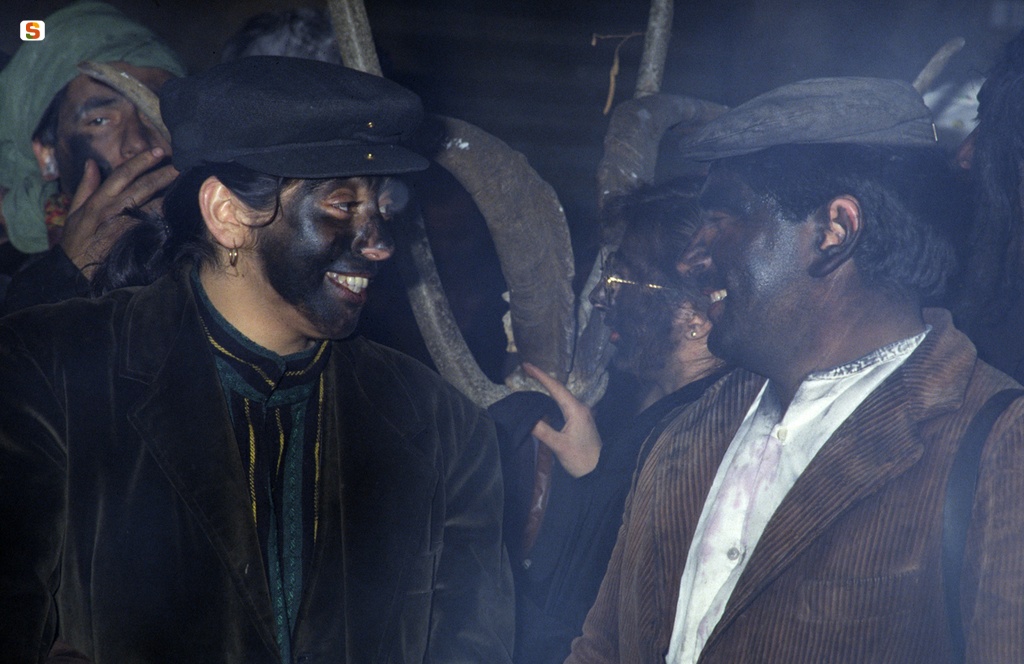
The protagonists of the Onifera carnival are “sos Maimones” typical masks that have their faces blackened with soot obtained from burnt cork. During the 20th century, the mask took on a goliardic character, so you can also meet Maimones with his face only partially painted.
A particularly suggestive moment is the dressing of “sos Maimones” that takes place inside the ancient hut used by the shepherds (on pinnetu), built of stone with a roof of branches.
After the blessing of the fire and the lighting of the bonfires, the masks go around the town carrying an anthropomorphic puppet on the back of a donkey, to represent the man who struggles in the fields, whose face consists of a prickly pear leaf fixed on a demijan or in a metal container for transporting milk (sa lama'e on milk), both covered with an orbace cloak (on saccu). Often the donkey is also disguised with horns of different sizes.
The mask of about Maimone goes from house to house accepting offers and loading saddlebags in orbace (sas berulas) of carnival sweets that, together with the wine poured into the demijan depicting the puppet Maimone, will be used for the party.
The Carnival of Onifera is characterized by the staging, through the streets of the town, of a series of real-life situations: difficulties, suffering and death are interpreted by SOS Maimones, ridiculing them in order to avert them. Among the situations represented, we can mention “sa parthi burra” (division of the double blanket through the representation of a sort of marital separation in which, by setting up a scandal on the street, the miserable assets in the orbace are divided); “s'ammuttu” (traditional song for the dead performed by preaching and for the occasion made burlesque by the masks that mourn her partner who died due to a heavy drinking and then resurrected thanks to another glass of wine) and “sa ilonzana” (a woman spinning the wool).
Once again, with the drawing of 'sos bullettes de sa fortuna' (tickets contained in a cork or wooden jar), a lottery is created that, with a burlesque intent, depending on the poetic vein of the moment, wishes all kinds of future.
The masks
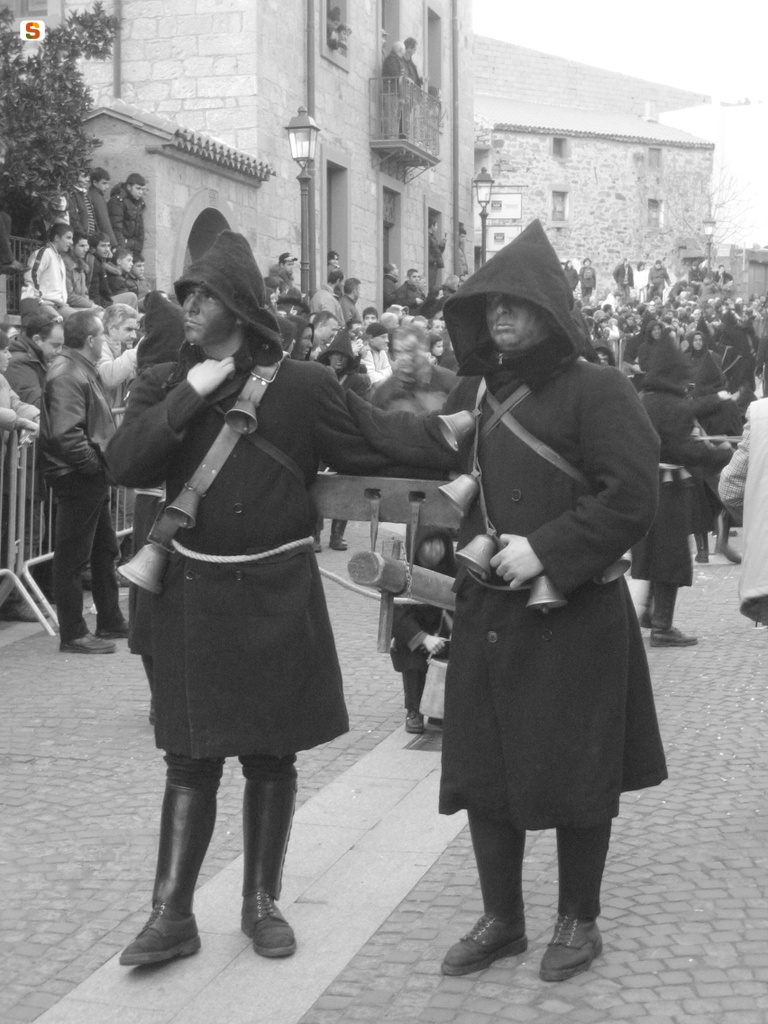
Sos Maimones: the male figure wears the typical dress of the Sardinian shepherd in dark velvet with a white shirt without a collar, leather boots (cambales) and a velvet hat (on bonette), traditionally worn hanging on the side of the forehead. Other garments, always typical of agro-pastoral culture, complete the clothing: hooded cape in orbace (on saccu'e fresi or furesi), heavy sheepskin in orbace (on gabbanu) or, alternatively, sheepskin or lamb skins worked with or without hair (sas peddas). The female figure, impersonated by male subjects, complements the clothing with a small cobace cape without a hood (on freseddu), skirts and a black handkerchief (on Muccadore Nigheddu) that is tied on the typical cap.
History
The typical mask of Su Maimone, which disappeared at the end of the 1950s, has recently been recovered thanks to the oral tradition handed down by the country's elderly and to the contribution of some studies.
The term Maimon would derive from the Greek mainomai (I am possessed) and more specifically from the epithet of the god Dionysus, Mainoles, the mad, the furious. It is used, together with the term Mamuthone, which has the same root, in different countries of Barbagia precisely to indicate the masks that, referring to the Dionysian cult, impersonate the followers of the god or the god himself, a symbol of intoxication and ecstasy.
Update


 Facebook
 Twitter
 LinkedIn
 Whatsapp

 Print
Print
 E-mail


Comments