Subjects





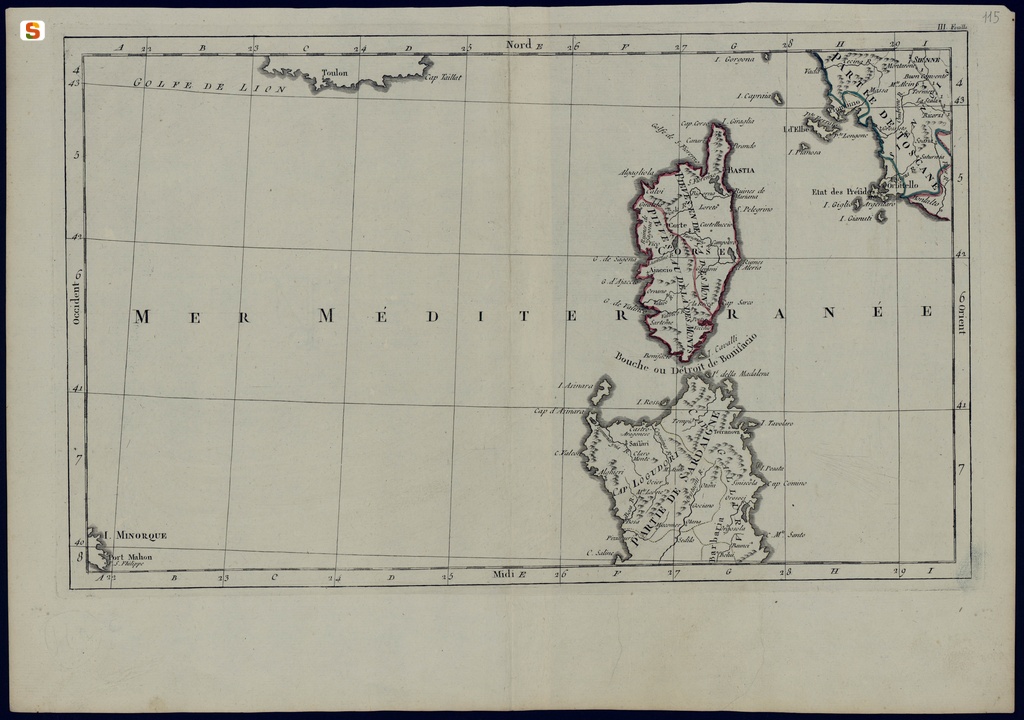
In 1877, the work “Sardinia and Corsica”, the result of Carlo Corbetta's travel experience, was published in Milan for the publisher Brigola. Like others before him, in the preface he hurries to declare the 'randomness' of his work, which initially 'was not destined to leave his writing' but which then, due to 'the flattering requests, the sweet violence of some friends, and the ill-fidious advisor of throwing himself, albeit late, into the public arena' he decides to print it. He therefore puts in writing his observations, the “news collected here and there”, in a large volume, of more than six hundred pages, which he hopes will “give rise to the desire to visit and study these Italian islands that are so little known and that they deserve it so much”. Both the section concerning Sardinia and the one concerning Corsica are divided respectively into two parts, a generic one that includes history, customs and flora; one that instead tells more detail about the journey, focusing in great detail on the various geographical regions of the island.
According to Corbetta, the causes of Sardinian illnesses are not to be found in the population (“it is not these populations to blame if they have not yet gone through the entire cycle of uncivilization”), but in the succession over the centuries of dominations that have only been able to impose taxes and tributes on the island, preventing its development. The work, therefore, started with the intention of being a collection of data and statistics, is enriched with historical and social considerations, with reflections, which make it smooth and pleasant, despite the repetition of well-established stylistic features and forms in travel literature, such as the series of hypotheses on the origin of the Nuraghi, which takes up the pages of General Della Marmora. The description of Cagliari is particularly accurate, to which he dedicates pages that are not very enthusiastic to tell the truth, even if he recognizes its value as a historical and cultural capital. In particular, he recounts the long-sought encounter in a dark castle house with Canon Giovanni Spano, of which he will always keep a “dear and reverent memory”.
The journey, divided into different itineraries, covers the entire island and ends in Santa Teresa, where after waiting for the right sirocco breeze, Corbetta sails to Corsica.
Update
Video


 Facebook
 Twitter
 LinkedIn
 Whatsapp

 Print
Print
 E-mail
![[Corsica e Sardegna settentrionale], III Feuille di un atlante francese non identificato](https://dam.sardegnacultura.it/DAM/iiif/2/659c4e2a-f0c6-41c4-a357-c9c902be8672/full/300,/0/default.jpg)


Comments