Subjects





In Sardinian pastry-making, decoration is not merely ornamental; it defines the pastry and renders it recognizable within a system of signs shared by the community. Indeed, with ritual pastries, it is the decorative elements that distinguish a festive product from its everyday counterpart and mark the difference between an ordinary occasion and a culturally codified moment.
Decorative techniques center on two main processes: shaping the body of the pastry into figurative forms, and applying glazes or coatings to the surface. These two processes are not mutually exclusive; in some cases, they may coexist on the same product (as seen with *candelaus*).
Shaping primarily involves almond paste or shortcrust pastry—materials worked either freehand or with molds to create plant, animal, or geometric forms.
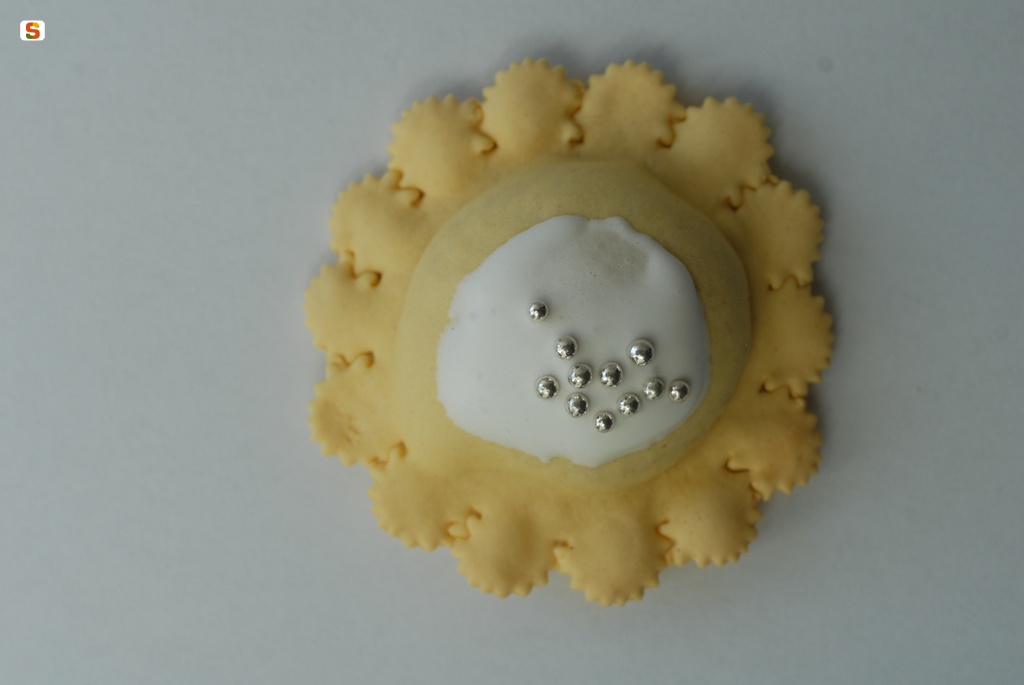
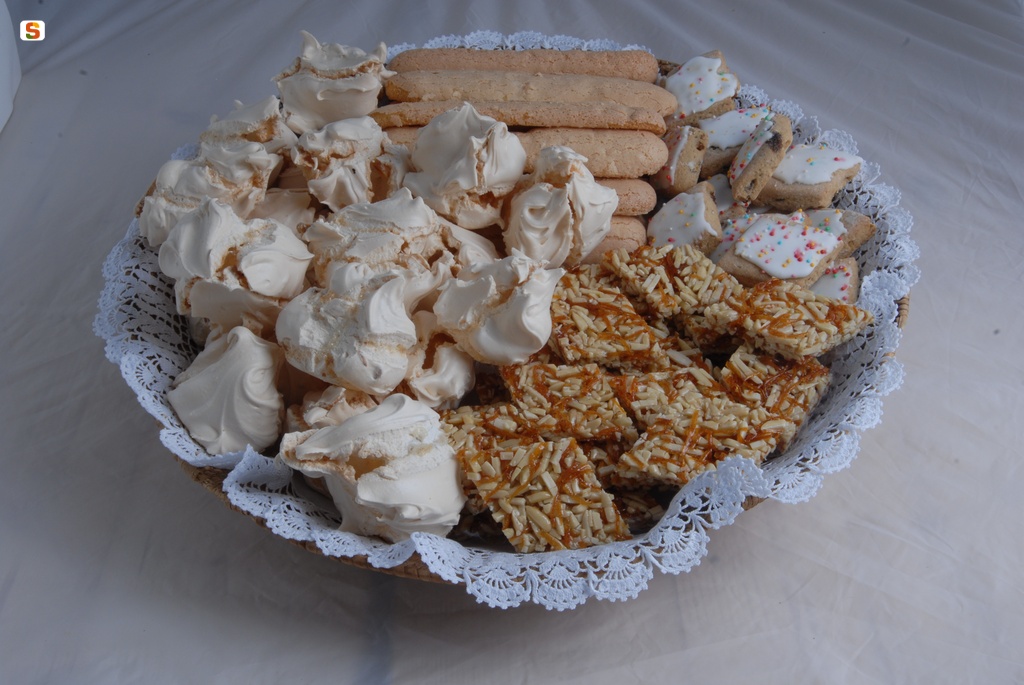
The application of glaze (*sa cappa*), on the other hand, concerns the surface finish of the pastry after it has been shaped and baked. Royal icing (made from egg white, powdered sugar, and lemon juice) represents the most refined decorative technique in Sardinian ceremonial pastry-making; it is applied using a paper or cloth piping cone that acts like a pen nib, allowing for the tracing of fine lines, intricate patterns, and personalized initials. In *candelaus* from the Campidano region, royal icing is applied over an initial sugar-water glaze that sets the surface. In *pastissus*, royal icing is used to create filaments and raised details, resulting in a play of three-dimensional textures. *Pistoccheddus de cappa*—which originated in Serrenti but are found throughout the island—are entirely coated in white glaze and finished with *tragera* (sugar sprinkles) and *indoru* (edible gold leaf).
The repertoire of decorative motifs draws upon a visual vocabulary shared with other forms of Sardinian craftsmanship. Rosettes, plant-like motifs, and geometric grid or diamond patterns appear frequently in pastries, textiles, and woodwork alike. This convergence does not necessarily imply direct derivation; rather, it points to a shared ornamental system spanning various techniques and materials—one that manifests consistently in domestic creations. Pastry decoration is traditionally a skill held by women; in its various individual styles, it is usually passed down within informal settings or during ceremonial occasions.
There is a direct link between the complexity of the decoration and the significance of the occasion: wedding pastries are the most elaborate, followed by those made for Easter, baptisms, and confirmations. Everyday pastries or those for routine consumption are left undecorated. This distinction is no coincidence: the attention paid to decorative detail is proportional to the social importance of the event, and the decoration itself signifies the collective effort invested in the preparation, the item's value as a gift, and the respect shown to the recipient.
Bibliography
S. Spiggia, Le Api nella Tradizione Popolare della Sardegna. Sassari, Carlo Delfino Editore, 1997, pp. 57-64.
Mandorlicoltura in Sardegna. Le varietà autoctone della Sardegna. Cagliari, Agenzia LAORE, 2021, pp. 40-57.
Formaggi di Sardegna, a cura di M. Venusti. Cagliari, Agenzia LAORE, 2010.
Dolci in Sardegna. Storia e tradizione. Nuoro, Ilisso, 2011.
D. Turchi, Le Tradizioni Popolari della Sardegna. Roma, Newton Compton Editori, 2016.
G. Marongiu, Mandigos, gustos e licanzas. Selezione di ricette della tradizione orale della Sardegna. Vol. 1 e 3, Cagliari, Agenzia LAORE, 2020.
Update
Images
Video
Audio


 Facebook
 Twitter
 LinkedIn
 Whatsapp

 Print
Print
 E-mail


Comments