Subjects





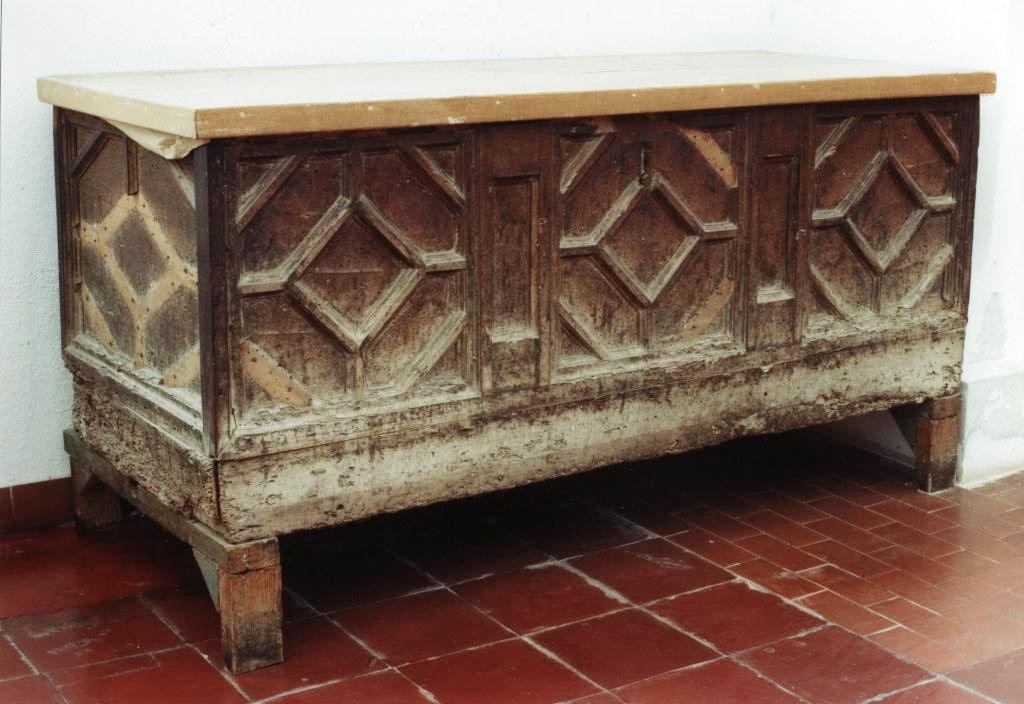
A less archaic model of Sardinian cash is the one that originated in Santu Lusorgu, the center of Montiferru, between Macomer and Oristano, from which it takes its name. The Lussurgese typology is developed mainly horizontally, in this way it can be easily combined with the model of the Tuscan wedding box.
A less archaic model of Sardinian cash is the one that originated in Santu Lusorgu, the center of Montiferru, between Macomer and Oristano, from which it takes its name. The Lussurgese typology is developed mainly horizontally, in this way it can be easily combined with the model of the Tuscan wedding box. It, made mainly of chestnut wood, has roughly a frame placed around the front panel kept clear of decorative interventions; a frame supported by an accentuated and projecting lower base, entirely carved. The overall idea is of a phytomorphic festoon, densely carved, to mark the front edges of the furniture. Also openable in the open, it underwent a treatment (goat or ox blood used to bite wood) similar to that of the barbarian box. Like this one, it rested on easels but the feet could be the most varied in shape, to the point of imitating even classic models, such as a lion's paw. In the Lussurgese box, the imagination of the carving motifs, freer than the barbaric ones, is all concentrated in the frame: this is where you can find surprising elements, such as in an eighteenth-century specimen kept by private individuals in Scano Montiferro, two mermaid figures (the reference is still to the Tuscan box, in the reworking of the anthropomorphic theme of the grotesque). Comparable to the Lussurgese model, in their overall morphology, are the boxes made in Oliena starting from the period characterized as Jesuit (first half of the 18th century). In this case, the front panel is decorated with a circular rose pattern, inspired by the decoration of the consecrated host. The color of the Jesuit case is brick red and none of the geometric patterns found follow the traditional archaic ones, while maintaining a general air
Update
Images
Audio


 Facebook
 Twitter
 LinkedIn
 Whatsapp

 Print
Print
 E-mail


Comments