Subjects





Gaston Vuillier (1846-1915) is a well-known and beloved French portrait painter, who illustrates works by Chateubriand and Mérimée, essayist and collaborator of several magazines, for one of which - the “Journal de voyages” - he travels to the Balearic Islands, Corsica and Sardinia, writing various services that he will collect in a book, entitled “Impressions de voyage” published in Paris in 1893.
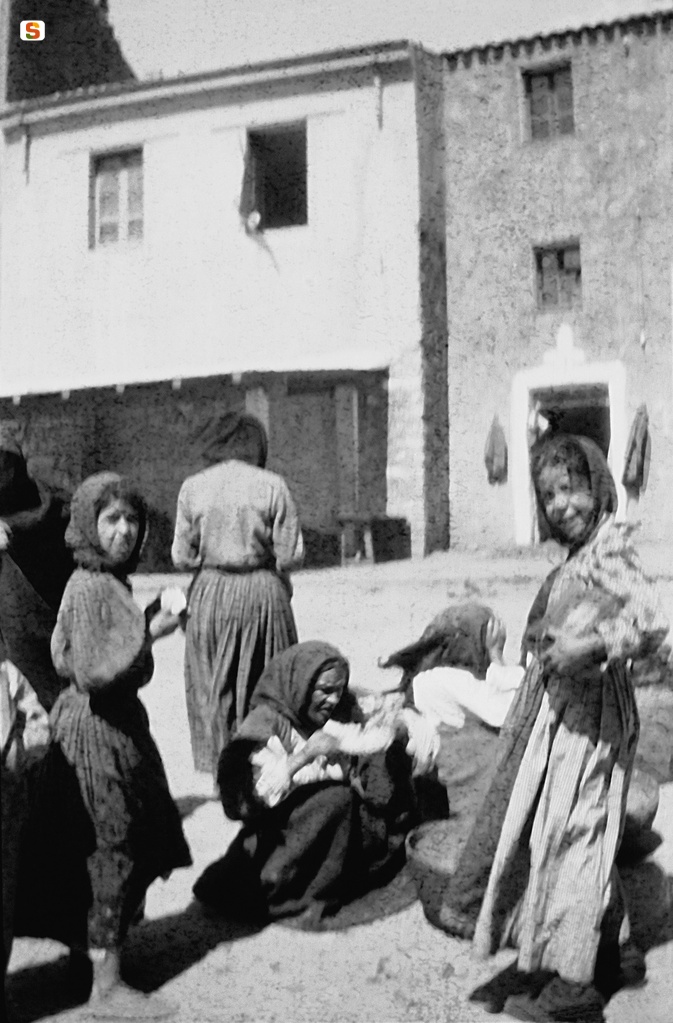
“Sardinia was a dazzling vision: in this land unknown to the Italians themselves, where the costumes of other times have preserved their original beauty, I became familiar with the velvet farsetto, and the Middle Ages spent every day by my side, as if the world had not rotated for four or five centuries.” With these words in the note to the reader, Vuillier anticipates his visual, icastic writing, where his aptitudes and qualities as a painter pass through osmosis to the pen, in a book full of characterizations, strong images, colors. He arrived in Porto Torres and when, after a storm at sea, he saw the island's coasts for the first time, he entrusts his feelings to a watercolor: “The sky turned pale pink and shapes of mountains were painted in front of us. This is Sardinia.” But then he notes that the first town he visits is “sad and poor, with low houses, where you see clueless children wandering around, and its port looks like a pond.”
Dead water is a real obsession for French people, who see malaria as the cause of the cloak of poverty that oppresses the island, devastating the health of its inhabitants and becoming the symbol of an ancient oblivion, which the ancient rulers perpetrated among themselves and which now continues with the unitary State, which in the months of its journey is now thirty years old.
This sometimes obscures the colors of its pages, which light up especially in the descriptions of nature, of the forests that are still thick and numerous, of the colorful costumes of the countries. The Vuillier also describes the cities: Sassari, 'the enchantment', Alghero, where it has 'the full illusion of Catalonia', and a windy Cagliari, in which it comes alive when visiting the Castle and the cathedral, described carefully in the interiors. Living images, enriched by sixty-eight engravings, collected in a work that, together with that of
Edwardes, closes a cycle on travelers, that of the nineteenth century, which will reopen in the following century with different “looks” and perspectives.
Update
Texts

Author : Fontana, Paolo <1951- >
Author : Fontana, Paolo <1951- >
Results 2 of 1589919
View All
Video


 Facebook
 Twitter
 LinkedIn
 Whatsapp

 Print
Print
 E-mail

Comments