Subjects





Based on the information found in the sources, the consistency of medieval painting in Sardinia must have been much greater, even in relation to works on panel, as well as frescoes: the former lost in their entirety, the latter surviving in small numbers.
In the palatine church of Santa Maria del Regno in Ardara (consecrated in 1107) there were wall paintings whose chronology was no longer fully verifiable: a “Final Judgment” ascribed to the twelfth century, canonically placed on the counterfaçade; sixteenth-century panels with Apostles and Doctors of the Church, after restoration relocated to the cylindrical pillars of the tri-vaulted room; figures perhaps of clients, painted in the 15th century on the wall where the apse opens.
With good reason, therefore, Dionigi Scano felt that “the impression of dark and grave”, inside the church entirely made of brown trachyte ashlars, was “diminished, if not eliminated, by the paintings, which had to decorate the walls” and thus redeemed the unicum of the grandiose pictorial altarpiece, signed by Giovanni Muru and placed in 1515 on the main altar.
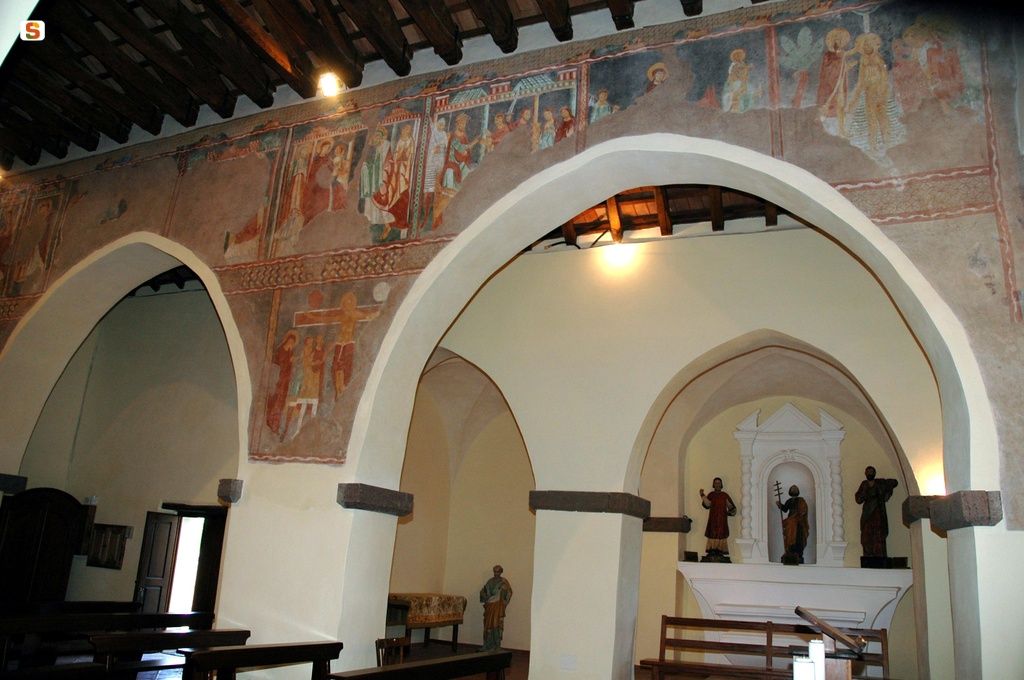
Inside the San Pietro di Zuri, until the last century, “from the various crustations of the walls escaped those who wanted to argue that these were frescoed”, while in the cross vaults and in the apsidal basin of San Nicola di Trullas (Semestene), the removal of modern plaster has brought to light medieval frescoes, referring to Roman craftsmen of the first decades of the thirteenth century.
In Galtellì, in the church of San Pietro, and in Orosei, in the church of Sant'Antonio, such an operation brought frescoes from the thirteenth and fourteenth centuries respectively, unfortunately abundantly pounded with chisels to facilitate the adhesion of the superimposed plaster.
Although known for some time, the most representative medieval frescoes in Sardinia remain those that are preserved in the middle apse of the Abbey of the Holy Trinity of Saccargia. Although the proposal to identify a synthesis between Catalan and Tuscan ways has been put forward, the attribution to Pisan painter from the second half of the 12th century still seems valid.
Update
Texts

Author : Filippini, Francesco
Author : Filippini, Francesco <1874-1951>
Results 2 of 1419382
View All


 Facebook
 Twitter
 LinkedIn
 Whatsapp

 Print
Print
 E-mail
Comments