Subjects





In Bosa is called Karrasegare, a term also used to indicate the three final and most important days of the festival: Sunday, Monday and Tuesday. It is the festival of the community, in which social roles are less rigid, characterized by parodistic and satirical aspects: a collective staging through the performance of satirical songs.
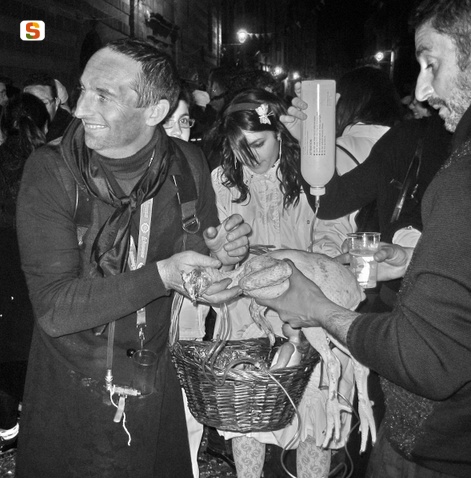
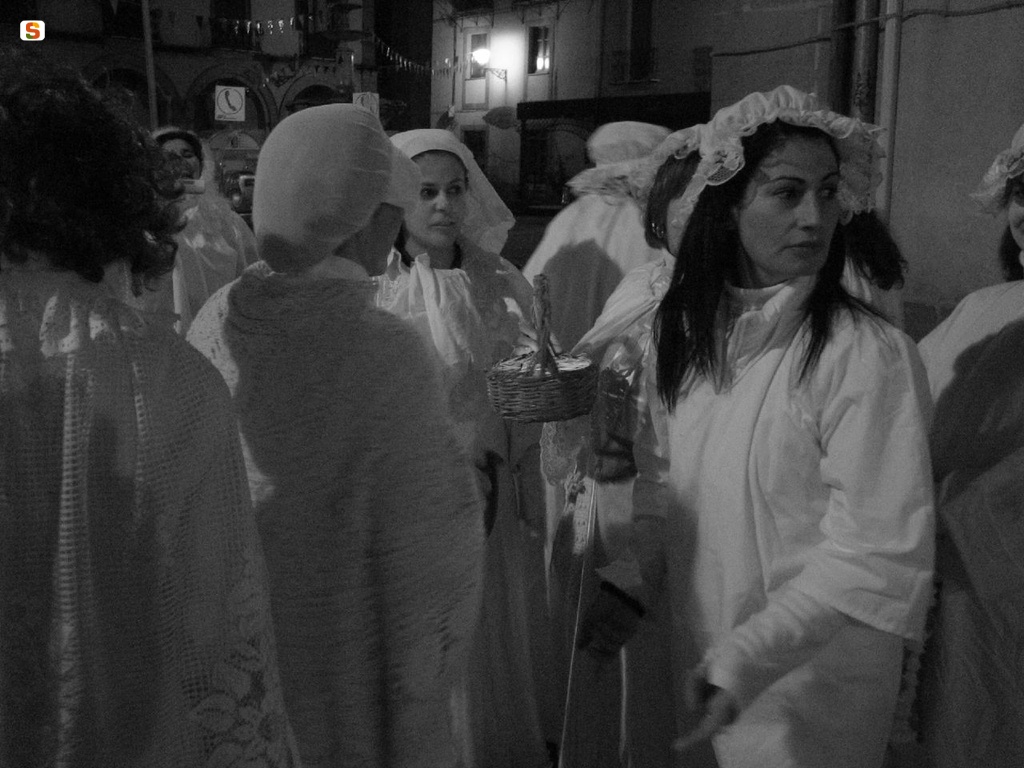
It begins a week before Shrove Thursday (lardazholu or laldaggiolu) when some masked groups go from house to house begging for food and drink (sa palte 'e sing) improvising satirical songs based on the structure of traditional songs. In exchange, they get meat, sausage, cheese, fruit and desserts to serve up dinner. Shrove Tuesday is dedicated to the parade of the entire masked community. The main characters are Gioldzi (King George symbol of Carnival) represented by a rag puppet with a beating in the belly and the masks of 's'attittidu' (funeral lament). From the early hours of the morning, the participants invade the streets and the Slickers, dressed completely in black, announce the death of Gioldzi, portrayed by an often dismembered doll carried in her arms or on a wheelbarrow. Their moans resound in the streets, producing a particular sound effect. The spectators are involved in the fashion show and sometimes annoyed by the protagonists: the Slickers ask the public for a drop of milk (unu tikkirigheddu de latte) for the newborn Gioldzi, abandoned by his mother distracted by the party. Dances and songs are staged, characterized by satirical and irreverent verses. When the sun goes down, there is a change of scene. The Slickers give way to the masks in white, the souls of the Carnival that is coming to an end, who wander the streets with lanterns in search of Gioldzi who, once found, is then burned at a stake that symbolizes collective purification.
The masks
Gioldzi: King George, represented by a puppet made of straw and rags with a barrel instead of a belly.
S'Attittadora: the preaching that sings and laments in honor of the deceased, with her face painted black with burnt cork (s'oltigiu brusiadu), dressed in mourning with a long skirt, bustier and shawl. She carries a doll in her arms that represents Gioltzi, a hungry newborn.
The masks in white: covered with a white sheet and a white pillowcase that acts as a hood, the face painted black, a basket or a lantern in your hand.
History
In the past, the Bosa Carnival began on New Year's Eve with the opening of the dance halls that continued their activities until the night of Shrove Tuesday, with a small revival on the occasion of the Pentolaccia festival during the first Sunday of Lent. From New Year's Day until Easter, all Sundays were considered holidays, the last two days of Carnival (Monday and Shrove Tuesday), Shrove Thursday, the Thursday before Shrove Thursday and, finally, Saturday and the first Sunday of Lent. The protagonists, with their faces blackened by soot, a headdress and an upside-down jacket, paraded behind the wagons.
Update


 Facebook
 Twitter
 LinkedIn
 Whatsapp

 Print
Print
 E-mail


Comments