Subjects




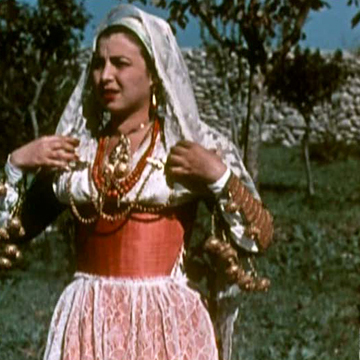
In traditional Sardinian clothing, the button had different functions: in pairs it closed the neck of the shirt; sometimes it was used to close the cuffs of the shirt, while, passed through buttonholes, it closed the sleeves of the jacket at wrist height. A series of buttons, varying in number from seven to twelve per sleeve, made up the buttonbox of the women's festive dress in Logudorese.
In traditional Sardinian men's and women's clothing, the button had different functions: in pairs (twin buttons) it closed the neck of the shirt; sometimes it was used to close the cuffs of the shirt, while, passed through buttonholes, it closed the sleeves of the jacket at wrist height. A series of buttons, varying in number from seven to twelve per sleeve, made up the button box (log. 'buttonera') of the women's festive dress in Logudorese.
As for the material, silver is the most used, even if gold examples are not uncommon. As far as the shape is concerned, several main types can be identified: a sphere with symmetric caps, a slightly flattened spherical shape (pomegranate), a pine cone with a lower hemispherical shell and a conical upper shell and a circular plate.
Regarding the spread, in principle, it can be seen that spherical and pomegranate shapes are widespread throughout the island, albeit with areas of greater or lesser presence, while the type with a conical upper shell has mainly Nuoro as its area of diffusion, so much so that this particular button is referred to as “Nuoro style”. With the exception of the plate type, consisting of a silver disc, if not directly of a coin with the suspension support consisting of a chain or an articulated element ending with a T-hook, all the buttons consist of the union of two hollow elements welded for the base: two hemispheres, or a hemisphere and a cone element.
As for the construction technique, four basic models can be distinguished: in smooth foil, in perforated foil with floral and geometric patterns imprinted with a chisel (hammered type), in filigree by day with double opposite spirals arranged inside teardrop shells, in a mixed technique with a lower shell in filigree “in the open” and the upper shell in foil covered with filigree “at night” wrapped in a spiral. The construction process of the button always involves the flat construction of the individual components. In practice, we begin with the construction of flat circular elements with a predetermined diameter in order to obtain finished objects (in foil or filigree) of approximately predetermined weight and then to give the appropriate curvature by means of the buttons inside which the discs are compressed by means of funnels; then the parts - made hemispherical - are welded for the bases. The welding is followed by the possible application of granules and the bezel on the upper shell intended to house the stone (generally turquoise or faceted garnet). A separate mention must be made of the type of button 'Nuorese'. For the construction of this button, only the lower shell is built with the procedure just described. The upper sheet shell is shaped on a conical iron support; welding then follows and then the application of the bezel and filigree in a spiral from top to bottom and its union with the lower hemispherical element equipped with a suspension hook. The weld circumference is then finished and masked with thick foil decorations and finished in a pin with grooves. The insertion of the stone on the bezel and polishing to remove traces of oxide complete the processing cycle.
In many centers, filigree or plate buttons were used to close and at the same time decorate the men's jacket on the front; even in this case they made up the button box.
Update
Images
Video
Author : Serra Fiorenzo

Year : 1975
Results 2 of 47767
View All
Audio


 Facebook
 Twitter
 LinkedIn
 Whatsapp

 Print
Print
 E-mail


Comments