Subjects





A chronological distinction characterizes the judicial churches. It is possible to identify an initial Romanesque period, which can be placed between 1050 and 1150 and characterized by the presence of workers who come from Pisa, accompanied by those from Lucca (as in the church of San Giovanni di Viddalba) and by the Catalan and Provençal ones who arrived following the monks of the abbey of San Vittore in Marseille (San Saturnino in Cagliari, Sant'Efisio di Nora near Pula).
During this period, large buildings were built and there was a tendency to favor the structural aspect over the decorative one. The most significant buildings of the period are San Gavino di Porto Torres, Santa Maria del Regno di Ardara, Santa Maria di Bonarcado and the cathedrals of S. Simplicio di Olbia, Santa Giusta and Sant'Antioco di Bisarcio (Ozieri).
This period of experimentation was followed by that of mature Romanesque, between 1150 and 1250, in which a deeper connection with Pisa was expressed, guaranteed by the circulation of workers between the island and the mainland, and by the massive presence of merchants who played an important role in the economic and political fields.
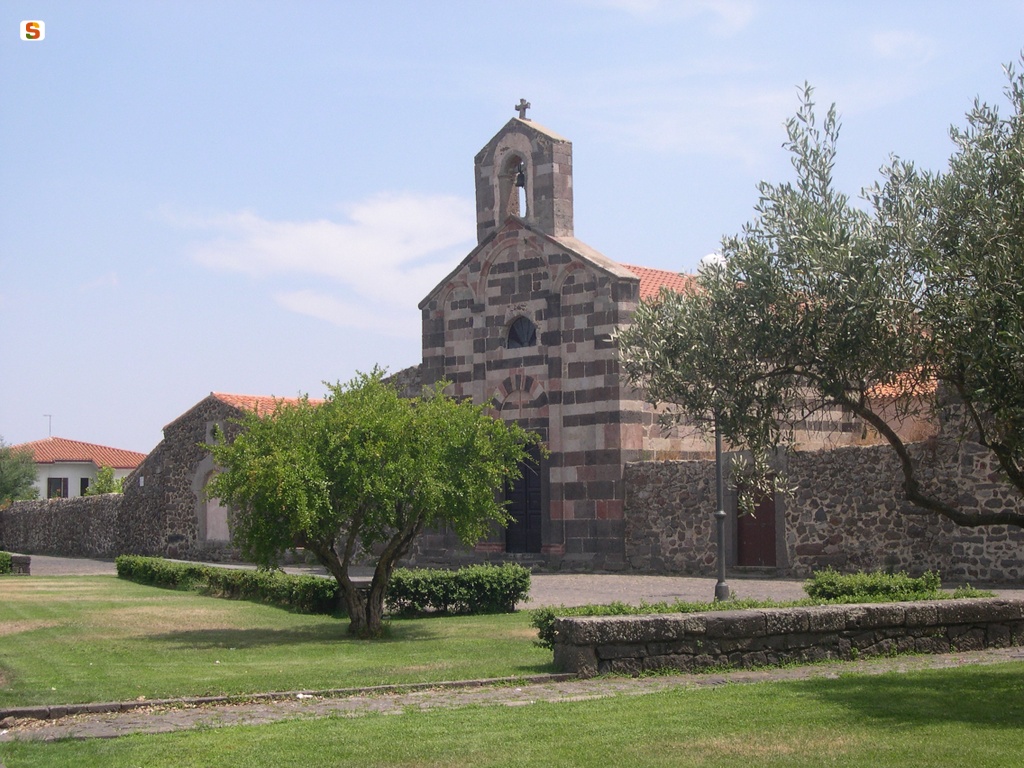
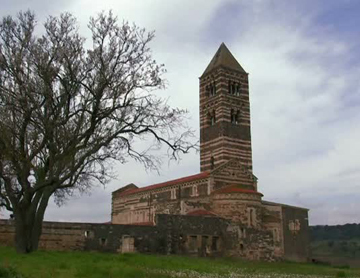
Starting from the church of San Nicola di Ottana, a building that mediates between the two moments, the application of new solutions is recorded, with the creation of grandiose buildings in which the trend towards architectural decoration finds more and more space. More evident in the facades, the new decorative system involves the creation of false overlapping loggias, which find their most complete expression in San Pietro di Sorres. From 1160, another innovation intervened, with the diffusion of the bichrome work, consisting of the alternation of rows of dark stone (volcanic in different shades) and light stone (calcareous). The best known and most significant examples of this technique are the Holy Trinity of Sacchargia, Santa Maria di Tergu and San Pietro del Cruciisso in Bulzi.
A third phase is that of the late Romanesque period, between 1250 and 1300, characterized by the insertion of Gothic decorative elements in a still Romanesque structure. This is justified by the fact that in Sardinia the advent of Gothic did not radically change the methods of construction, but was inserted into the Romanesque cultural fabric in continuity with it. At an early stage, the changes mainly affected surface elements, such as the shapes of hanging arches or windows or legs, which took on a more elongated appearance.
The expansion of the Santa Maria di Bonarcado is representative of this last phase, which can also be seen in the reconstruction of the cathedral of San Pantaleo di Dolianova, in San Pietro di Zuri (Ghilarza), in whose factory the master Anselmo da Como worked, and in the church of San Pietro Extra Muros in Bosa, where the presence of Anselm himself and his workers can be identified.
Update
Video


 Facebook
 Twitter
 LinkedIn
 Whatsapp

 Print
Print
 E-mail


Comments