Subjects





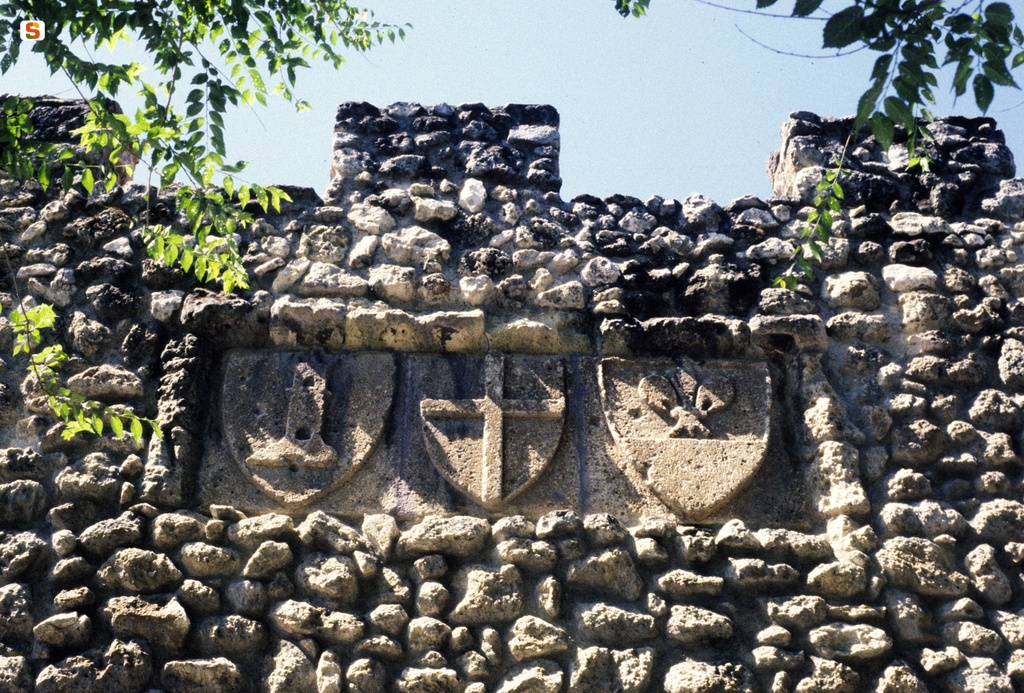
The walls of Sassari are now incorporated by the urban expansion of the city, capital of the province and second in Sardinia in terms of number of inhabitants.
The walls of Sassari are preserved today only in a small part, but they also evoke the city's medieval past, characterized by a strong autonomist drive, culminating in the elevation to a free municipality, the only example in Sardinia of the affirmation of that mercantile class that elsewhere in Italy gave birth to significant forms of local government.
The original circle dates back to years before 1278, when according to tradition five villages, which belonged to the parishes of the historic center, were merged to create a single urban center, gathered around the church of San Nicola, which in 1441 became the cathedral of the Turritan diocese, inheriting the ancient role of the Basilica of San Gavino.
The walls were certainly strengthened around 1236, when Sassari gave itself the municipal statutes, from which it appears that citizens were required to pay an annual tax for their maintenance and that foreigners had to pay a toll to enter the city.
The wall was built of limestone, had a pentagonal shape and a length of about 2 km. It consisted of 35 quadrangular towers and a circular one called Turondola. The towers were in square blocks, equipped with wooden floors with the open part facing the city; they were crenellated and had loopholes. The Turondola, unlike the others, was structured as a central pillar with radiated vaults.
The doors opened at the four cardinal points: to N the door to Sant'Antonio, to E the door to Macello or Rosello, to O the door to Utzeri, to S the door to Capu de Villa, then called Porta Castello. In 1616, a door was opened on the side of the University at the request of the Jesuits, called Porta Nuova, so that students could access the college from the countryside.
The constant care of the walls in the fourteenth century, with the imposition of duties for the fortifications, and the interventions throughout the sixteenth century were not enough to preserve it from decay. Concessions to private individuals and religious congregations date back to the 16th century, who transformed towers into houses, with the consequent decline and the obvious loss of effectiveness for defensive purposes. In 1694, there were countless openings in the walls, as recalled by a letter sent by the mayor to the Madrid court. In 1712, under Austrian rule, a restoration was carried out and another in 1730 under the Savoy.
The master plan of 1837 caused the opening of numerous gates, but it was only in 1844 that the section near Porta Castello was demolished. In 1853-56 the Rosello gate was torn down, and in 1857 the Utzeri gate. In 1863, the Carmel porch was opened. This was followed in 1866 by the demolition of the Porta di Sant'Antonio and in 1874 that of Porta Nuova. The nineteenth-century photographs of Delessert still show the doors of Rosello and Sant'Antonio.
History of studies
On the urban history of Sassari, the most complete study is by Marisa Porcu Gaias (1996). The contribution of Alma Casula (1989) is always useful on the walls.
Bibliography
V. Angius, voce ''Sassari'', in G. Casalis, Dizionario geografico storico-statistico-commerciale degli Stati di S.M. il re di Sardegna, XV, Torino, G. Maspero, 1849, pp. 45-47;
G.F. Orlandi, Thathari, pietra su pietra. Sassari dalle origini al XIII secolo, Sassari, 1985;
A. Casula, "La cinta muraria e alcune testimonianze del periodo romanico e gotico'', in Sassari: le origini, Sassari, 1989, pp. 139-144;
F. Segni Pulvirenti - A. Sari, Architettura tardogotica e d'influsso rinascimentale. Nuoro, Ilisso, 1994, scheda 14;
M. Porcu Gaias, Sassari. Storia architettonica e urbanistica dalle origini al '600, Nuoro, Ilisso, 1996, pp. 52-57.
Update
Images
Author : Anedda Gianluigi

Results 2 of 119956
View All


 Facebook
 Twitter
 LinkedIn
 Whatsapp

 Print
Print
 E-mail
Comments