Subjects





Archaeological excavations in various areas of coastal cities characterized by a long urban history have brought to light churches with a longitudinal structure and baptisteries, which do not seem to have existed before the 5th century. This is the case, among others, of the basilicas of Cornus, Tharros, Nora and Porto Torres, typologically late-antique buildings dating no later than the 7th century.
In the town of Columbaris, near Santa Caterina di Pittinuri, starting from the sixties of the last century, first occasional earthworks, then regular excavation campaigns have highlighted the impressive Episcopal complex of Cornus: a mononave basilica, equipped with a baptistery, and two other churches with a longitudinal structure, one of which was later transformed into a baptistery; the latter were trinavated and apsidated one in the west and the other in the east.
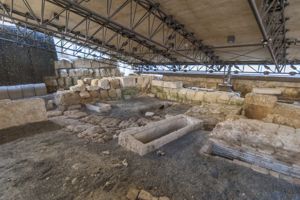
In the municipality of Cabras, in the archaeological area of the ancient Phoenician-Punic and then Roman city of Tharros, the ruins of a tri-naved basilica with an apse to the west and of an octagonal baptistery were brought to light.
In more recent years, the resumption of archaeological investigations in Nora has allowed the identification of a tri-naved Christian basilica with an apse to the west, not far from the thermal baths to the sea.
The archaeological situation of the area of the Basilica of San Gavino in Porto Torres is more complex, where excavations from the sixties of the last century found, under the north aisle of the Romanesque building, part of a late-antique church with three naves and an apse to the west; this is accompanied by the other, a large tri-naved church but apsed to the east, excavated in the nineties in the external area adjacent to the same side as the Romanesque cathedral.
To these first examples of churches characterized by their longitudinal structure, which became canonical in the Latin context throughout the Middle Ages, are added less characterized contexts and buildings, as their structure derived from the consistent reuse of pre-existing structures.
Update
Texts

Results 2 of 1011148
View All


 Facebook
 Twitter
 LinkedIn
 Whatsapp

 Print
Print
 E-mail
Comments