Subjects





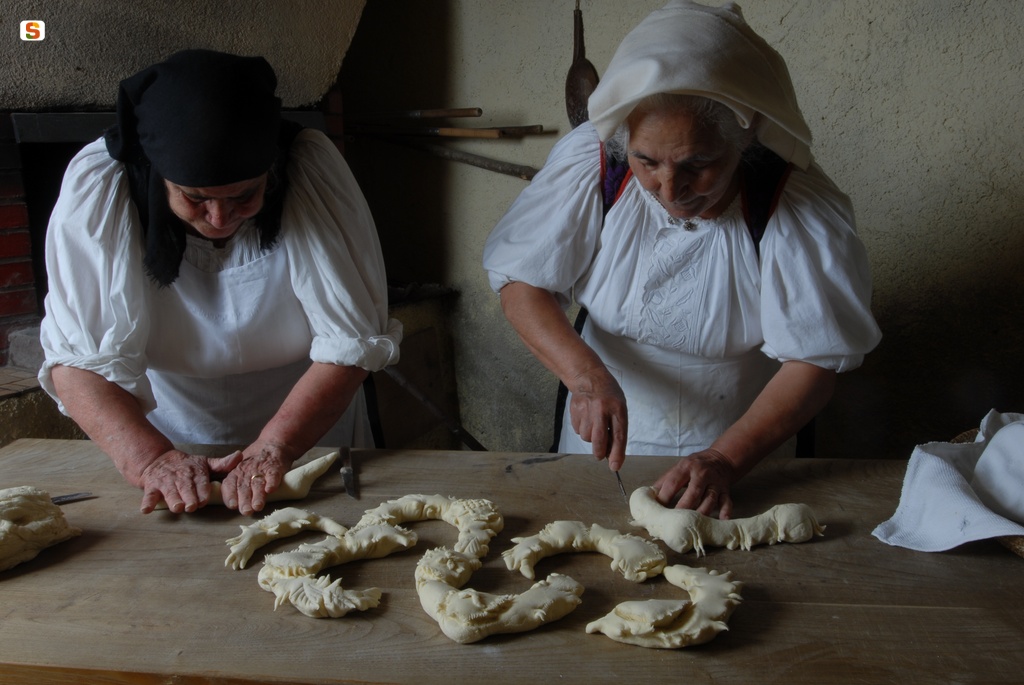
Among the ritual breads characteristic of Lent and especially of Holy Week are those that reproduce the Arma Christi, or the instruments of the Passion of Christ (the nails, the crown of thorns, the cross and the ladder). In particular, the cross, due to the depth of its symbolism (a means of the extreme sacrifice of Agnus Dei), holds particular importance within this category of breads. The loaves of Lent reproducing the Arma Christi find a suggestive comparison with the symbols invested in the processions of the Mysteries that in some places on the island (e.g. Castelsardo, Iglesias, etc.) reach extraordinary levels of suggestion. In Galtellì, on Holy Thursday, sa Corona is eaten in the confraternity, a round bread in the center of which a large cross stands out, while on the sides there are numerous artichokes. To understand the meaning of the presence of this plant symbol, it must be remembered that, in the iconography of the Church, the thistle and the artichoke become symbols of original sin and, above all, of the Passion of Christ as thorny plants.
In some centers of the island, such as Teulada, to thank God for the harvest of the previous year and to propitiate that of the current year, the farmer would bring sweetened bread in the shape of a cross, sacruxi de Pasca, to cross the field and at all four ends, after being marked, he would break an arm with his hands and crumble it on the ground. He would bring home the remaining bread and eat it with his family members with the hope of being able to eat another similar one the following year.
The fact that the cross, the instrument of Christ's capital torture, is used for propitiatory purposes precisely on Easter day should not be surprising. In fact, with the Resurrection, the Cross becomes an instrument of Passion, a sign of divine victory, a tree of life. A summary, similar to that of Christ, is made of the story of wheat, which only if it dies bears much fruit.
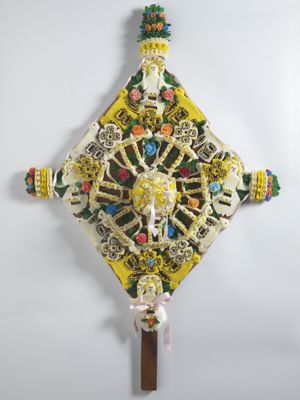
In this same key, we must read the symbols of the Crucifixion (cross, crown of thorns, nails and ladder) in sa pertusita 'e Pasca, a bread that is no longer vital, widespread in the past in the Marghine, Meilogu, Planargia and Logudoro. This circular-shaped bread on which the above-mentioned symbols rested, three-dimensional modeled with bread dough, also contained floral and plant motifs on the surface, a sign of good omen and of the rebirth of nature, based on the Resurrection of God made man.
In the Meilogu, always on the occasion of Easter, it was packaged on càpudes with the symbols of the crucifixion. The base repeated the same vaguely anthropomorphic bread that was consumed ritually in conjunction with the beginning of the new year as a sign of good wishes. The Easter variant was a good omen, especially for the successful harvest.
At Macomer, on the occasion of Palm Sunday, sas rugulitas were prepared, small bread crosses that were often superimposed. They were embedded in a blessed palm leaf, adorned with olive leaves and hung on the jambs of interior doors or windows of houses, where they were left all year round and then replaced the following year. By virtue of the symbolic power of the cross and the palm and the blessed olive leaves, they were believed to have an apotropaic power, that is, the ability to ward off all evil. They were hung immediately after Mass by the hostess, who made the sign of the cross, recited the Creed three times and then the
formula:
I must insert myself in Sa Janna Mia
Cun sas istangas de Santa Lughia
with those distances from Santu Larentu.
Wrinkles in Sa Janna
wrinkles in the window
Yes Ch'at Cosa Mala, Ch'essat Fora
And yes that non ch'end'at, never ch'end'intret.
Anghelos ch'isten and Luca and Mattei,
Azzudaenos, Lord God!
[I lock myself inside my house (lit. 'in my door')/with the rods of Saint Lucy/with the rods of Saint Lawrence./Cross in the door/cross in the window/if there is a devil who comes out/if he is not there, never enter. /Let angels and Saint Luke and Saint Matthew dwell there,/help us, Our Lord].
(Cover image: “The bread made for the occasion is crowned - Galtellì Holy Thursday”, Galtellì. Photo archive (ISRE)
Update
Images
Texts

Author : De Cortes, Antonio
Year : 1900
Author : Luraschi, Arnaldo <1872-1945>
Year : 1940
Results 2 of 1453067
View All


 Facebook
 Twitter
 LinkedIn
 Whatsapp

 Print
Print
 E-mail
Comments