Subjects




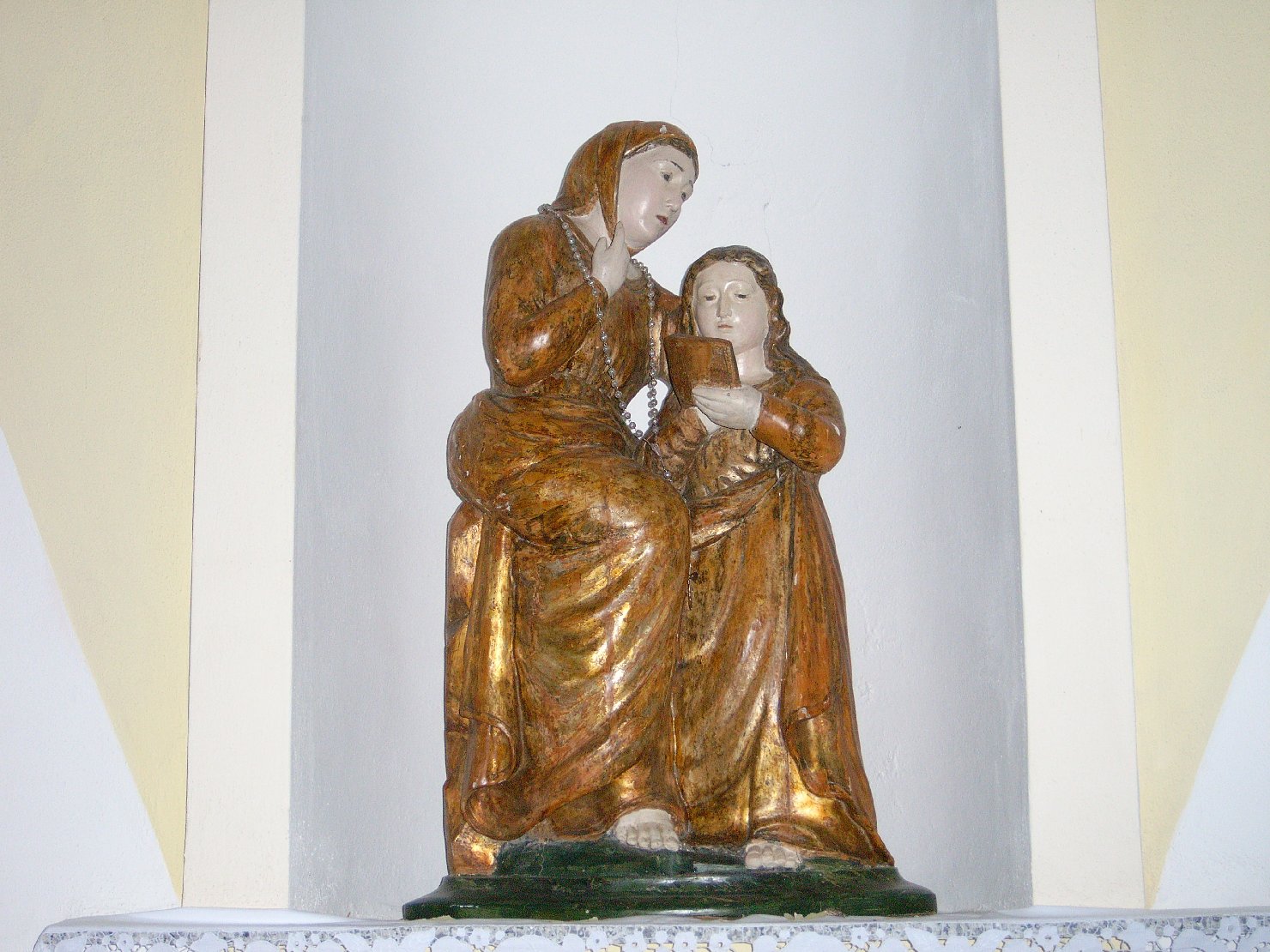
The Catholic liturgy and the Orthodox Church celebrate the birth of Mary on September 8. The Nativity of the Virgin Mary is also known as the Feast of the Infant Mary. Celebrations and festive rites are spread all over the island. Here we will limit ourselves to mentioning, by way of example, a few examples.
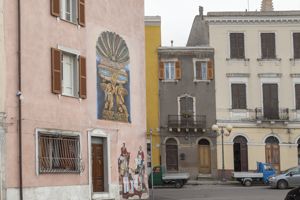
Santa Maria Bambina, who is the patron saint of the town in the province of Sassari, was honored in 2014 with a special mural that represents her, executed by the artist Pina Monne.
Particularly suggestive, during the Bonorvese festival, which lasts three days, is the procession through the streets of the town with the simulacrum of Santa Maria Bambina. In Nule, in the Goceanarium, and in Usini, in the historic sub-region of Coros, the procession is also a moment of folkloric performance. In Usini, the procession that crosses the streets of the town includes not only the Ploaghe musical band, the Usini choir, the Brotherhood of the Holy Cross, but also people wearing the traditional clothes of Uri, Sorso, Ittiri, Sennori, Osilo, Nuoro, Ploaghe, Bitti, Thiesi, Ossi, Burgos, Tissi, Trinità d'Agultu
. Thefestival that celebrates the Nativity of Mary is associated, as in the rest of Italy, with a strong popular devotion. So much so that at Quartu Sant'Elena during the Holy Mass on September 8, all the newborns of the current year are entrusted to Santa Maria Bambina. In the same Quartu Sant'Elena, Santa Maria Bambina is also called Santa Maria Cepola, from the name of the church where the simulacrum that runs through some streets of the city on the same day of the Nativity, accompanied by the musical band and the folk group, is kept. Probably built on the ruins of an early Christian church, the church of Santa Maria Cepola has been documented since the 11th century. “Cepola”, a toponym of uncertain origin but well attested by medieval sources, probably designated a village now incorporated as a neighborhood within Quartu. The name of the place, no longer understood, ended up being used for the purpose of determining the title of Our Lady, or at the popular level deformed into Cipudda (Cipolla), Santa Maria Cipolla
.In Samugheo, for the two days of festivities (7 and 8 September), community life moves to the small country church dedicated to Santa Maria. On the afternoon of the 7th, a long procession starts from the town's parish church and heads towards the country church with the simulacrum of Santa Maria Bambina. Upon arrival inside the sanctuary, the rosary is sung. After dinner, prepared in the Muristenes and eaten near the sanctuary, to the sound of the accordion, the traditional dances start
.Finally, in Siurgus Donigala, a town in the thirteenth century, on the occasion of the celebrations of the Nativity of Mary, we witness the ritual offering of the candle to Our Lady. The town just mentioned stands out from other centers of Sardinia (Sassari, Nulvi, Ploaghe, Iglesias), where the candles of the past are today wooden candlesticks (or Clouds of canes and papier-mâché), as well as for the material, for the occasion of the offering to the Virgin: her Sleeping and Assumption into Heaven and not her Nativity
.The oldest candle in Siurgus Donigala dates back to 1600. Then there are about fifty candles dating back to more recent times, strictly made of virgin wax and offered to Our Lady by the locals. There are also three honored by the communities of Dolianova, Nurri
and Orroli.According to tradition, the festivities include a suggestive procession during which the youngest and strongest of the town's inhabitants carry votive candles on their shoulders.
The religious rite is followed by civil appointments with poetic contests and musical shows.
Update


 Facebook
 Twitter
 LinkedIn
 Whatsapp

 Print
Print
 E-mail


Comments