Subjects





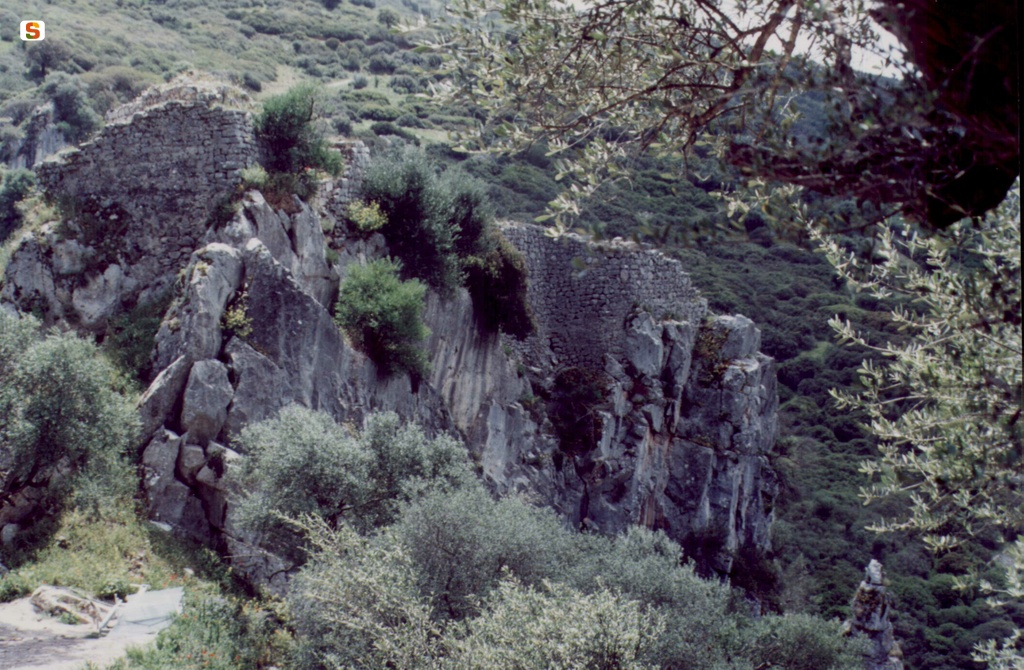
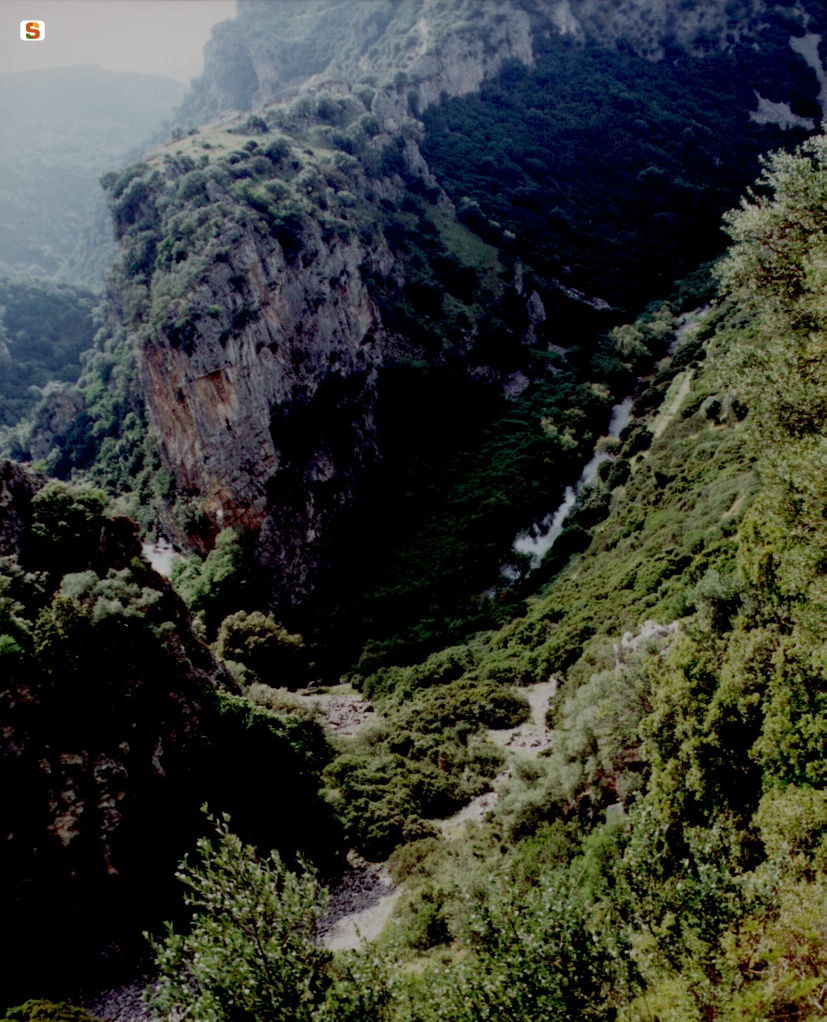
The castle of Medusa rises above the gorge formed by the Riu Araxisi. Going further downstream, this river becomes Riu Majori and gives life to the “Mitza sa canna” gorge, with its limestone walls rich in caves and vegetation. The importance of the fortification depended on the role of controlling the territory and protecting against raids operated by the barbarians who lived in the interior of Sardinia, to the detriment of the rich centers of the plain and the coast.
Archaeological investigations have made it possible to date the first phase of the settlement in the castle of Medusa to the 4th-5th century AD. A second phase is located in the 6th century, while the third dates back to the 7th-8th centuries. The most recent structures were built between the tenth and twelfth centuries.
The first archival mention could be found in a document from 1189, in which reference is made to a “Castrum Asonis” that is probably to be identified with the same fortified structure. In that year, the castle was ceded by Judge Pietro I of Arborea to the municipality of Genoa and after a short while recovered by the sovereign after the promise of a large payment.
The material remains of the fortification are immersed in dense vegetation, making it difficult to analyze them in detail. Only sections of the walls remain, which were supposed to enclose an area of about 540 square meters, a tank, and the remains of two towers.
Numerous legends circulated and still circulate about the presence, in the castle, of an elusive queen Medusa. Among other things, the story, halfway between reality and fantasy, is curious, narrated in a document from the Cagliari Archive. During his detention in a Piedmontese prison in the 19th century, a bandit, Pietro Perseu, told how during his escape he had happened to the ruins of the castle of Medusa and, going down a marble staircase, found himself in a wonderful room full of jewels, weapons and valuables. The bandit wrote to the Minister asking for a pardon if he managed to find the treasure room, but once accompanied to the place he found neither the stairs nor the room, not obtaining a pardon and not even managing to escape.
History of studies
There is very little historical information about the castle of Medusa, despite the legends that have flourished around its origin. Alberto Della Marmora in 1860 and Canon Giovanni Spano in 1861 began the analysis of the ruins, followed by more recent studies by Giorgio Cavallo in 1981 and Giorgio Farris in 1988. The contributions of Foiso Fois and Mauro Perra date back to the nineties of the last century; Dolores Turchi's monograph on the legends that hover around the castle dates back to 1992. Finally, in 2003, there is the article by Joan Armangue y Herrero entitled “Perseus and Medusa in the traditional imagination: treasure searches in the castle of Samugheo”.
Bibliography
G. Spano, ''Castello di Medusa'', in Bullettino Archeologico Sardo, III, 1861, p. 7;
G. Cavallo, ''Il castello di Medusa. Un antico castrum bizantino'', in Archeologia Sarda, 1, 1981;
G. Farris, ''Nel castello di Medusa le impronte di una triste leggenda medioevale'', in Quaderni Oristanesi, 17-18, 1988, pp. 3-17;
F. Fois, Castelli della Sardegna medioevale, a cura di B. Fois, Cinisello Balsamo, Amilcare Pizzi, 1992, pp. 147-151;
D. Turchi, Samugheo: il fascino delle più arcaiche tradizioni della Sardegna centrale attraverso la storia, i racconti, le leggende e le preghiere del paese sul quale aleggia ancora il mistero del castello di Medusa, Roma, 1992;
J. Armangué y Herrero, ''Perseo e Medusa nell'immaginario tradizionale: ricerche di tesori nel castello di Samugheo'', in Roccas: aspetti del sistema di fortificazione in Sardegna: atti degli incontri sui castelli in Sardegna (2002) dell'Arxiu de tradicions, a cura di S. Chirra, Oristano, 2003, pp. 105-120;
G. Serreli, Tutti i castelli dei quattro regni, "Darwin. Quaderni", n. 1 (luglio-agosto 2006), pp. 104-109.
How to get there
The castle of Medusa is equidistant from Samugheo and Asuni. To reach it, leave the SS 131 just before Uras, taking the SS 422. After passing the town of Nureci, take the SP 38 road towards Asuni. After a few kilometers you can see the castle.
Content type:
Fortified architecture
Province: Oristano
Common: Samugheo
Macro Territorial Area: Central Sardinia
POSTAL CODE: 09086
Address: strada comunale Asuni-Meana Sardo
Update
Where is it
Images
Video
Audio


 Facebook
 Twitter
 LinkedIn
 Whatsapp

 Print
Print
 E-mail


Comments