Subjects





The church is in the district that was the hub of political and religious power in Cagliari between the 13th and 19th centuries.
The church was probably built after 1554, when the noblewoman Gerolama Rams Dessena, who together with other daughters of the Cagliari nobility had dedicated herself to monastic life, had the adjacent cloistered monastery built.
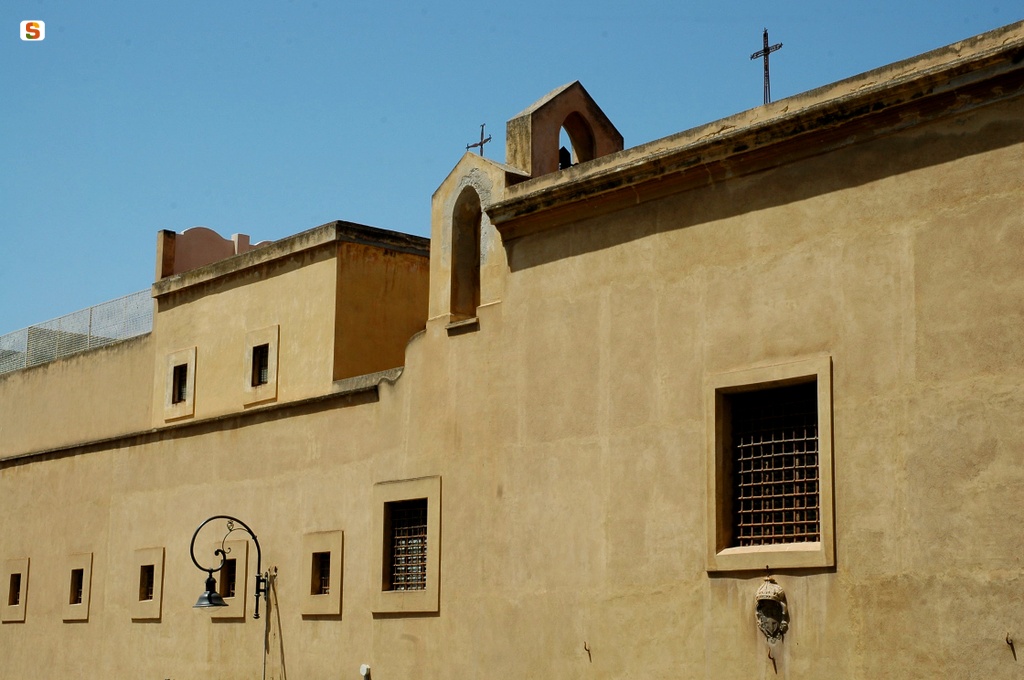
The prospectus on Via Lamarmora appears anonymous, since it is a simple wall devoid of ornaments. The entrance is on the street closed by a wrought-iron gate added during the 1903-4 restorations; beyond the gate, a small atrium, turned like a barrel, on which the entrance portal opens, arched and with an oval lunette on which there is a pointed arch resting on perforated capitals. Above is the noble coat of arms of the Brondo family.
The interior of the church is far from anonymous and indeed stands out for the formal elegance with which the builders followed the precepts of Gothic-Catalan architecture.
The Church of the Most Pure has a single nave divided by a pointed arch into two bays veiled in a cross with a pendulous gem in the center. Connected by means of a pointed arch, the presbytery, small compared to the classroom, has a beautiful starry vault, with hanging ribs and gemstones and stained peduncles. The six chapels, which open on both sides at the first two bays, have a similar star-vaulted roof. The church is illuminated by mullioned windows that open on the side walls and by oculi in the side chapels. Two monastery stands, currently closed, always open on the side walls.
The church remained in use until 1867 when the monastery was suppressed and acquired by the State, which later used it as a school. The monastery was closed, the nuns were scattered, even the church was abandoned and closed to worship. Only in 1903-4, on the occasion of the fiftieth anniversary of the proclamation of the dogma of the Immaculate Conception, was the church chosen for solemn celebrations and restored. Once again forgotten, the church was, in 1933, assigned to the congregation of the “Handmaids of the Holy Family” that still guards it today.
History of studies Formerly
studied by Renata Serra, the church is the subject of a summary fact sheet in the volume by Francesca Segni Pulvirenti and Aldo Sari on late-Gothic and Renaissance-influenced architecture (1994).
Bibliography
G. Spano, Guide to the city and surroundings of Cagliari, Cagliari, Cagliari, 1861;
R. Serra, “The parishes of Assemini, Sestu and Settimo S. Pietro. Notes for a history of late Gothic architecture in Sardinia”, in Proceedings of the XIII Congress on the History of Architecture. Sardinia, Rome, 1966;
R. Serra, “Sardinian-Catalan architecture”, in The Catalans in Sardinia, edited by J. Carbonell-F. Manconi, Cinisello Balsamo, Silvana, 1984;
A. Sari, “The Architecture of the Sixteenth Century”, in Sardinian society in the Spanish Age, edited by F. Manconi, I, Quart, Regional Council of Sardinia, 1992;
F. Segni Pulvirenti - A. Sari, Late Gothic and Renaissance-influenced architecture. Nuoro, Ilisso, 1994, sheet 37;
Archdiocese of Cagliari, series “Churches and sacred art in Sardinia”, Cagliari, Zonza, 1999;
A. Piseddu, The churches of Cagliari, Cagliari, Zonza, 2000;
S. Murgia, Muravera and its churches in archival documents, Dolianova, Graphics of Parteolla, 2005.
Content type:
Religious architecture
Province: Cagliari
Common: Cagliari
Macro Territorial Area: South Sardinia
POSTAL CODE: 09124
Address: via Lamarmora, s.n.c.
Update
Where is it
Images
Video


 Facebook
 Twitter
 LinkedIn
 Whatsapp

 Print
Print
 E-mail



Comments