Subjects





The city lies at the base of a deep ria on the northeastern coast of Sardinia and extends across a stretch of plain on the shore of the gulf of the same name. The city has one of the island's most important commercial and tourist ports and an airport, the "Costa Smeralda," considered one of the most important in Italy.
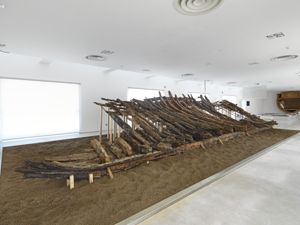
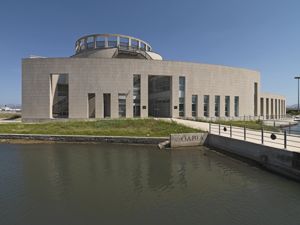
The modern city center largely occupies the site of the ancient city. Monumental remains from the Punic and Roman periods consist primarily of the Punic walls, the Roman aqueduct, and the large Roman shipwrecks currently undergoing restoration and will be exhibited in the Archaeological Museum, currently being completed in Olbia.
The city's archaeological heritage also includes numerous underwater sites. An ongoing survey has identified around a hundred sites that provide a glimpse of the busy stretch of sea in front of the city, not only by large cargo ships but also by small vessels that shipped goods along the coast using short-distance navigation, using sheltered inlets on the coast (Porto San Paolo, Cala Moresca) and coastal islands (Spalmatore, Tavolara) as landing places. One of the underwater finds stands out for its exceptional nature: the head of a life-size terracotta statue of the god Hercules. It is a copy of a lost bronze original that must have been located in the city sanctuary dedicated to the god and was cast in Olbia in the 2nd century BC using matrices.
The visible and visitable section of the Punic walls consists of a rectilinear double-curtain wall, constructed of large granite blocks on the outside and smaller ones on the inside, an access gate, and another rectilinear section from which a rectangular defense tower protrudes, built by enclosing a small natural rock ridge with blocks. Inside the tower is a water collection tank, now re-filled for conservation purposes. Some of the blocks still retain ashlar workmanship, found in other Punic defense structures.
The aqueduct, starting from Cabu Abbas, ran for approximately 7 km and entered the city center from the north along a route that passed through the current Centro Martini, Via A. Nenni, and Vicolo F of Via delle Terme to reach the thermal baths. The remains visible today are located to the south of the paved road in the locality of Sa Rughittula; The water flowed first into a buried conduit, then into a small square basin, from which a section consisting of arches begins, some of which are preserved, and continues with a section of solid wall. On the right of the road is a large rectangular cistern with two naves, almost completely excavated from the rock except for the roof, which still has ventilation holes and portions of the waterproof hydraulic mortar lining. Adjacent to the short sides of the cistern were two other basins and a well for water inlet and outlet.
The area, measuring 120 x 20 meters, where the remains of boats were found, corresponds to the main port of the ancient city, once protected by a long pier that connected the shore to the island of Peddona. Significant quantities of ceramic artifacts from various periods, jewelry, coins, lamps, granite columns, animal bones, fishing tools, and, most importantly, 24 shipwrecks in good condition were recovered, including two from the era of Nero, 16 dating to the 5th century AD, and two from the Judicial period. One of the most important finds was the recovery of an imperial fleet dating to the 5th century. The ships, originally between 18 and 30 meters long, were arranged parallel to each other and perpendicular to the coastline, and sank at the same depth in shallow water. Their position suggested that they were sunk while moored in the harbor, along wooden piers, the remains of which have been identified. This led to the belief that they were all destroyed simultaneously following a major destructive event, as evidenced by the traces of burning on the wood.
History of the Excavations
The first investigations into the city's origins took place in the early 17th century and focused on the cemetery areas near the church of San Simplicio. In the first half of the 19th century, archaeological research began, aimed at acquiring material evidence that was collected in both museums and private collections in Italy and abroad. Canon Giovanni Spano chronicled this activity, which led to numerous discoveries, from 1855 to 1876. From 1880 to 1884, Pietro Tamponi compiled a series of important notes on the archaeological discoveries made in Olbia and its surrounding area. Superintendent Antonio Taramelli also contributed in the first decades.
Archaeological excavations were conducted on a number of occasions in the twentieth century, and Doro Levi in the 1930s. Dionigi Panedda's work in the 1950s was very important, resulting in the two volumes on Olbia in "Forma italiane." From 1958 to 1977, the city was the subject of sporadic excavation and restoration projects, such as those of the first Superintendent of Antiquities for the Provinces of Sassari and Nuoro, Guglielmo Maetzke, between the late 1950s and 1966, and those of Enrico Acquaro in the 1970s. In the years that followed, up until 1990, the Archaeological Superintendency's protection became systematic and continuous. Since 1990, research and in-depth knowledge of the area have been carried out in Olbia, which also includes the monitoring and recovery of archaeological heritage from sporadic excavations both on land and underwater. Unfortunately, the destruction of the ancient city's structures paralleled the development of the modern city. Most excavations in the urban area alone have, and still have, emergency characteristics (fifty in number from 1980 to 1994, under the direction of Antonio Sanciu and then Rubens D'Oriano). In 1992, an emergency excavation uncovered an important funerary area in the Su Cuguttu area. In July 1999, during construction of a tunnel below sea level, the remains of what the three-year archaeological excavation conducted by Rubens D'Oriano, spread along the coastal strip, identified as the wrecks of ancient ships and their cargoes, were discovered.
Bibliografia
D. Panedda, Olbia nel periodo punico e romano, Roma, 1953;
D. Panedda, L'agro di Olbia nel periodo preistorico, punico e romano, Roma, 1954;
R. D'Oriano, "Olbia: ascendenze puniche nell'impianto urbanistico romano", in L'Africa Romana. Atti del VII convegno di Studio (Sassari, 15-17 dicembre 1989), Sassari, Gallizzi, 1990, pp. 487-496;
Olbia e il suo territorio. Storia e archeologia, Ozieri, Il Torchietto, 1991;
R. D'Oriano, "Un santuario di Melqart-Ercole ad Olbia", in L'Africa Romana. Atti del X convegno di Studio (Oristano, 11-13 dicembre 1992), Sassari, Archivio Fotografico Sardo, Sassari 1994, pp. 937-948;
A. Mastino, P. Ruggeri, "Claudia Augusti liberta Acte, la liberta amata da Nerone ad Olbia", in Latomus. Revue d'Études Latines, LIV, 3, 1995, pp. 513-544, tavv. VII-XI;
Archeologia del territorio, territorio dell'archeologia. Un sistema informativo territoriale orientato sull'archeologia della regione ambientale Gallura, Cagliari, 1996;
Olbia in età antica. Atti del Convegno internazionale di Studi "Da Olbìa ad Olbia. 2500 anni di storia di una città mediterranea" (Olbia, 12-14 maggio 1994), Sassari, Chiarella, 1996;
R. D'Oriano, "Relitti di storia: lo scavo del porto di Olbia", in L'Africa Romana. Atti del XIV convegno di Studio (Sassari, 7-10 dicembre 2000), Roma, Carocci, 2002, pp. 1249-62;
E. Riccardi, "I relitti del porto di Olbia", in L'Africa Romana. Atti del XIV convegno di Studio (Sassari, 7-10 dicembre 2000), Roma, Carocci, 2002, pp. 1263-73;
A. Sanciu, "Lucerne con bolli di fabbrica dal porto di Olbia", in L'Africa Romana. Atti del XIV convegno di Studio (Sassari, 7-10 dicembre 2000), Roma, Carocci, 2002, pp. 1281-99;
R. D'Oriano-G. Pietra, "Mehercle! Culto e immagini di Ercole a Olbia", in Sardinia, Corsica et Baleares antiquate. International Journal of Archaeology, I, 2003, pp. 131-146;
A. Sanciu, "Scavi all'acquedotto romano di Olbia", in Sardinia, Corsica et Baleares antiquate. International Journal of Archaeology, I, 2003, pp. 147-156;
R. D'Oriano, "Euploia. Su due luoghi di culto del porto di Olbia", in Sardinia, Corsica et Baleares antiquate. International Journal of Archaeology, II, 2004, pp. 109-118;
A.R. Ghiotto, L'architettura romana nelle città della Sardegna, Roma, Quasar, 2004, pp. 194-195;
R. D'Oriano, "I Serdaioi da Olbia?", in La Parola del Passato, 340, LX, 2005, pp. 58-74;
R. D'Oriano-I. Oggiano, "Iolao ecista di Olbia: le evidenze archeologiche tra VIII e VI secolo a.C.", in Il Mediterraneo di Herakles. Atti del convegno di studi (Sassari 26 marzo, Oristano 27-28 marzo 2004), Roma, 2005, pp. 169-199;
A. Mastino, Storia della Sardegna antica, Nuoro, Il Maestrale, 2005, pp. 286-289;
R. D'Oriano, I favolosi relitti di Olbia la cosmopolita, "Darwin. Quaderni", n. 1 (luglio-agosto 2006), pp. 98-103.
Getting There
To reach the archaeological site, take Corso Umberto and in a few minutes' walk you can reach the Punic walls located between Via Torino, Via Acquedotto (not far from the Central Post Office), and the Romanesque church of San Simplicio, built between the 11th and 12th centuries. The remains of the Roman aqueduct are visible in Sa Rughittula (from the seafront on Via dei Lidi, turn left and immediately after the overpass, follow the paved road for about 1 km).
Update
Images
Results 2 of 112534
View All
Video


 Facebook
 Twitter
 LinkedIn
 Whatsapp

 Print
Print
 E-mail

Comments