Subjects





The fort stands on a volcanic rock emergency from which you can enjoy the wonderful natural panorama of the Gulf of Palmas. It has been restored and is currently open to visitors.
The town of Sant'Antioco is the main center of the homonymous island. He is the heir to Sulky, one of the oldest Phoenician foundations in Sardinia (8th century BC), preceded by a nuraghic settlement documented by the remains of a nuraghe and a village right on the hill of the Savoy fortress. Documented as a diocesan seat since the 5th century, it was abandoned during the Middle Ages, when the bishop moved to Tratalias and then to Iglesias, and repopulated only in the 18th century, by the will of the Order of Saints Maurice and Lazarus.
The “new” fort was designed and designed in August 1812 by the Captain of the Royal Artillery Corps Ambrogio Capson and was built at the expense of the population who provided for the wagons for transporting the necessary materials and for their installation. It was equipped with a storage room, pantry, powder keg, tank, dorm, guardhouse, prison, courtyard, gunboat, armory and gate (drum or barbican). Its staff consisted of 12 gunners from the Royal Artillery Corps and had an armament that consisted of 3 12-pound guns, 2 4-pound field guns, 1 shotgun, 12 rifles and various sabers. It was used for defense until 1815.
The fortification is characterized by a set of quadrangular bodies superimposed on the corners, at different levels. A series of slits, trumpeted on the outside, runs around the perimeter. A small gate with slits, now walled up, protected the entrance, which had been designed with a drawbridge. On the arch leading to the fort, you can still see the two holes through which the chains of the bridge never built should have flowed. The highest angle, in S/E, served as a turret; below there are two rooms facing up to a barrel, one the guardhouse and the other the garitta. The gunboats, arranged on two levels, are oriented to E, N/E and S, the side where the entrance opens.
The fort was conquered during the last barbarian incursion on the coast of Southern Sardinia, perpetrated by Tunisian pirates in October 1815. Direct testimony of the event is reported in the manuscript of the Giornale di Sardegna from Giuseppe Manno's library in Villanova Solaro (Cuneo) in which it is written: “Cagliari October 21, 1815 - Finally, after so many walks by the Tunisian fleet on our shores, it showed up on the small peninsula of Sant'Antioco, and at the end of the current 16th, 17 lances landed many hundreds of Barbareschi in the place called Is Pruinis, and some claim that their strength was 1,500 people... The poor inhabitants of the village fled inside with their families, but a portion of the men locked themselves inside the fort, where there were about 15 soldiers commanded by Artillery Lieutenant Effisio Melis, and by Mr. Raimondo Bruscu, major assistant in that port, and among all, the fort contained a hundred and more armed people. A horrible fire broke out on both sides for 6 continuous hours... The good lieutenant Melis was killed in the action just as some soldiers and villagers, but all the others overwhelmed by numbers, had to give in and were taken into slavery in Tunis... At the first warning, the Militian Cavalries, commanded by Mr. Don Agostino Salazar, who was there for his business, left Iglesias, but the help did not arrive in time...”.
History of studies
The fort is included in the main works on coastal fortifications in Sardinia.
Bibliography
F. Fois, Torri spagnole e forti piemontesi in Sardegna, Cagliari, 1981.
How to get there
Follow, at the beginning of the town, the Via Nazionale and Rome, you cross Piazza Italia. Continuing along the tree-lined Corso Vittorio Emanuele, you reach the central Piazza Umberto I and from here, along the steep Via Regina Margherita, you climb to the highest point of the town, where Piazza De Gasperi opens. At the entrance of the square, on D., is Via Castello that leads to the open space where the fort of “Su Pisu” was built.
Structure category: Monument or Monumental Complex
Content type:
Fortified architecture
Usability: Open
Province: South Sardinia
Common: Sant'Antioco
Macro Territorial Area: South Sardinia
POSTAL CODE: 09017
Address: via Castello, s.n.c.
Telephone: +39 0781 82105 +39 389 0505107 +39 389 7962114
E-mail: info@archeotur.it tofet@tiscali.it archeotur@tiscali.it
Website: www.archeotur.it/v4/aree-archeologiche/forte-sabaudo mabsantantioco.it/forte-sabaudo
March - October
Monday - Tuesday - Wednesday - Thursday - Friday - Saturday - Sunday
9:00 AM - 7:00 PM
November - February
Monday - Tuesday - Wednesday - Thursday - Friday - Saturday - Sunday
9:00 AM - 6:00 PM
Information on tickets and access: To visit Fort Sabaudo, it is necessary to refer to the ticket office of the Su Magasinu and Su Binu Ethnographic Museum, in Via Necropoli, 24 D. Closing days during the year: December 25 and 26, January 1. Admission is free for the disabled and their companion, for minors up to 7 years old, for citizens of non-EU countries on condition of reciprocity, for tourist guides and tourist interpreters with a card, for MiBACT staff, for members of the I.C.O.M., students and professors in the sector, for journalists with cards. Reservation: none. On the official website of the operator there are other combinations of cumulative tickets, which can be found on the following dedicated web page: mabsantantioco.it/ticketing.
Access mode: For a fee
Tickets :
Update
Services
 Bookshop
 Guided tours
Where is it
Images
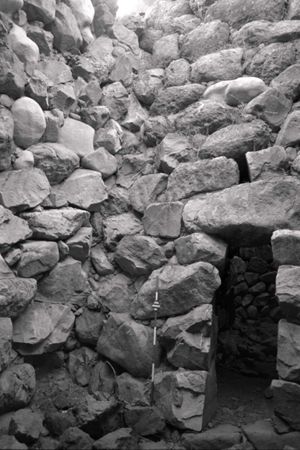
Author : cultura nuragica

Year : 1841
Results 2 of 115495
View All
Texts

Author : Peresson, Giovanni
Author : Peresson, Giovanni
Results 2 of 1503911
View All


 Facebook
 Twitter
 LinkedIn
 Whatsapp

 Print
Print
 E-mail
Comments