Subjects





Samassi is located in the Campidano plain, near the Mannu river. The town was inhabited starting from prehistoric times and attests to a continuity of living up to the Byzantine era. The church of San Gemiliano stands on a hill called su Cunventu, perhaps in memory of an ancient monastic belonging.
Built in Romanesque forms, it has an architectural simplicity that characterizes most of the medieval buildings in Sardinia.
It was built on a Byzantine-era chamber tomb. The Middle Byzantine fragments of marble pillars used for a presbyterial fence, reused in Romanesque walls, date back to the tenth century. One of the fragments is decorated with rosettes and a cross on a bunch of grapes.
The church was originally named after San Mamiliano. In fact, the title is attested in 1118 as belonging to the Camaldolese monastery of San Mamiliano on the island of Montecristo. There is no documentary evidence of the date of reconstruction, presumably in the 13th century, in volcanite from the Serrenti quarries.
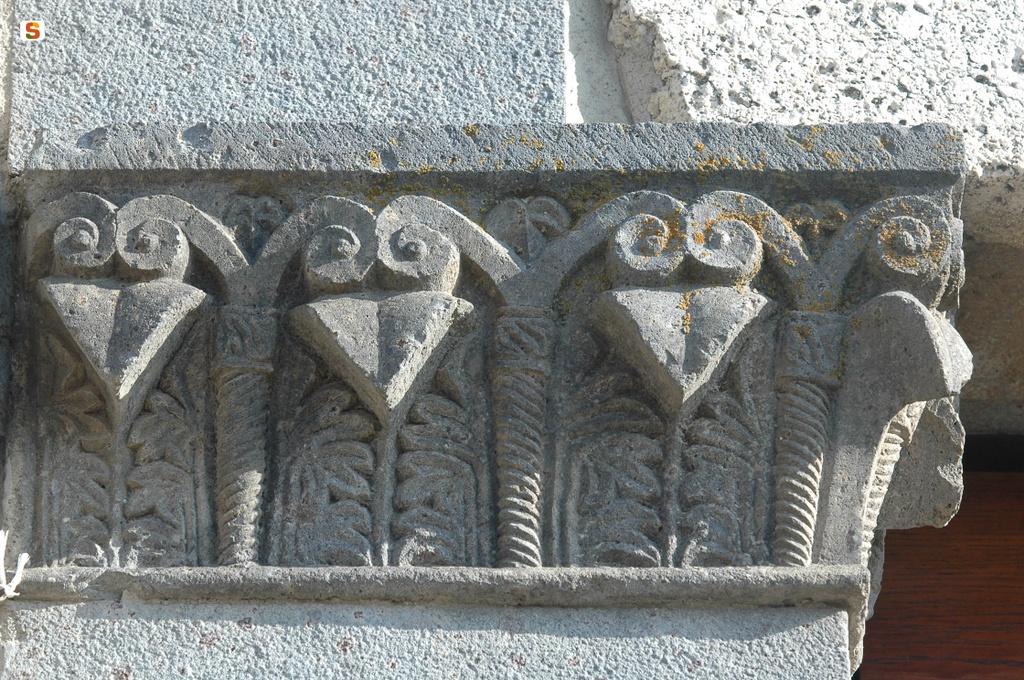
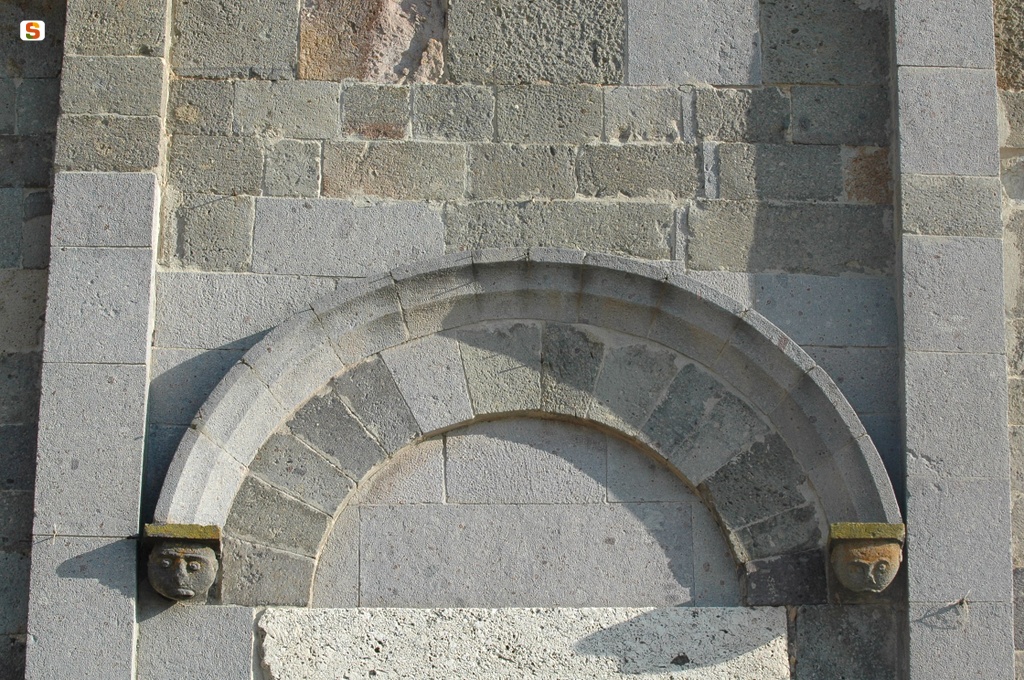
The classroom has a single aisle with a wooden roof. From a base there are angular pilasters that strengthen the structure and pilasters that mark the space on the façade as in the sides. Along the terminals there are semicircular arches set on peducci. On the façade, there is a portal with an lintel, resting on two phytomorphic capitals, and an eyebrow draining arch, set on two small shelves with human features. On the sides there is a series of single-light windows; in the apse, also decorated with arches set on peducci, there are three single-light windows.
Inside the church is the marble funerary monument of Emanuele Castelvì, built in 1586 by the sculptor Scipione Aprile.
History of studies
The studies on Samassi and the church of San Gemiliano are based on the entry 'Samassi' by Vittorio Angius (1849) in the Casalis' Dictionary '. From the following century were the contributions of Dionigi Scano (1907) and Raffaello Delogu (1953). More recent is the synthetic fact sheet by Roberto Coroneo (1993), which records the pre-existence of the Byzantine era.
Bibliography
V. Angius, “Samassi”, in G. Casalis, Historical and Statistical-Commercial Geographical Dictionary of the States of His Excellency the King of Sardinia, XVIII, Turin, G. Maspero, 1849, pp. 7-12;
D. Scano, History of art in Sardinia from the eleventh to the fourteenth century, Cagliari-Sassari, Montorsi, 1907, p. 339;
R. Delogu, The Architecture of the Middle Ages in Sardinia, Rome, The State Library, 1953, pp. 190-191; G. Zanetti, I Camaldolesi in Fosse, Cagliari, Sataro, 1974, pp. 195-199; R. Serra, The Sardinia, “Romanesque Italy” series, Milan, Jaca Book, 1989, pp. 356-357;
R. Coroneo, Romanesque architecture from the middle of the thousand to the early '300, Nuoro, Ilisso, 1993, sheet 123; R. Coroneo-R. Serra, Pre-Romanesque and Romanesque Sardinia, series “Italian artistic heritage”, Milan, Jaca Book, 2004, pp. 291-293; R. Coroneo, Romanesque Churches of Sardinia. Tourist-cultural itineraries, Cagliari, AV, 2005, p. 88.
Content type:
Religious architecture
Province: South Sardinia
Common: Samassi
Macro Territorial Area: South Sardinia
POSTAL CODE: 09030
Address: via San Geminiano, s.n.c.
Update
Where is it


 Facebook
 Twitter
 LinkedIn
 Whatsapp

 Print
Print
 E-mail


Comments