Subjects





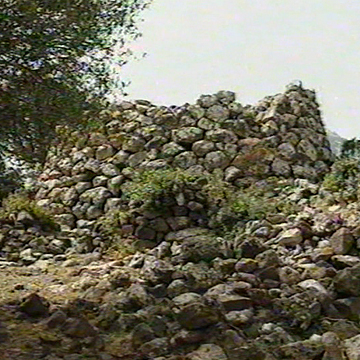
The site is on the southern slopes of the tuff hill where the Ruggiu Nuraghe rises, in the Marghine, a region of central-northern Sardinia.
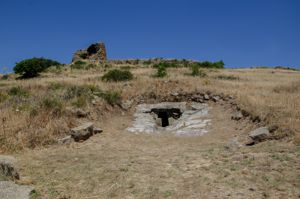
The necropolis is known for giving its name to the Eneolithic culture of Filigosa-Abealzu. It includes four tombs, three of which (I, II, III) excavated at the foot of the hill, the fourth on a higher level. The burials are of the horizontal projection type, with corridors that follow the natural inclination of the rock.
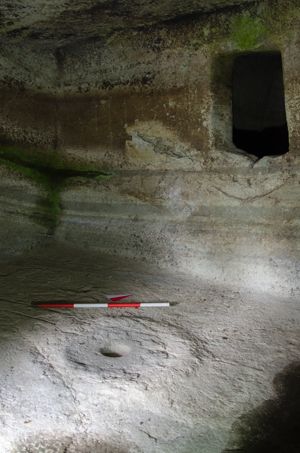
Tomb I has a long “dromos” that leads into a larger room into which six secondary cells open, two in the s and four in the d. The “dromos”, facing S-E (m 11.60x0.30-1.50; h m 1.75), introduces into the trapezoidal cell (m 4.50x3.50; h m 1.90) which has two hemispherical cups on the side and at the base of the wall a funeral bed (m 2.15x0.60; h m 0.15). On the floor, in a central position, there is a circular fireplace (diam. m 0.97) with a raised annular margin and a central cup.
In the back wall of this room, two raised doors are created: the one of s. enters a polygonal compartment and from this into another rectangular room (width m 1.22; h m 1.40); the one of d. gives access to a second group of rooms arranged in pairs: a rectangular room (m 1.80x1.30; h m 1.05), an irregular one, a subtrapezoidal compartment and a quadrangular one (m 2.24 x 3.92; h m 1.30-1.10) divided into two parts by a central partition (h m = 0.25).
Tomb II has a “dromos” (m 7.00 x 0.95-1.80; h m 1.45) with an initial curvilinear development, a larger cell and three other rooms arranged in succession.
The main cell, trapezoidal (2.50x2.50/3 m; h 1.40/1.65 m) and with a sloping ceiling towards the entrance, shows, in the center of the floor, a ritual hearth with a central dimple and a bowl on the wall.
At the center of the back side is the door, quadrangular (h m 0.65; width 0.50 m) and with a double recessed frame, which introduces a small quadrangular environment: on wall d. of this room, the quadrangular entrance opens to a third cell, divided in two by a dividing septum; on the back side, in a decentralized position on the d., the entrance to a fourth quadrangular cell (m 1.25; width. m 1.48) opens.
Tomb III has a “dromos” and two coaxial N/S compartments.
The dromos, facing S (length m 10.50; h m 1.30) grows in height and width towards the bottom and is covered in the final section by a small pavilion.
On the back wall, the quadrangular door opens (width m 0.80; h m 1; thickness m 0.30), which leads to the first quadrangular compartment (m 2.20x2.15; h m 1.40/1.70) which has, in the center of the floor, a circular fireplace with a raised ring and a central cup.
A hatch (h m 0.60; width m 0.40; thickness m 0.28) in the center of the back wall and adorned with a negative frame leads into the second quadrangular compartment (m 1.75x3.85; h m 1.10/1.30).
Tomb IV also has a 'dromos' followed by three coaxial cells, while a fourth side compartment is open in the second room.
The irregular “dromos” (length m 8.20; width m 0.40/2.10) introduces, through a trapezoidal hatch (width m 0.80-0.53; h m 0.92) into the first quadrangular cell (m 2.65x1.98) with a circular fireplace with a cup (diam. m 0.70) and, on the wall s., a small elliptical niche. From this room you can access the second (m 1.03x1.90) and the third compartment (m 1.45x 2.15; h m 1.05), both quadrangular. In the back wall of the third room, the hatch that leads to the fourth square chamber (1.55x1.02 m; h 0.80 m) is dug.
The necropolis, where the presence of stripped human bones attests to the rite of secondary burial, was in use from the middle of the third millennium to the beginning of the second millennium BC.
History of excavations
The tombs were excavated in 1965 by Ercole Contu. A second intervention was conducted, in the 80s, by Alba Foschi.
Bibliography
E. Contu, "Notiziario", in Rivista di Scienze Preistoriche, XX, 1965, pp. 377-379;
A. Moravetti, Relazione preliminare sui monumenti archeologici dei comuni di Birori, Borore, Bortigali, Macomer e Sindia, Macomer, 1973;
V. Santoni, "Nota preliminare sulla tipologia delle grotticelle artificiali funerarie in Sardegna", in Archivio Storico Sardo, 30, 1976, pp. 3-49;
A. Foschi, "La Tomba I di Filigosa (Macomer)", in Atti della XXII Riunione dell'Istituto Italiano di Preistoria e Protostoria, 1980, pp. 289-293;
A. Foschi, "Macomer (Nuoro), Località Filigosa", in I Sardi. La Sardegna dal paleolitico all'età dei nuraghi, a cura di E. Anati, Milano, Jaca Book, 1984, pp. 203-204;
A. Foschi Nieddu, La tomba I di Filigosa (Macomer-Nuoro). Alcune considerazioni sulla cultura di Abealzu-Filigosa nel contesto eneolitico della Sardegna, Nuoro, Coop. grafica nuorese, 1986;
A. Moravetti, Ricerche archeologiche nel Marghine-Planargia. Il Marghine - Monumenti, Parte prima. Sassari, C. Delfino, 1998 (Sardegna archeologica. Studi e monumenti; 5), pp. 91-97;
A. Moravetti, Ricerche archeologiche nel Marghine-Planargia. La Planargia – Analisi e monumenti, Parte seconda. Sassari, C. Delfino, 2000 (Sardegna archeologica. Studi e monumenti; 5).
How to get there
Reach the northern outskirts of the town of Macomer and, shortly before arriving at the Civil Hospital, turn right on a narrow paved road that leads to the Filigosa hill on which the Nuraghe Ruggiu stands. The Filigosa necropolis is dug halfway up the slope.
Structure category: archaeological area or park
Content type:
Archaeological complex
Archaeology
Usability: Open
Province: Nuoro
Common: Macomer
Macro Territorial Area: Central Sardinia
POSTAL CODE: 08015
Address: SS 129 bis
Telephone: +39 347 9481337 +39 0785 743044 +39 0785 70475
E-mail: info@esedraescursioni.it esedraescursioni@libero.it
Website: www.esedraescursioni.it/escursioni-servizi/sistemamusealemacomer
Facebook: www.facebook.com/esedraescursioni
January - December
Monday - Tuesday - Wednesday - Thursday
9:30 AM - 1:00 PM
Information on tickets and access: Tickets for guided tours can be purchased directly at the Filigosa Necropolis site. Reservation required for the afternoon.
Access mode: For a fee
Tickets :
Services information: The guided tour is included in the ticket price.
Update
Services
 Guided tours
Where is it
Texts


 Facebook
 Twitter
 LinkedIn
 Whatsapp

 Print
Print
 E-mail


Comments