Subjects





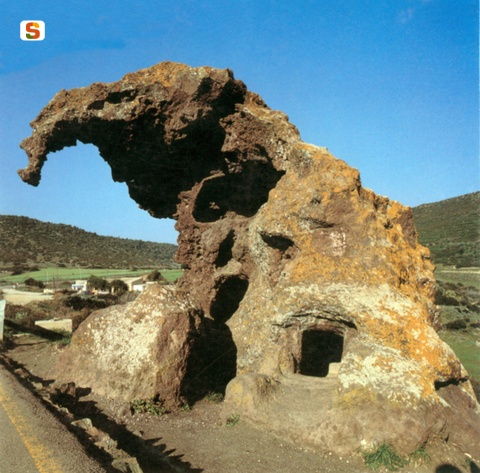
The tombs are dug into an isolated trachyte boulder, at the foot of a steep slope that slopes down to the valley crossed by a tributary stream of the Coghinas; on the other side of the valley stands the Paddaggiu Nuraghe, with the height of the Ossoni Mountains dominated by the homonymous megalithic wall.
The Domus de Janas complex of the Elephant Rock (chronologically framed in the final Neolithic period, 3200-2800 BC) It consists of two hypogeic tombs (I and II) dug, on different levels, inside an erratic trachyte boulder that atmospheric agents have shaped, making it similar to an elephant.
Of the upper hypogeum (tomb II), damaged by the subsidence of the frontal part of the rock, today there are traces of three rooms, arranged on the north-west/south-east axis and of modest dimensions. It is not unlikely that the group of three cells was preceded by a covered pavilion.
It is possible that the destruction of the burial occurred already in ancient times and motivated the construction of a new tomb using the underlying rock surface.
Tomb I is characterized by the presence of taurine protomes carved on the walls of one of the internal rooms.
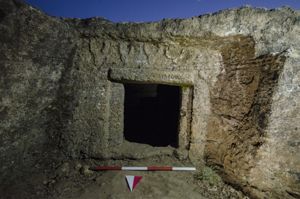
Today, the hypogeum comprises four small rooms; these were originally preceded by a short open-air corridor (“dromos”) with a step in the final section.
The entrance door, with a quadrangular light and with a “frame” recessed, leads into a subquadrangular compartment (m 1.37 x 1.40; height 0.83 m) that preserves, sculpted in relief on the side walls, two bovine protomes with crescent horns and a long trapezoidal head.
Both protomes are set on a low hoof spared in the rock, while a band is carved above the horns, below the ceiling line.
The concentration of symbolic and architectural-decorative elements in the cell qualifies the environment in a sacred sense.
On the N wall of the room, the quadrangular door leading to the second room (cell b) opens; on the sides of the door there are two pilasters that preserve the reproduction of the base and the capital.
On compartment b, with a subcircular plan (m 1.30 x 1.48; height m 0.90) and today in communication with the outside, the entrances open to two other cells c and d, respectively semicircular and quadrangular; the door that communicates with compartment d, similar to the previous one, was marginalized by two sculpted pilasters set up on as many bases and surmounted by capitals.
History of excavations
The grave was excavated from time immemorial.
Bibliography
D. Lovisato, "Nota 2. ad una pagina di preistoria sarda", in Rendiconti della Reale Accademia dei Lincei, 3, 4°, 1887, p. 95;
Ministero della Pubblica Istruzione. Elenco degli edifici monumentali, XIX, Roma, Tip. operaia romana cooperativa, 1922, pag. 86;
A. Taramelli, "La ricerca archeologica in Sardegna", in Il convegno archeologico in Sardegna, Reggio Emilia, Officine grafiche reggiane, 1927, p. 35, fig. 10;
G. Lilliu, "Preistoria sarda e civiltà nuragica", in Il Ponte, VIII, 9-10, 1951, p. 988;
G. Lilliu, "La triste penombra delle ‘domus de janas'", in Tuttitalia, Firenze, Sansoni, 1961, p. 53;
G. Tanda, Arte preistorica in Sardegna: le figurazioni taurine scolpite dell'algherese nel quadro delle rappresentazioni figurate degli ipogei sardi a Domus de Janas, collana "Quaderni", 5, Sassari, Dessi, 1977, p. 43, fig. 12;
P. Basoli, "Castelsardo (Sassari) loc. Multedu domus dell'Elefante", in I Sardi. La Sardegna dal paleolitico all'età dei nuraghi, a cura di E. Anati, Milano, Jaca Book, 1984, pp. 271-273;
P. Melis, La domus dell'Elefante, collana "Sardegna archeologica. Guide e Itinerari", 15, Sassari, Carlo Delfino, 1984;
G. Tanda, L'Arte delle domus de janas nelle immagini di Jngeborg Mangold, Sassari, Chiarella, 1985, pp. 127-130.
How to get
From Castelsardo, take the SS 134 of Anglona in the direction of Perugas, until you reach 19,300 km; the Elephant Rock is located right on the side of the road, on the left for those coming from Castelsardo. For those coming from the new very direct Sassari-Santa Teresa Gallura road (Castelsardo ring road), it is necessary to turn at the junction for Sedini-Castelsardo: the monument is clearly visible at the end of the junction.
Content type:
Archaeological monument
Archaeology
Usability: unmanaged site
Province: Sassari
Common: Castelsardo
Macro Territorial Area: Nord Sardegna
POSTAL CODE: 07031
Address: SS 134 Km 19,300
Update
Where is it
Castelsardo, Domus dell'Elefante Images number: 3
Images
Video

Year : 1992
Year : 1992
Results 2 of 44313
View All


 Facebook
 Twitter
 LinkedIn
 Whatsapp

 Print
Print
 E-mail
Comments