Subjects





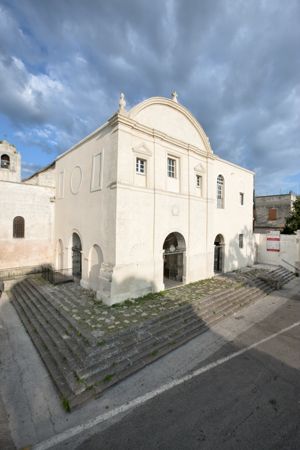
The church is located inside the parking area of a large supermarket overlooking Viale Trieste.
Near the Romanesque church of San Pietro, funerary inscriptions dating back to the V-VI century AD were found, currently kept at the National Archaeological Museum of Cagliari.
One of the inscriptions recalls the young Fortuna, who died at only 27 years old, and relates the tender gesture made towards her by her husband who, when he saw her now devoid of life, closed his eyes. The epitaph was dated to the middle of the 5th century AD.
In 1874, a second inscription was also found, engraved on both sides of the tombstone and placed at the end of a bisomous tomb. The oldest epitaph, dating back to the 5th century AD, mentions Renobata, who died at the age of 25, whose name is linked to the Christian concept of renewal achieved with the sacrament of baptism. The marble plate was subsequently reused and, on the back side, we remember Pascasius, whose name is clearly linked to Easter and, therefore, to the concept of the resurrection. This epitaph dates back to the end of the V-beginning of the 6th century AD. The two bodies buried in the closed tomb with embrici, Renobata and Pascasius, were probably members of the same family.
These are two of the numerous epigraphic tombstones found in a wide-ranging area between Viale Trieste and Viale Sant'Avendrace. The fact that all the epitaphs are undeniably of Christian content and have been found at different points in the area surrounding the church of San Pietro, has suggested that nearby there was an extensive cemetery used during the transition from the late Empire to the early medieval period.
The church is mentioned as “Sanctus Petrus de Piscator” in the document of 1089 in which the Cagliari judge donated a series of religious buildings to the Vittorini and, since it was located on the shore of the Santa Gilla lagoon, it maintained this title, strongly linking itself to the fishermen's guild.
At the end of the eleventh century, the apse can be traced back to large limestone blocks, arranged in E. In the thirteenth century, the church underwent a reconstruction in the Tuscan Gothic style, to which the Gothic façade is shaped. The classroom has been completely renovated in the modern age.
History of excavations Archaeological excavations have
not been conducted in the area surrounding the church of San Pietro, but only superficial reconnaissance investigations. The epigraphs were found randomly and at different times, starting in the nineteenth century.
Bibliography by
A. Taramelli, Guide to the National Archaeological Museum of Cagliari, Cagliari, 1915, p. 144;
L. Pani Ermini-M. Marinone, National Archaeological Museum of Cagliari. Catalogue of early Christian and early medieval materials, Rome 1981;
R. Coroneo, Romanesque architecture from the middle of the thousand to the early '300, Nuoro, Ilisso, 1993, sheet 41;
A.M. Corda, The Christian inscriptions of Sardinia before the 7th century, Vatican City, 1999, pp. 51-52, 67-68, 75, 93-94, 99-100; M. Dadea, “Saint Peter of the Fishermen”, in M. Dadea-S. Mereu-M.A. Serra, Archdiocese of Cagliari, series “Churches and sacred art in Sardinia”, Cagliari, Zonza, 2000, pp. 197-198.
Content type:
Religious architecture
Province: Cagliari
Common: Cagliari
Macro Territorial Area: South Sardinia
POSTAL CODE: 09123
Address: viale Trieste, 112
Update
Where is it
Cagliari, Chiesa e necropoli di San Pietro dei Pescatori Images number: 1
Images


 Facebook
 Twitter
 LinkedIn
 Whatsapp

 Print
Print
 E-mail


Comments