Subjects





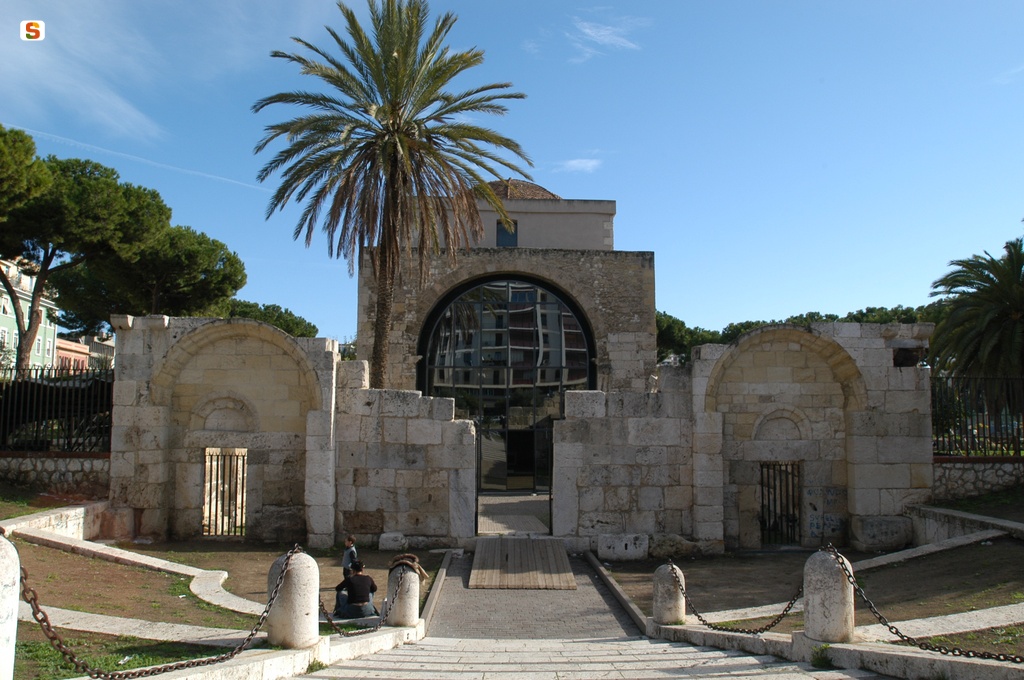
The basilica, in the town of Cagliari, overlooks a large square. The area on which it rises, at the foot of the hill of Bonaria, corresponds to the oldest Christian necropolis attested in the capital.
The title is recorded for the first time in a passage by the deacon Ferrando, biographer of Fulgenzio, the bishop of Ruspe who in the first quarter of the 6th century was exiled by King Trasamondo from North Africa to Cagliari, where he stayed twice and founded a monastery “iuxta basilicam sancti martyris Saturnini”.
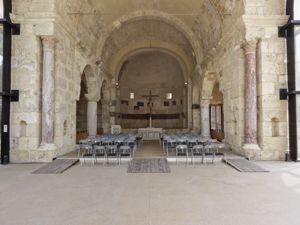
The building would have been built as a 'martyrium' to honor Saint Saturnino, martyred in Cagliari in 304. The original structure was that of an early medieval cruciform church, with a central plan with four equal arms and a central domed body. The domed body and remnants of the quadrangular scarsella apse remain from this factory. The dome is connected by means of half-cross headphones (which perhaps replaced quarter-ball trumpets) to the square compartment, defined by arches in the middle that drain onto pillars with honeycomb columns in red African marble.
In 1089 the title was donated by Constantino-Salusio II de Lacon-Gunale, judge of Cagliari, to the Vittorini of Marseille, who rebuilt the monastery and established the seat of the Sardinian priory in San Saturnino. The monks were responsible for the restructuring of the church in proto-Romanesque forms between 1089 and 1119, the year of its reconsecration. During this phase, due to Provençal workers, the central domed body was maintained and the four arms were rebuilt, of which only the eastern one remains intact, with three naves and apse, with a bonaria limestone wall, hints of bichromia due to the insertion of volcanic ashlars and the use of marble remains. The middle aisle has a barrel vault set on a frame and punctuated by underarches, while the navatelle have cross vaults in cantonetti.
A manuscript by Carmona, from 1631, contains two drawings of the Romanesque building that was still intact, before the material used in the renovation of Cagliari's cathedral was removed from its ruined arms in 1669.
History of studies
Scholars disagree on the original naming, configuration and chronological placement of the early medieval plant. In 1953 Raffaello Delogu recognized in the church the typical pattern of the “martyrium”, the honorary building built with a cruciform plan on the burial of those who had sacrificed themselves for the faith. In 1978, Renata Serra, using the Delogu, gave the cruciform building to the first half of the 5th century. In 1979, Tatiana K. Kirova claims that the cruciform “martyrium”, assigned to the 6th century, had its arms drilled right from the original factory. In 1984, Letizia Pani Ermini identified in a mononave structure with an N-shaped apse, found under the cruciform church, the “basilica sancti martyris Saturnini” where Fulgenzio di Ruspe built the monastery at the beginning of the 6th century; towards the middle of the 6th century, the single-naved church would have given way to the cross-shaped one. There is greater agreement on the Romanesque restructuring, for which Delogu already identified ways of constructing the Franco-Iberian area due to the Vittorini of Marseille.
Bibliography
R. Delogu, L'architettura del Medioevo in Sardegna, Roma, La Libreria dello Stato, 1953, pp. 8-13, 48-51;
T.K. Kirova, La basilica di S. Saturnino in Cagliari, La sua storia e i suoi restauri, Cagliari, 1979;
L. Pani Ermini, "Ricerche nel complesso di S. Saturno a Cagliari", in Atti della Pontificia Accademia Romana di Archeologia. Rendiconti, LV-LVI, 1982-84, pp. 111-128;
R. Coroneo, Architettura romanica dalla metà del Mille al primo '300, collana "Storia dell'arte in Sardegna", Nuoro, Ilisso, 1993, sch. 2;
R. Coroneo-R. Serra, Sardegna preromanica e romanica, collana "Patrimonio artistico italiano", Milano, Jaca Book, 2004, pp. 35-41, 44.
R. Serra, Studi sull'arte della Sardegna tardoantica e bizantina, Nuoro, Poliedro, 2004, pp. 95-96, 101-102;
R. Coroneo, Chiese romaniche della Sardegna. Itinerari turistico-culturali, Cagliari, AV, 2005, pp. 92-93;
R. Coroneo, "La basilica di San Saturnino a Cagliari nel quadro dell'architettura mediterranea del VI secolo", in San Saturnino Patrono della Città di Cagliari nel 17° centenario del martirio, Cagliari, 2005, pp. 55-83.
Structure category: Monument or Monumental Complex
Content type:
Religious architecture
Usability: Open
Province: Cagliari
Common: Cagliari
Macro Territorial Area: South Sardinia
POSTAL CODE: 09127
Address: piazza San Cosimo, s.n.c.
Telephone: +39 070 662496
E-mail: drm-sar.sansaturnino@cultura.gov.it
Website: musei.sardegna.beniculturali.it/musei/basilica-di-san-saturnino
December - January
Tuesday - Wednesday - Thursday - Friday - Saturday
9:00 AM - 4:00 PM
Information on tickets and access: For always updated information on opening hours, it is advisable to visit the dedicated web page of the Regional Directorate of National Museums of Sardinia.
Access mode: Free
Update
Services
 Guided tours
 Facilitated physical accessibility for visitors with specific needs
Where is it
Cagliari, Basilica di San Saturnino Images number: 8
Images
Results 2 of 124057
View All


 Facebook
 Twitter
 LinkedIn
 Whatsapp

 Print
Print
 E-mail


Comments