Subjects





The necropolis is located in the rocky outcrop of Corona Moltana, on the edge of a plateau, in the Logudoro, a region of northwestern Sardinia.
The site is particularly known for having given its name to the “culture of Bonnanaro”, widely spread in Sardinia and dating back to ancient Bronze Age (1800-1600 BC).
It includes five hypogeans with a two-celled and poorly articulated planimetric development.
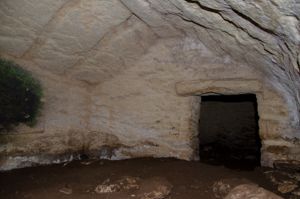
Tomb I - the best known and the first to be identified - has a short corridor with a trapezoidal pavilion that leads - through a raised door that shows a chain for the closing plate - into a rectangular antecell (width 3.90 m; length 2.70 m; height 1.50 m) with a sloping roof; above the door you can see a probable corniform pattern of rectilinear style in relief.
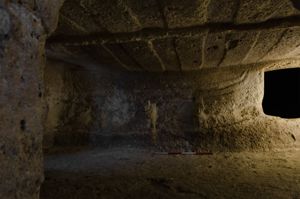
On the back wall of the anticell, the entrance to the main cell opens: the rectangular door is surmounted by a curvilinear corniform pattern with four semicircular recesses at the top.
The cell, coaxial and smaller in size (width 3.10 m; length 1.80 m; height 0.50 m), has an irregular plan; eight hemispherical cups are dug at the base of the walls.
In the cell were placed two individuals with a set of 18 vases and a small bronze ring; this was, in fact, the first organic context of ancient Bronze found on the island.
Of Tomb II, considerably deteriorated, there remains a trapezoidal cell expanded on the back wall by a small furnace room. There is no trace left of the front wall, nor of the other rooms that were supposed to constitute the hypogeum.
Tomb III is accessed through a door - with a cutout for the closing slab and raised on the decking - that leads to an ellipsoidal anticell. The hatch is surmounted by a double rectilinear corniform pattern. The anticell, with a flat ceiling, has two entrances that lead to the next cell with an irregular floor plan and a sloping ceiling.
Tomb IV, also seriously damaged, has a rectangular cell, missing the front wall. In the back wall, there is access to a small ellipsoidal compartment. Various hemispherical cups are carved into the floor and walls.
Tomb V has a cockpit entrance that leads into an irregularly shaped cell, with two niches on the side walls; the ceiling is vaulted and the walls are concave, while on the floor you can see hemispherical cups of various sizes. On the entrance wall, under the access hatch, a small niche opens up.
The necropolis was in use from the late Neolithic to the Ancient Bronze Age (3200-1600 BC).
History of excavations
The necropolis was excavated in 1889; other investigations were carried out in 2000 by Giovanna Maria Meloni.
Bibliography
F. Vivanet, “Bunnanaro. Ancient tombs found in the 'Corona Moltana' district”, in News of the Excavations, 1891, pp. 324-325;
G. Pinza, “Primitive Monuments of Sardinia”, in Ancient Monuments of the Lyncei, XI, 1901, coll. 1-280, p. 84 ff., fig. 57;
A. Taramelli, “Sheet 193 (Bonorva)”, in Archaeological Edition of the Charter of Italy, Florence, Military Geographic Institute, 1940, p. 19, n. 22;
G. Lilliu, The civilization of the Sardinians from the Paleolithic era Age of the Nuraghi, Turin, Nuova ERI, 1988, p.166 ff.; G. M. Meloni, “Research archeological in the towns of Corona Montana and Zarau”, in Bonnanaro and its cultural heritage, Sassari, Segnavia, 2004, pp. 90-99.
How to get
From the town of Bonnanaro, take the paved road that passes on the SS 131. After crossing a bridge, turn right into a dirt road; follow it for 2 km until you reach the domus de janas dug, to the right of the road, on the rock walls inside private land.
Content type:
Archaeological complex
Archaeology
Usability: unmanaged site
Province: Sassari
Common: Bonnanaro
Macro Territorial Area: Nord Sardegna
POSTAL CODE: 07043
Address: località Sa Seas
Update
Where is it
Texts

Author : Sanna, Ignazio <tecnico di archeologia subacquea>
Author : Sanna, Ignazio <tecnico di archeologia subacquea>
Results 2 of 1271576
View All


 Facebook
 Twitter
 LinkedIn
 Whatsapp

 Print
Print
 E-mail
Comments