Subjects





The necropolis is located in the Gallura hinterland, about 10 km from the Gulf of Arzachena. It develops in a small clearing between sweet and green hills.
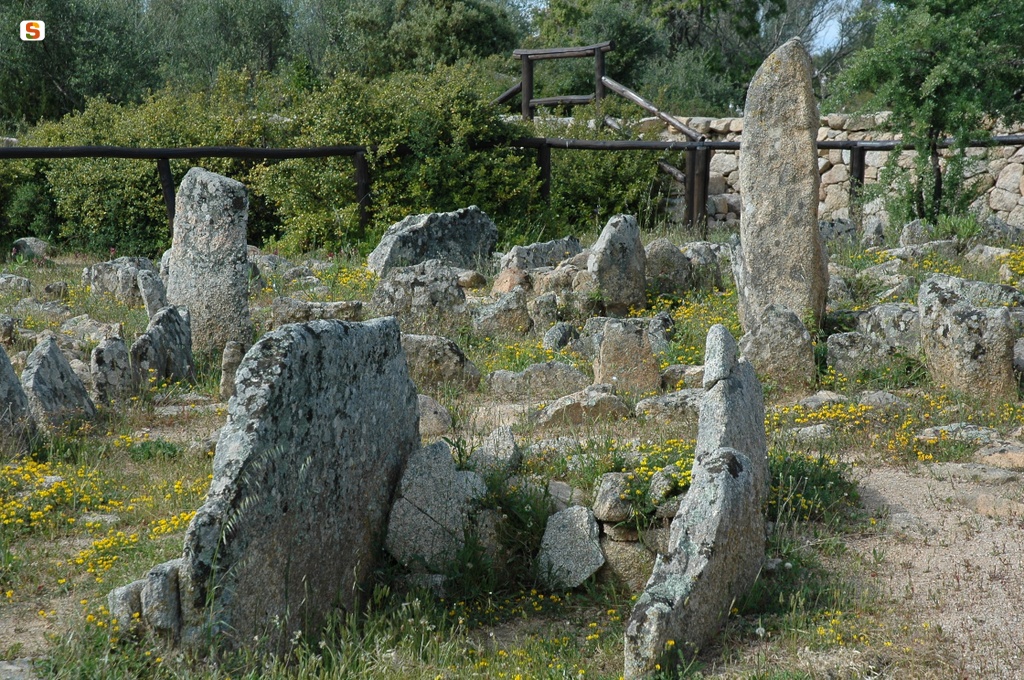
Built with local granite, it consists of five lithic tombs, four of which are surrounded by vertically fixed stone circles. The fifth tomb, from a later period (Bronze Age), consists of a small collective corridor tomb built on an older funerary circle.
The quadrangular cysts probably housed only one deceased person and were originally equipped with a roof plate. Once closed, they were covered by mounds of earth and crushed stone, as demonstrated by the dense series of plates arranged in concentric circles around the burial cells, which were used to contain the mound, protecting it from washing up by rain.
The necropolis therefore had to look like a series of hills at the time.
The circles (diameters from 5.30 m to 8.50 m) are tangent to each other and in the resulting area inside them and in S there are small lithic boxes probably destined to receive periodic food offers for the dead.
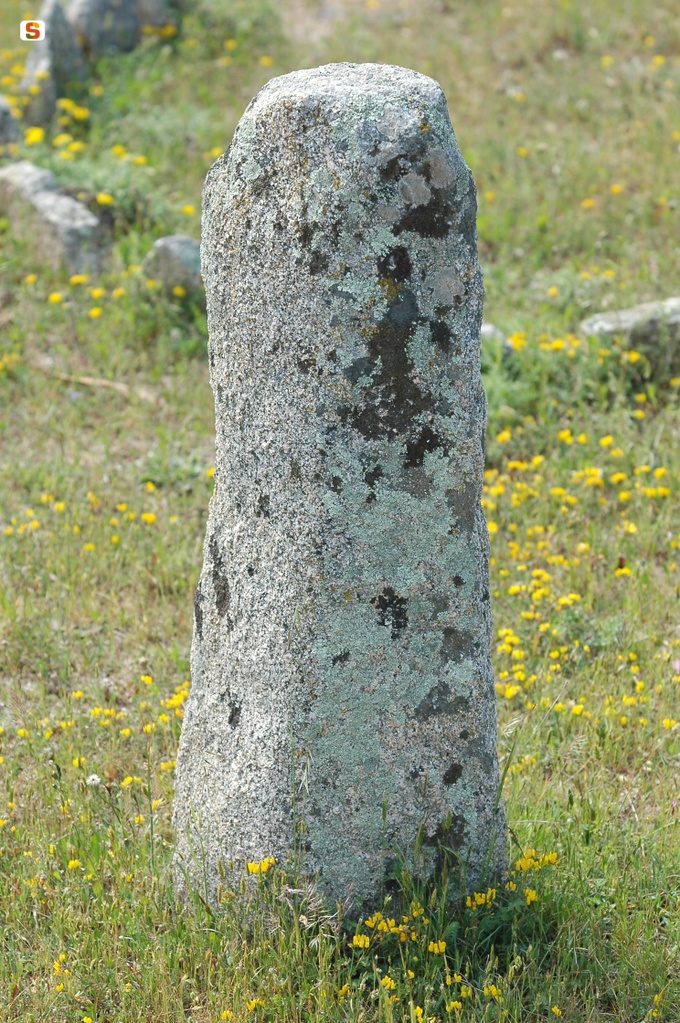
Menhirs are inserted in the circles that externally delimit the burials, evidence of a funerary cult, perhaps marks of the dead or protective effigies.
The tombs have returned few bone remains, which does not allow us to reconstruct the funerary ritual practiced. The discovery of pebbles with traces of red ochre made us think of the preparation of the dye, which was perhaps used on the same body of the dead.
The ceramics found are ornate and not significant, while the lithic finds are remarkable: a steatite cup with a pair of spool sockets and a ring-shaped foot, of Aegean influence, spheroid knobs, flint blades, hatchets and loose necklace.
For a long time in the history of studies, this site has given the name to a culture considered in its own right: that of the “megalithic circles” or “of Arzachena”, then interpreted as a Gallura facies of the culture of San Michele or Ozieri (recent Neolithic, 3200-2800 BC). Today, due to the strong typological resemblance between the famous green steatite cup found in the necropolis and the ceramic productions relevant to the San Ciriaco facies (3400-3200 BC), there is a tendency to attribute the necropolis culturally to this facies of the recent Sardinian Neolithic.
History of excavations
It was discovered in 1939 and excavated between 1939 and 1940 by Salvatore Puglisi.
Bibliography
S. Puglisi, "Villaggi sotto roccia e sepolcri megalitici della Gallura", in Bollettino di Paletnologia Italiana, n.s., 5, 1941;
E. Castaldi, Arzachena. Monumenti archeologici. Breve itinerario, Sassari, Carlo Delfino, 1984.
How to get
To the archaeological site, located about 9 km from Arzachena, can be reached by taking the provincial road to Luogosanto (SP14) or the one to Bassacutena (SP115). Li Lolghi's Giant Tomb is about 1 km away.
Structure category: archaeological area or park
Content type:
Archaeological complex
Archaeology
Usability: Open
Province: Sassari
Common: Arzachena
Macro Territorial Area: Nord Sardegna
POSTAL CODE: 07021
Address: SS 427
Telephone: +39 0789 83401 +39 345 7200094 +39 333 4282607
E-mail: archeologia@gesecoarzachena.it
Website: www.gesecoarzachena.it
October - April
Tuesday - Wednesday - Thursday - Friday - Saturday - Sunday
10:00 AM - 4:00 PM
Maggio - September
Monday - Tuesday - Wednesday - Thursday - Friday - Saturday - Sunday
10:00 AM - 7:30 PM
Information on tickets and access: The schedules may change: we recommend that you always consult the website of the managing body. For always updated information on tickets, given the variety of visit combinations and cumulative offers, please refer to the dedicated web-ticket page on the manager's website.
Access mode: For a fee
Services information: Guided tours are available upon reservation. Audio guides are available, currently only in Italian.
Update
Services
 Bookshop
 Audiooguide
 Guided tours
Where is it
Arzachena, Circoli di Li Muri Images number: 5
Video
Audio


 Facebook
 Twitter
 LinkedIn
 Whatsapp

 Print
Print
 E-mail


Comments