Subjects





*Sa carapigna* is one of the products that differs most from the rest of the island's confectionery repertoire: it contains no almonds, honey, or *sapa* (grape must syrup); it is undecorated; and it is not linked to any life-cycle ritual or specific ceremonial occasion. It is a sorbet made of water, sugar, and lemon juice, with a unique character derived entirely from its production technique. The name most likely comes from the Spanish *garapiña*, introduced to Sardinia during the period of Iberian rule in the 15th and 16th centuries, when the art of making sorbets and frozen drinks spread from the island's Spanish administrative centers.
The main production center is Aritzo, a town whose traditional economy relied significantly on the snow trade. Snow was stored in *neviere*—semi-underground stone structures—in the Gennargentu mountains; during the summer, it was cut into blocks and transported in wooden crates to be used by *carapigneris* (specialized itinerant vendors from Aritzo) at festivals and celebrations across the island.
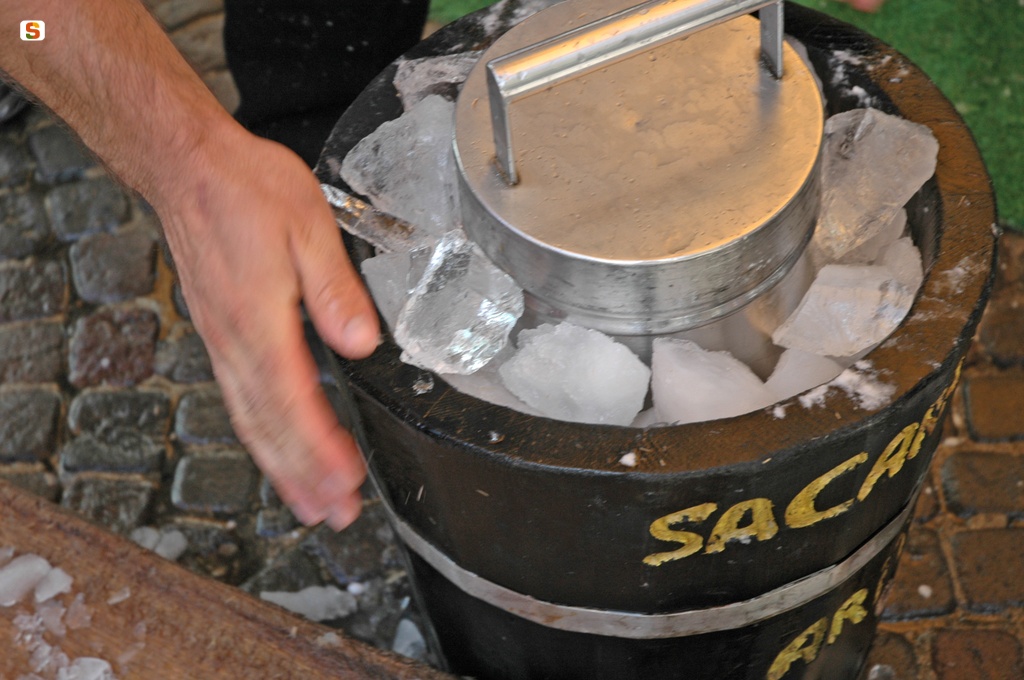
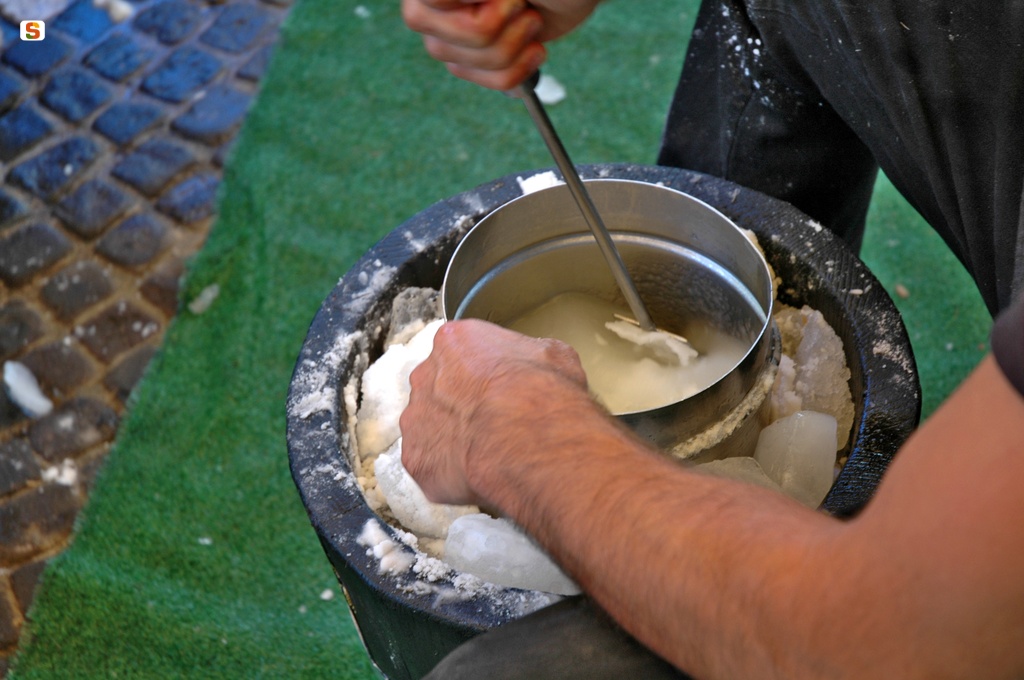
The preparation method has remained essentially unchanged. A mixture of water, sugar, and lemon juice is prepared and poured into *sa carapignera*, an airtight metal container placed inside *su barrile*—a small wooden barrel filled with ice and sprinkled with salt to enhance cooling power. The container is vigorously rotated for about forty minutes while the mixture is worked, first with steel paddles and then with wooden ones, until the desired consistency is achieved. Today, the number of active *carapigneris* is very small; the product is officially recognized as a "Traditional Agri-food Product," and its survival depends on the few families who continue to practice the craft.
Bibliography
U. Dessy, Sardegna: segni della cultura popolare. Quartu Sant’Elena, Alfa Editrice, 1983.
M. L. Wagner, La vita rustica della Sardegna riflessa nella lingua. Nuoro, Ilisso, 1996.
Dolci in Sardegna. Storia e tradizione. Nuoro, Ilisso, 2011.
G. Marongiu, Mandigos, gustos e licanzas. Selezione di ricette della tradizione orale della Sardegna. Vol. 1, Cagliari, Agenzia LAORE, 2020.
S. Paulis, Dolci in Sardegna. Nuoro, Ilisso, 2024.
Update
Video


 Facebook
 Twitter
 LinkedIn
 Whatsapp

 Print
Print
 E-mail


Comments