Subjects





*Su pistiddu* is a pastry filled with *sapa* (cooked grape must syrup) or honey; traditionally prepared for the Feast of Saint Anthony the Abbot, it is common in the Barbagia and Nuoro regions. Significant variations in the filling, dough, and decoration exist across different local traditions. The name refers to both the pastry as a whole and the filling itself; the verb *pistiddare* describes the process of cooking down the grape must into a jam-like consistency.
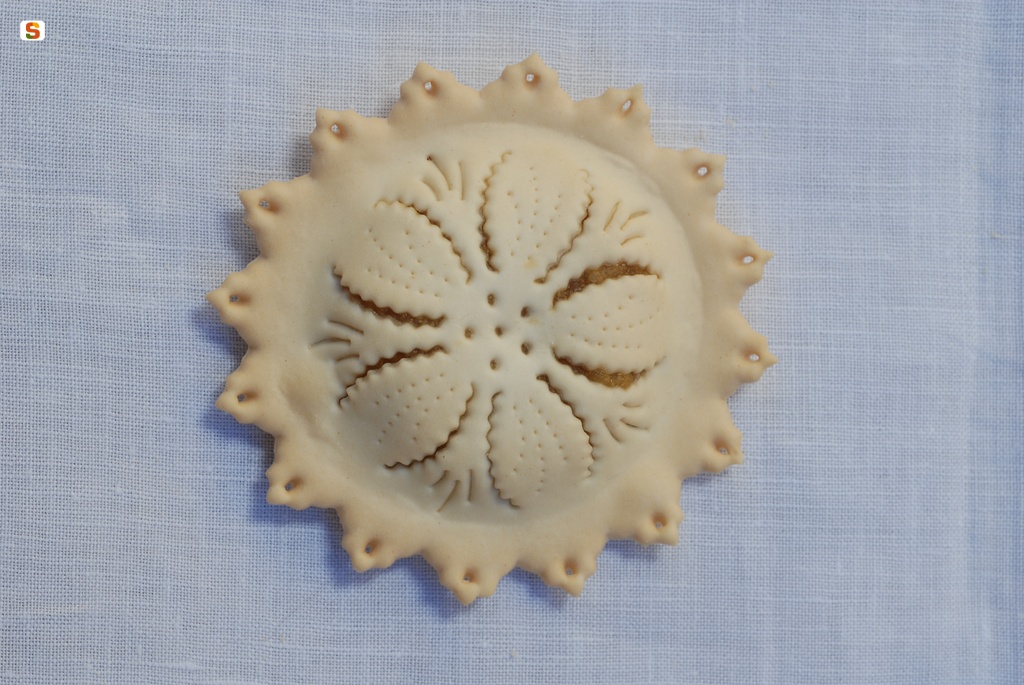
The pastry is structured like a circular tart, consisting of two layers of dough enclosing the filling. The dough—*pasta de tzambella* for the shortcrust version or *pasta suitta* for the semolina-and-lard version—is rolled into discs ranging from fifteen to twenty-five centimeters in diameter. Its most distinctive feature is the decoration, consisting of raised elements and cutouts—such as stars, diamonds, braids, and floral motifs—that reveal the dark filling beneath.
The filling varies significantly by location: in Dorgali, it is made from wine-based *sapa* reduced to a jam and flavored with orange zest; in Orotelli, honey replaces the *sapa*; in Orani, the filling consists of prickly pear jam. In all versions, a small amount of semolina is added to the chosen sweetener to create a mixture thick enough to prevent leakage during baking, a process that sets the structure and caramelizes the surface.
The connection to the Feast of Saint Anthony the Abbot is documented in local sources: the bonfires lit on the evening of January 16th—around which Barbagia communities gather—provide the ceremonial setting for consuming *su pistiddu*. Preparation takes place in the days leading up to the festival, with the reduction of the filling alone requiring many hours. In some areas, this pastry is part of wedding rituals, owing to the complexity of its preparation and its rich filling—qualities that make it suitable for the most solemn occasions. It is recognized as a Traditional Agri-food Product.
Bibliography
U. Dessy, Sardegna: segni della cultura popolare. Quartu Sant’Elena, Alfa Editrice, 1983.
M. L. Wagner, La vita rustica della Sardegna riflessa nella lingua. Nuoro, Ilisso, 1996.
La cucina delle festività religiose. Milano, Accademia Italiana della Cucina, 2010, pp. 343-360.
Dolci in Sardegna. Storia e tradizione. Nuoro, Ilisso, 2011.
G. Marongiu, Mandigos, gustos e licanzas. Selezione di ricette della tradizione orale della Sardegna. Vol. 1, Cagliari, Agenzia LAORE, 2020.
S. Paulis, Dolci in Sardegna. Nuoro, Ilisso, 2024.
Update
Images
Video


 Facebook
 Twitter
 LinkedIn
 Whatsapp

 Print
Print
 E-mail


Comments