Subjects





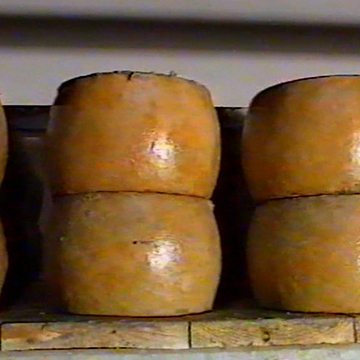
Pecorino Sardo is the cheese that best embodies the island's sheep-farming tradition—specifically in its role as a daily table cheese—with a lineage dating back to the late 18th century. It has held the Designation of Origin status since 1991 and the European Protected Designation of Origin (PDO) status since 1996 (EC Reg. No. 1107/96). It is produced exclusively in Sardinia using whole milk from Sardinian-breed sheep, inoculated with lactic cultures native to the region and coagulated with calf rennet.
Two varieties of this cheese are recognized. *Pecorino Sardo Dolce* (Sweet) is aged for a short period (20 to 60 days); it features a smooth, thin, pale straw-colored rind, a soft and elastic white paste, and a sweet, aromatic, or slightly tangy flavor—making it a classic table cheese. *Pecorino Sardo Maturo* (Mature) is aged for more than two months; it has a firmer, darker rind, a compact and somewhat granular paste, and a pleasantly piquant flavor, making it suitable for both table consumption and grating.
The designation is guaranteed by a traceability system: a "PS DOP" mark featuring the producer's identification code, and a label with a logo that uses color-coding—green for the *Dolce* variety and blue for the *Maturo* variety—to distinguish between the two types. The protection consortium is based in Cagliari.
Bibliography
Formaggi di Sardegna, a cura di M. Venusti. Regione Autonoma della Sardegna – Agenzia Laore, 2010, p. 13.
A. Guigoni, Il formaggio nei presidi Slow Food: marchi di qualità, in Formaggio e pastoralismo in Sardegna. Storia, cultura, tradizione e innovazione. Nuoro, Ilisso, 2015, pp. 653-664.
A. Nudda, Il latte ovino e caprino in Sardegna, in Formaggio e pastoralismo in Sardegna. Storia, cultura, tradizione e innovazione. Nuoro, Ilisso, 2015, pp. 157-168.
A. Piga - P.P. Urgeghe, Tecnologia di produzione e qualità di prodotti caseari ovini della Sardegna, in Formaggio e pastoralismo in Sardegna. Storia, cultura, tradizione e innovazione. Nuoro, Ilisso, 2015, pp. 355-378.
A. Pirisi, I formaggi tradizionali e a Denominazione di Origine Protetta, in Formaggio e pastoralismo in Sardegna. Storia, cultura, tradizione e innovazione. Nuoro, Ilisso, 2015, pp. 199-262.
Update
Video


 Facebook
 Twitter
 LinkedIn
 Whatsapp

 Print
Print
 E-mail


Comments