Subjects





*Pardulas de arrescottu* ("ricotta *formaggelle*") represent the Campidanese and southern variant of the pastry known as *formaggella* and are among the most recognizable and widespread Easter treats in Sardinian confectionery. The geographical distribution of the term *pardula*—which originates in the Campidano region—roughly corresponds to the area where the pastry is found. The filling's deep golden hue, derived from saffron from San Gavino Monreale, distinguishes the Campidanese *pardula* from the *casadina* of the Barbagia region, which is generally paler.
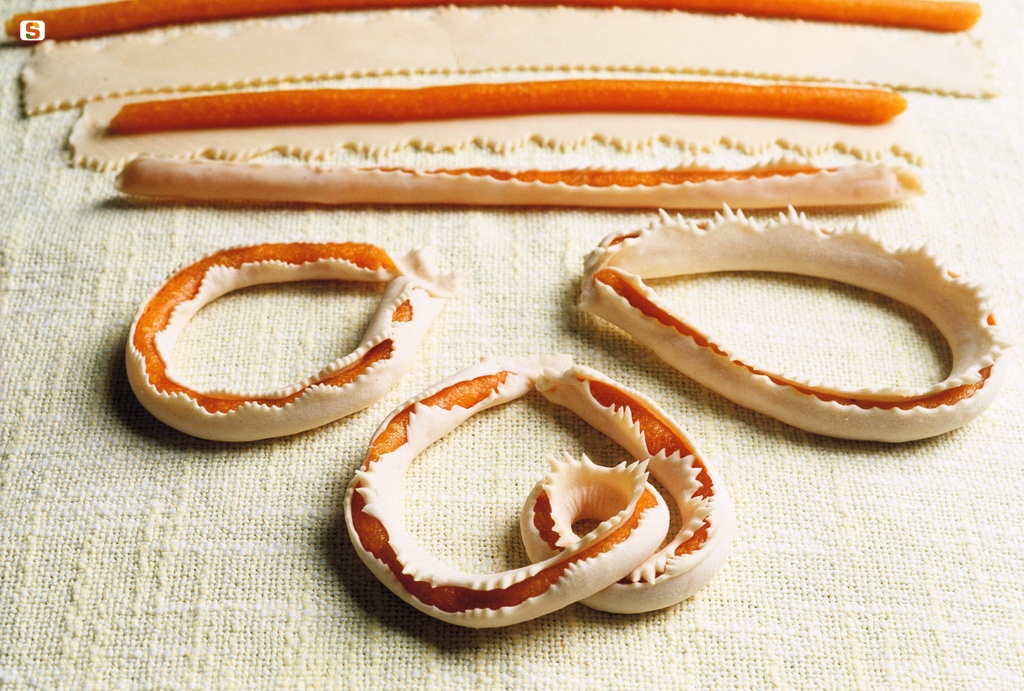
The outer shell is made of *pasta violada* (durum wheat semolina, lard, water, and a pinch of salt), worked until the dough is smooth and elastic. The thickness of the pastry—around three millimeters—is crucial: if too thin, it breaks during baking; if too thick, it alters the ratio between the shell and the filling. The filling is a blend of sheep's milk ricotta, sugar, egg yolks, saffron, grated citrus zest, and a small amount of semolina. This mixture is placed in the center of the pastry disc, and the edges are folded inward using five or six evenly spaced pinches—made with the thumb and index finger—to form the characteristic open crown shape. The uniformity of these folds and their ability to hold their shape during baking are technical indicators of the pastry's quality.
Baking takes place in a static oven at a moderate temperature for twenty-five to thirty minutes. The filling rises, creating the slightly domed, golden surface that defines the finished product. Home production is concentrated in the days leading up to Easter Sunday: the pastry is included in the trays and baskets of sweets exchanged between families as a festive gift and appears on Easter lunch tables alongside lamb, eggs, and other seasonal products.
Bibliography
U. Dessy, Sardegna: segni della cultura popolare. Quartu Sant’Elena, Alfa Editrice, 1983.
Formaggi di Sardegna, a cura di M. Venusti. Cagliari, Agenzia LAORE, 2010.
La cucina delle festività religiose. Milano, Accademia Italiana della Cucina, 2010, pp. 343-360.
Dolci in Sardegna. Storia e tradizione. Nuoro, Ilisso, 2011.
G. Marongiu, Mandigos, gustos e licanzas. Selezione di ricette della tradizione orale della Sardegna. Vol. 1, Cagliari, Agenzia LAORE, 2020.
S. Paulis, Dolci in Sardegna. Nuoro, Ilisso, 2024.
Update
Video


 Facebook
 Twitter
 LinkedIn
 Whatsapp

 Print
Print
 E-mail


Comments