Subjects





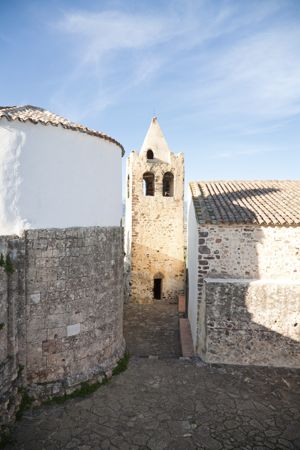
The church is in the urban center. On the large churchyard there is a column at the top of which there is a judicial cross from the Spanish era.
San Ranieri in Villamassargia offers an uncommon fact in medieval Sardinian architecture: from an epigraph, placed on the façade above the rosone, not only does one obtain the date of construction, 1318, but also the name of the builder, Arzocco de Garnas.
Only the façade remains of the Romanesque church, made of sedimentary stone. The current forms of the building are due to the reconstruction between the 14th and 16th centuries. Inside there is a sixteenth/seventeenth-century holy water fountain, interesting for the presence of fish in relief on the bottom.
The church has a single-aisle plan vaulted in a barrel, punctuated by three baskets. The presbytery, turned like a cross, is raised above the classroom by two steps. The pointed access arch is set on molded jambs, with capitals whose decoration repeats ornamental motifs widely used in Catalan Gothic. Along the side walls of the bays, in simple recesses of the walls, chapels are carved, some of which have niches.
The façade is divided into three mirrors. The central one houses the portal, with jambs woven into the walls and capitals with leaf decoration. On the recently inserted monolithic lintel, there is a molded plate and a semicircular drain arc, topped off by an eyebrow decorated with leaves (similar to those of the jamb capitals but with a more accentuated relief) and set on two shelves sculpted respectively with a human and an animal head.
In line with the portal there is a lobed rose window with a frame decorated with a leaf ornament. On its left is the internally smooth rhombus that houses the aforementioned epigraph. Below the rose window, a horizontal frame decorated with plant decoration houses, in the center, the figures of Eve and the snake.
The central mirror is concluded by a theory of round arches on peducci adorned with leaves; at the top there is a sailing bell tower equipped with two pointed lights, aligned with the portal and the rose window.
The side mirrors end with pointed arches, which follow the profile of the roof and rest on floors decorated with plant motifs and human heads.
History of studies
Church studies intensified in the 20th century. With varying degrees of study, Dionigi Scano, Raffaele Delogu, Renata Serra, Roberto Coroneo and Gianni Murtas have contextualized the monument in the historical, artistic and cultural events of the territory of Villamassargia.
Bibliography
D. Scano, History of Art in Sardinia from the 11th to the 14th century, Cagliari-Sassari, Montorsi, 1907, pp. 152-153;
R. Delogu, Architecture of the Middle Ages in Sardinia, Rome, The State Library, 1953, pp. 231-232; R. Serra, La Sardegna, series “Romanesque Italy”, Milan, Jaca Book, 1989, pp. 362-363;
R. Coroneo, Romanesque architecture from the middle of the thousand to the early '300, Nuoro, Ilisso, 1993, sheet 159; Diocese of Iglesias, by G. Murtas, series “Churches and sacred art in Sardinia”, Sestu, Zonza, 1999, pp. 151-152; R. Coroneo-R. Serra, Pre-Romanesque and Romanesque Sardinia, series “Italian artistic heritage”, Milan, Jaca Book, 2004, pp. 293-294; R. Coroneo, Romanesque Churches of Sardinia. Cultural tourist itineraries, Cagliari, AV, 2005, p. 106.
How to get there
At km 48 of the SS 130, turn in the direction of the urban center of Villamassargia. The church, now dedicated to the Madonna del Pilar, stands in Piazza Pilar.
Content type:
Religious architecture
Province: South Sardinia
Common: Villamassargia
Macro Territorial Area: South Sardinia
POSTAL CODE: 09010
Address: piazza Pilar, s.n.c.
Update
Where is it
Images
Video


 Facebook
 Twitter
 LinkedIn
 Whatsapp

 Print
Print
 E-mail



Comments