Subjects





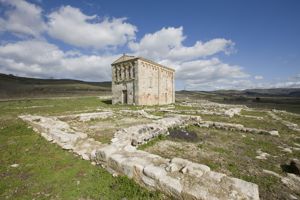
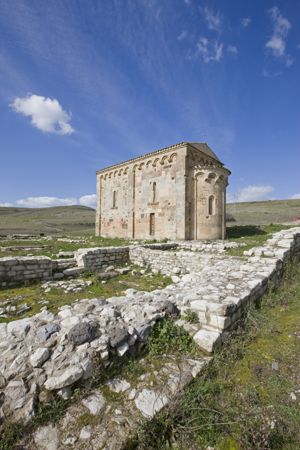
Semestene is in the Campeda plateau, near the Riu sa Puntigia. The fertile and intensely cultivated territory has returned important archaeological documents of human presence since prehistoric times. The church of San Nicola di Trullas or Truddas is located in the open countryside, on the site of a Roman Dominican villa, on which a Camaldolese monastery was built in the Middle Ages.
The church of San Nicola di Trullas is one of the most interesting buildings in the entire Sardinian Romanesque landscape. Added to the purity of its architectural forms is the value of the frescoes from the first decades of the 13th century, which decorate the interior.
It was built by the will of the Athen family before 1113, when it was donated to the Camaldolese, who annexed it to their own monastery. The administration of the latter is known thanks to the papers of the “Condaghe di San Nicola di Trullas” (12th-13th century).
The monowave classroom is divided into two square bays, turned crosswise and separated by an undercrow set up on pilasters.
The façade is divided by a horizontal frame: in the lower part, the architraved portal opens with a raised relief arch, and in the upper part a series of arches on columns creates a false loggia. Each column is surmounted by a peduccio with the function of a capital, decorated with very low engravings or reliefs. Between one arch and the other there are ashlars with housing for ceramic basins.
Arches run along the terminal of the flanks and the apse, punctuated by a median pilaster. On each side, there are two single-light windows, with both smooth and stepped trumpets like those of the apse.
History of studies
The history of studies concerning Saint Nicholas of Trullas is rich in contributions: the entries “Sassari” and “Semestene” (1849) by Vittorio Angius, in the Casalis Dictionary, followed by the news of Dionigi Scano (1907) and Raffaello Delogu (1953). Giovanni Lilliu's article dates back to 1959, while Ginevra Zanetti's monograph on Camaldolese monks in Sardinia (1974) is more recent. The article by Michele Pintus (1976) and the study by Renata Serra in her volume on Romanesque Sardinia (1989) were then published. Roberto Coroneo's summary record (1993) is more recent.
Bibliography
V. Angius, ''Sassari'', in G. Casalis, Dizionario geografico storico-statistco-commerciale degli Stati di S.M. il Re di Sardegna, XVIII, Torino, G. Maspero, 1849, p. 323;
V. Angius, ''Semestene'', in Goffredo Casalis, Dizionario geografico storico-statistco-commerciale degli Stati di S.M. il Re di Sardegna, XVIII, Torino, G. Maspero, 1849, pp. 833-834;
D. Scano, Storia dell'arte in Sardegna dal XI al XIV secolo, Cagliari, Montorsi, 1907, pp. 121-124;
R. Delogu, L'architettura del Medioevo in Sardegna, Roma, La Libreria dello Stato, 1953, pp. 109-111;
G. Lilliu, ''Trulla ''cupola'' in Sardegna'', in Archivio Storico Sardo, XXVI, 1959, pp. 509-521;
G. Zanetti, I Camaldolesi in Sardegna, Cagliari, Fossataro, 1974, pp. 81-112;
M. Pintus, ''La chiesetta di San Nicola di Trullas'', in Atti della Facoltà di Ingegneria dell'Università di Cagliari, 4, 1976, pp. 275-302;
R. Serra, La Sardegna, collana ''Italia romanica'', Milano, Jaca Book, 1989, pp. 389-391;
R. Coroneo, Architettura romanica dalla metà del Mille al primo '300. Nuoro, Ilisso, 1993, scheda 10;
R. Coroneo-R. Serra, Sardegna preromanica e romanica, collana ''Patrimonio artistico italiano'', Milano, Jaca Book, 2004, pp. 102-110;
R. Coroneo, Chiese romaniche della Sardegna. Itinerari turistico-culturali, Cagliari, AV, 2005, pp. 56-57.
How to get there
Semestene is about 50 km from Sassari. Driving along the SP 8 in the direction of Pozzomaggiore, after 2.5 km you can find the Romanesque church of San Nicola di Trullas on the road.
Content type:
Religious architecture
Province: Sassari
Common: Semestene
Macro Territorial Area: Nord Sardegna
POSTAL CODE: 07010
Address: strada vicinale Binza Corte, s.n.c. - località Chiesa S. Nicolo
Update
Where is it
Semestene, Chiesa di San Nicola di Trullas Images number: 5
Images
Video


 Facebook
 Twitter
 LinkedIn
 Whatsapp

 Print
Print
 E-mail



Comments