Subjects





The territory of Orotelli, near the Sa Serra natural park, is rich in archaeological sites dating back to the Nuragic era. With the name of Ortillen, it was the seat of the bishop of Othana between 1116 and 1139.
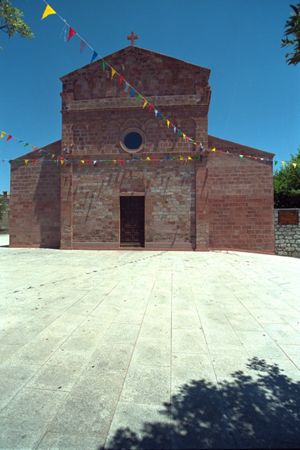
The church dedicated to Saint John the Baptist had to be built around 1116, when the church served as a cathedral due to the temporary unavailability of the one in Ottana. Over the centuries, it has undergone interventions and changes that have altered its original physiognomy, divided into a “commissioned” cross-shaped plan. The single-aisle room had a wooden roof, the transept arms turned like a cruise. In the sixties of the last century, side naves were added, which increased the capacity of the classroom.
Of the Romanesque volcanic stone structure, the façade, the apse and the corner pilasters of the transept and the flanks remain visible. The rest of the church is covered with white plaster. Two horizontal frames divide the façade into three mirrors: in the lower part, the architraved and lunetted portal opens; in the center, an oculus opens, surmounted by a series of arches resting on molded legs. In the upper part of the façade, the slopes are decorated with arches on feet that continue along the sides of the building and into the apse. Inside the apse, a monophorous window with a carved Greek cross opens, similar to the one in the church of San Nicola in Ottana. Other single-light windows open in the sides of the church.
History of studies
The historiography concerning the monument and its territory is based on the entry 'Orotelli' (1845), by Vittorio Angius, inserted in the 'Dictionary' by Goffredo Casalis. Subsequently, the studies of Dionigi Scano (1907, reprint 1980) and Raffaello Delogu (1953) are identified. Fernanda Poli's (1977) contribution was more recent, followed by Renata Serra (1989) and Roberto Coroneo (1993) in their respective volumes on Romanesque architecture in Sardinia.
Bibliography
V. Angius, “Orotelli”, in G. Casalis, Historical and Statistical Geographical Dictionary of the States by H.M. the King of Sardinia, XII, Turin, G. Maspero, 1845, pp. 543-547;
D. Scano, History of Art in Sardinia from the 11th to the 14th Century, Cagliari, Montorsi, 1980, pp. 336-337;
R. Delogu, The Architecture of the Middle Ages in Sardinia, Rome, The State Library, 1953, p. 135; F. Poli, “For a Reinterpretation of Saint Nicholas of Ottana”, in Sardinian Studies, XXIV, 1975-77, pp. 225-240;
R. Serra, Sardinia, series “Romanesque Italy”, Milan, Jaca Book, 1989, pp. 408-409;
R. Coroneo, Romanesque Architecture from the Mid Thousand to the Early '300, series “History of Art in Sardinia”, Nuoro, Ilisso, 1993, sch. 16; R. Coroneo-R. Serra, Pre-Romanesque and Romanesque Sardinia, series “Italian Artistic Heritage”, Milan, Jaca Book, 2004, pp. 278-279; R. Coroneo, Romanesque Churches of Sardinia. Tourist-cultural itineraries, Cagliari, AV, 2005, p. 61.
Content type:
Religious architecture
Province: Nuoro
Common: Orotelli
Macro Territorial Area: Central Sardinia
POSTAL CODE: 08020
Address: via San Lussorio, s.n.c.
Update
Where is it
Orotelli, Chiesa di San Giovanni Battista Images number: 1
Video
Audio


 Facebook
 Twitter
 LinkedIn
 Whatsapp

 Print
Print
 E-mail


Comments