Subjects





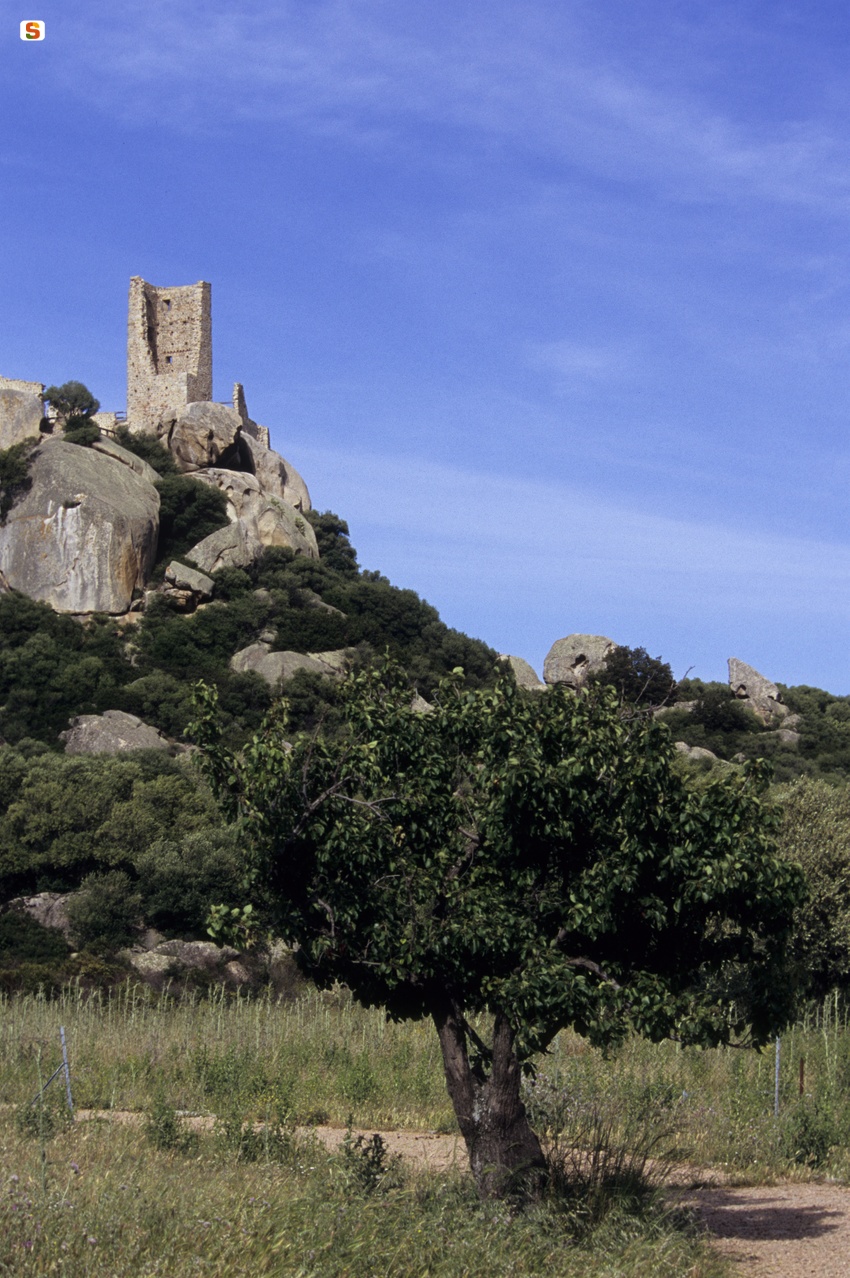
The ruins of the fortress are located in O of the city of Olbia, in the Casteddu region. To get to the site it is necessary to climb for 1 km along the slopes of the hill on which the castle is built. The hill is covered with olive trees and scattered with natural cavities in the granite.
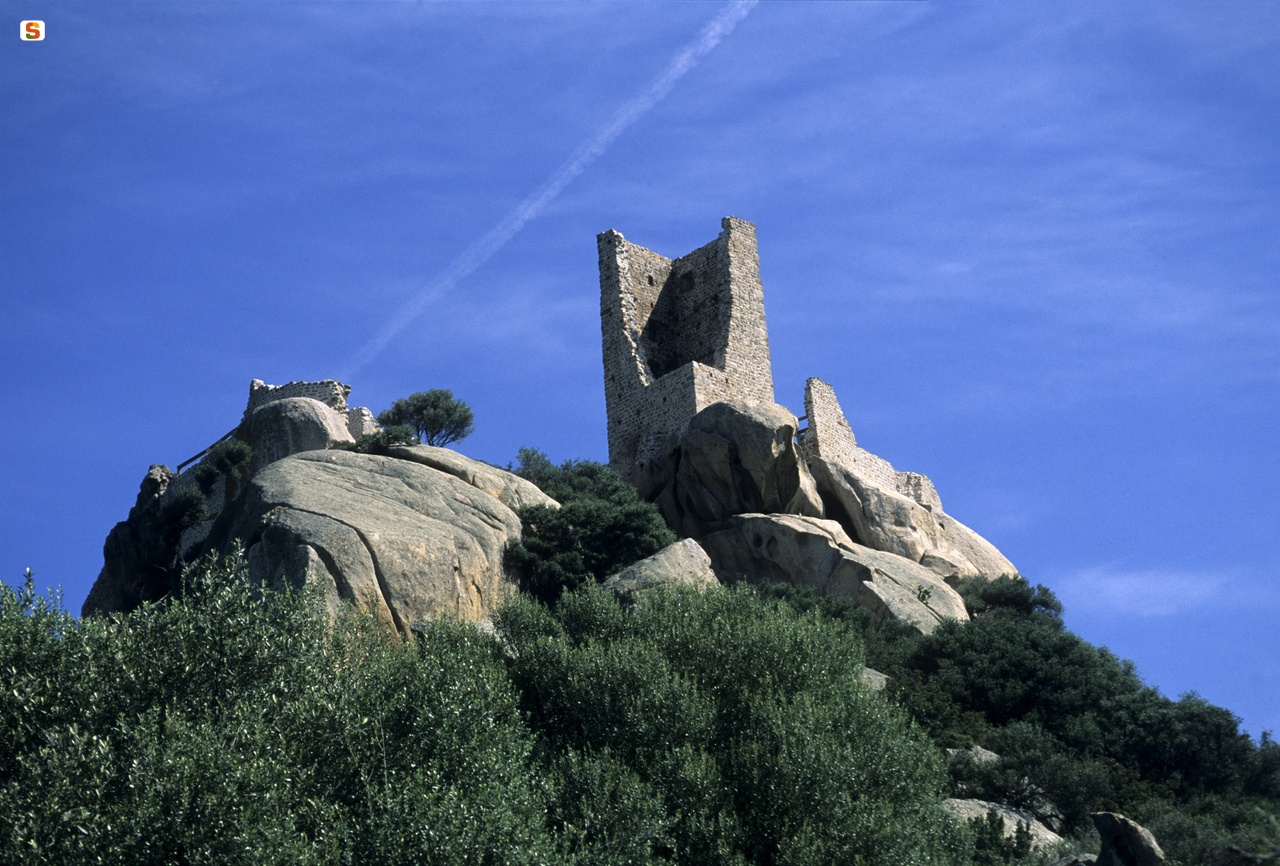
Despite the collapses, the view of the Castle of Pedres from the north makes it still seem powerful and impregnable today.
The castle of Pedres symbolizes and represents, together with the Romanesque-Pisan church of San Simplicio, the full judicial period of Olbia. Its origin, in fact, dates back to between 1296 and 1322, and the commission is attributed to the Visconti, the powerful family of Pisa that dominated the Giudicato Gallurese for almost the entire 13th century.
The castle characterizes the entire southern part of the Olbia basin, entirely dominated by the building despite the fact that it stands on a fortress of only 89 meters.
There is little historical information about the fortification: in 1339, a friar of the hospital order of Saint John of Jerusalem was a Castilian; between 1355 and the end of the century, the castle passed alternately into the hands of the Aragonese and the Arborense, and was then permanently abandoned with the cessation of hostilities on the island, at the beginning of the 15th century.
The structure of the castle, now restored, appears to the visitor as consisting of a few elements: a polygonal wall encloses the remains of a square-shaped tower. The changes that occurred to the windows of the tower indicate how this, over the centuries, has been reused even in times of non-belligerence, undergoing the necessary changes and adaptations.
The fortified structure consists of two fenced squares that integrate the natural strategic fortress.
The upper one consists of the keep, a service environment that has now collapsed, a residential building with cross vaults and an isolated tank.
The keep, preserved for a height of more than 10 meters, was originally divided into four wooden shelves, with a terrace paved in cocciopesto on top.
It can be prudently assumed that the name of the fort derives from the presence of the nearby Villa Petresa, or Petrosa, the small medieval town that died out with the economic and demographic crisis of the 14th and 15th centuries.
A short distance away, there are two important monuments from the Nuragic Age, the Giant Tomb of Su Monte de s'Ape and the Casteddhu Nuraghe, a square tower. The changes that occurred to the windows of the tower indicate how this, over the centuries, has been reused even in times of non-belligerence, undergoing the necessary changes and adaptations.
The fortified structure consists of two fenced squares that integrate the natural strategic fortress.
The upper one consists of the keep, a service environment that has now collapsed, a residential building with cross vaults and an isolated tank.
The keep, preserved for a height of more than 10 meters, was originally divided into four wooden shelves, with a terrace paved in cocciopesto on top.
It can be prudently assumed that the name of the fort derives from the presence of the nearby Villa Petresa, or Petrosa, the small medieval town that died out with the economic and demographic crisis of the 14th and 15th centuries.
A short distance away, there are two important monuments from the Nuragic Age, the Giant Tomb of Su Monte de s'Ape and the Casteddhu Nuraghe.
History of studies
Castel Pedreso or Pedres is described in an article by Maurizio Solinas, in 1988, and in the contribution by Foiso Fois in “Castles of Medieval Sardinia”, in 1992.
Bibliography
D. Scano, History of Art in Sardinia from the 11th to the 14th Century, Cagliari-Sassari, Montorsi, 1907, pp. 345-393;
R. Carta Raspi, Medieval Castles of Sardinia, Cagliari, 1933;
M. Solinas, “The Pedres Castle”, in ancient Sardigna: Journal of Archaeology, History, Antiquity, 4, 1988, pp. 30-32;
F. Fois, Castles of Medieval Sardinia, edited by B. Fois, Cinisello Balsamo, Amilcare Pizzi, 1992, pp. 18 5-187; G. Serreli, Tutti i castelli dei quattro
kingdoms, “Darwin. Notebooks”, n. 1 (July-August 2006), pp. 104-109.
How to get there
From Olbia take the SP 24 in the direction of Loiri. At 3.3 km, turn right into Via Castello Pedrese and continue for about two km, to the car park, from which you continue on foot on two short paths: one that leads to the access to the castle and the other to the tomb of the giants of Su Monte 'e S'Ape.
By bus: you can get nearby about 1.8 km from the site using line 12 of the Aspo urban public transport, stop Castello di Pedres (info and tickets: https://www.aspo.it).
Structure category: Monument or Monumental Complex
Content type:
Fortified architecture
Usability: Open
Province: Sassari
Common: Olbia
Macro Territorial Area: Nord Sardegna
POSTAL CODE: 07026
Address: via Castello Pedrese, s.n.c.
E-mail: info@olbiaturismo.it
Website: https://www.helloolbia.com/luoghi-dinteresse/monumenti
Information on tickets and access: Can be visited freely. The service and refreshment facilities are not yet up and running. Approach the fortification with caution. Visiting is not recommended on days with a strong mistral wind.
Access mode: Free
Update
Where is it
Olbia, Castello di Pedres (Castel Pedreso) Images number: 3
Images
Texts
Video


 Facebook
 Twitter
 LinkedIn
 Whatsapp

 Print
Print
 E-mail



Comments