Subjects





The site is located along a secondary road that was supposed to connect Forum Traiani with the road “to Turre Karales”.
This is an important building complex from the 2nd century BC, renovated in the 3rd-4th century AD and finally abandoned in the 6th century AD.
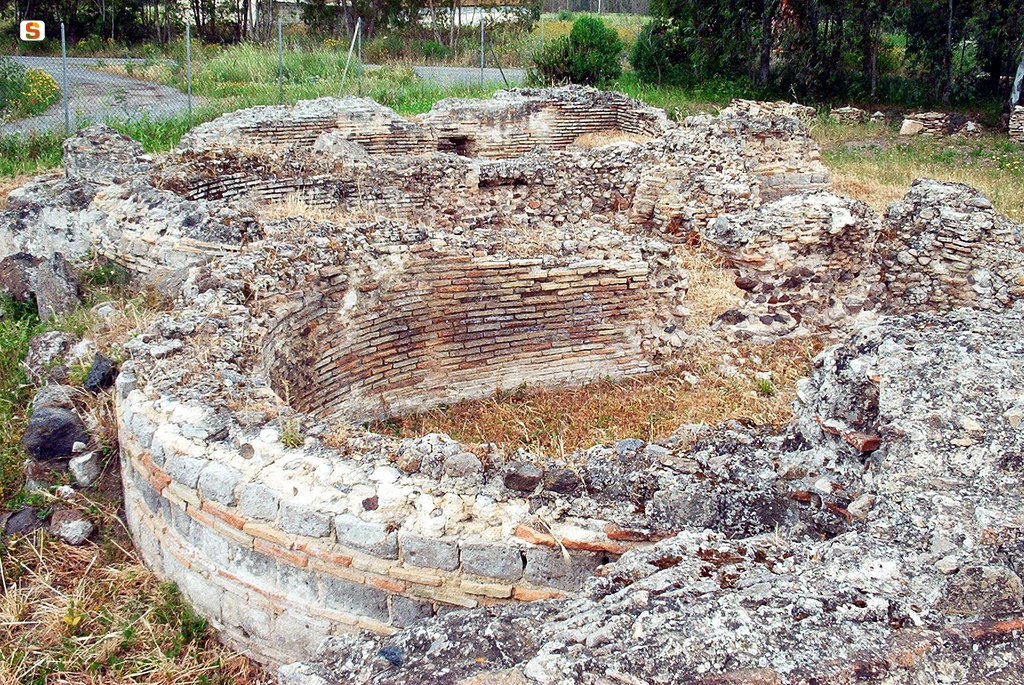
The main body of the building has a rectangular plan, with an N/O-S/E orientation. In the center there was a porched courtyard, with a tub, around which sixteen rooms with a mainly quadrangular plan were arranged. Along the N/O side, there was a rectangular space that was accessed through a series of steps: it was interpreted as a cultic chapel. The service rooms and thermal facilities were located S/O of the main body of the “praetorium”, connected by a narrow corridor.
The baths were articulated in the canonical spaces: “apodyterium” (dressing room), “frigidarium” (room equipped with a cold bath), “tepidarium” (room heated to medium temperature), “praefurnium” (compartment and oven for heating), “destrictarium” (changing room where spa visitors could dedicate themselves to cleaning from sweat and dust by means of the strigile), “calidarium” (heated room), “balnea” (private bathrooms), not heated).
The masonry techniques attested in this building are the 'opus vittatum mixtum', used for the construction of the 'apodyterium' and the 'frigidarium', and the 'opus testaceum', used for the remaining heated rooms.
The excavations of the building complex have returned an important inscription in which the term “praetorium” appears. The interpretation of the semantic value to be attributed to this term has raised a number of problems. In fact, the term “praetorium”, a Latin neologism taken from the Greek language, was used in the Roman world in three different fields: military, administrative and judicial.
In the military sense, the term 'praetor' ('prae-itor') designates the general who commands the army, while the term 'praetorium' designates the place of the military camp (the tent) where the 'praetor' resides. By analogy, 'praetorium' also came to indicate the military council of senior officers, who usually met in the tent of the 'praetor'. The same term also indicated the personal military guard of the 'praetor', the 'cochors praetoria'. The use of the term in the administrative sense is attested starting from 27 BC, when, in Sicily, the government of the provinces was entrusted to a “praetor”, whose residence is precisely called “praetorium”.
Finally, the term “praetorium” was also used in the judicial field: the governor of the provinces, the praetor or the pro-praetor was delegated the task of administering justice. In the case of Muru de Bangiu, the presence of the term “praetorium” in the inscription has been interpreted as an indication that the building complex where the inscription was found should perform the function of a temporary headquarters that the governor could use during his travels from Karales, his ordinary headquarters, to northern Sardinia. At the same time, since the term 'praetorium' was also used in the imperial age to designate the administrative centers of the imperial 'saltus', it is possible that the 'praetorium' of Muru de Bangiu performed the function of the administrative headquarters of the imperial estates present in this territory.
History of excavations
The first mention of the Muru de Bangiu site is due to Giovanni Antonio Carbonazzi and dates back to 1842. Vittorio Angius later wrote about it in 1863. We have news of a first excavation work from a publication by Canon Giovanni Spano in 1863. More significant and systematic interventions are those carried out by the Archaeological Superintendence for the Provinces of Cagliari and Oristano in the years 1986-87 and 1989-91 (since 1990 in collaboration with the chair of Roman Epigraphy at the Second University of Rome).
Bibliography
R. Zucca, "Un'iscrizione monumentale dall'oristanese", in L'Africa romana, 10, II, 1991;
C. Cossu-G. Nieddu, Terme e ville extraurbane della Sardegna romana, Oristano, S'Alvure, 1998.
How to get there
The town is crossed by the railway line that connects Cagliari to Oristano and is very close to the SS 131.
Content type:
Archaeological monument
Archaeology
Usability: unmanaged site
Province: Oristano
Common: Marrubiu
Macro Territorial Area: Central Sardinia
POSTAL CODE: 09094
Address: strada per Is Bangius
Update
Where is it
Images
Texts

Author : Havran Luciani, Roberta
Year : 2017
Author : Havran Luciani, Roberta
Year : 2017
Results 2 of 1277489
View All


 Facebook
 Twitter
 LinkedIn
 Whatsapp

 Print
Print
 E-mail
Comments