Subjects





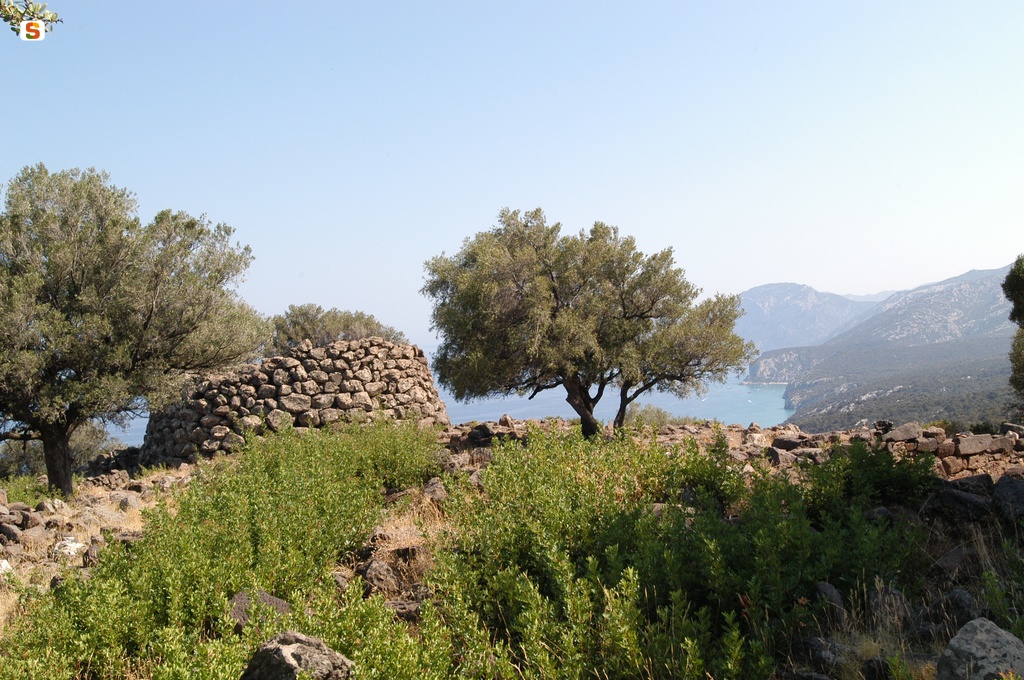
The nuraghe is located in a dominant and suggestive position on a basaltic relief near the coast, in the center of the Gulf of Orosei, in eastern Sardinia. Around the nuraghe there is a vast village of huts.
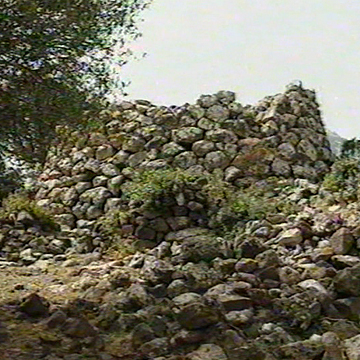
The nuraghe is a mono-tower made of regular rows of large polygonal volcanite and basalt boulders (residual height m 4.70- 3.50, on 13-8 rows; diameter m 12.80 at the base, m 11.20 at the top). It has an E-shaped entrance surmounted by an irregular lintel (length m 1.20; width m 0.45) with an exhaust window.
The entrance leads into a corridor (length m 3.70; width m 1.10) with a flat roof - of which only two basalt boulders remain - where the entrance staircase, now obliterated, opened. The corridor leads into the room, located in an eccentric position, which has a sub-elliptical plan (diameter 3.60 m x 4.60 m) and is almost completely obstructed by the collapse. On the S/O wall there is a reniform niche, also partly obstructed by the collapse.
Outside the tower, on the S side of the wall, there are four niches located a short distance from each other (max. length m 2; max. width m 1.80; height m 1.65), built with rows of irregular blocks.
It is likely that the niches were guardrails with an external entrance to the nuraghe, functional to its defense, but the hypothesis that these are loopholes accessible by a stairwell that was present in a first construction phase of the building and later incorporated into the masonry is not discarded.
Around the nuraghe there is a vast village of huts: it is likely that the name of the monument (“mannu”: large, in the Sardinian language) is due to the large extension of the town, rather than to the monument, which is actually modest in size.
The huts that lean against the building are circular and made of medium-sized unworked stones; as you move away, the houses have a rectangular plan and are made of square blocks.
On the edge of the ravine below, a fence wall built with large blocks is integrated with the large natural boulders.
History of the excavations
It was excavated in 1927 by Antonio Taramelli. Since 1994, archaeologist Maria Ausilia Fadda has conducted repeated excavation campaigns.
Bibliography
A. Taramelli, “Sheet 208. Dorgali”, in Edition of the Archaeological Map of Italy, Florence, Military Geographic Institute, 1929;
A. Taramelli, in Excavation News, IX, 1933;
M.A. Fadda, “Nuraghe Mannu”, in Dorgali. Archaeological Documents, Sassari, Chiarella, 1980, pp. 199-205;
M.A. Fadda, “Dorgali (Nuoro). Nuraghe Mannu”, in I Sardi. Sardinia from the Paleolithic to the Roman Age, Milan, Jaca Book, 1984, pp. 216-217; M.A. Fadda-P. Pruneti, “Operation Nuraghe Mannu”, in Archeologia Viva, 48, November-December 1994; M.A. Fadda-S. Massetti, “Four excavation campaigns with Operation Nuraghe Mannu”, in Bulletin of Archaeology, 1997, 43-45, pp. 217-221; A. Moravetti, Serra Orrios and the archaeological monuments of Dorgali. Sassari, C. Delfino, 1998 (Archaeological Sardinia. Guides and itineraries; 26).
How to get
there Exit from Dorgali and take the SS 125 “Orientale Sarda” in a southerly direction and then, at the height of the tunnel, turn left towards Cala Gonone. After about 4.1 km from the fork, on the right, take the dirt road that leads directly to the archaeological area. The nuraghe is located on the hill to the right of the road.
Structure category: archaeological area or park
Content type:
Archaeological complex
Usability: Open
Province: Nuoro
Common: Dorgali
Macro Territorial Area: Central Sardinia
POSTAL CODE: 08022
Address: strada per Nuraghe Mannu
Telephone: +39 348 4780104 +39 338 8341618
E-mail: info@museoarcheologicodorgali.it museoarcheologico@comune.dorgali.nu.it
Website: www.museoarcheologicodorgali.com
Maggio - September
Monday - Tuesday - Wednesday - Thursday - Friday - Saturday - Sunday
9:00 AM - 12:00 PM
Monday - Tuesday - Wednesday - Thursday - Friday - Saturday - Sunday
4:00 PM - 7:00 PM
April - April
Monday - Tuesday - Wednesday - Thursday - Friday - Saturday - Sunday
10:00 AM - 1:00 PM
Monday - Tuesday - Wednesday - Thursday - Friday - Saturday - Sunday
3:00 PM - 6:00 PM
October - October
Monday - Tuesday - Wednesday - Thursday - Friday - Saturday - Sunday
10:00 AM - 1:00 PM
Monday - Tuesday - Wednesday - Thursday - Friday - Saturday - Sunday
3:00 PM - 6:00 PM
Information on tickets and access: The site is closed from November to March. Last visit to the site, autumn time: morning at 12:20pm, afternoon at 5:20pm. Reservation: none.
Access mode: For a fee
Tickets :
Other services: In Dorgali it is possible to visit two other archaeological sites: Tiscali and Serra Orrios. A visit to one of these sites allows free admission to the Civic Archaeological Museum of Dorgali.
Update
Services
 Guided tours
Where is it
Texts
Video


 Facebook
 Twitter
 LinkedIn
 Whatsapp

 Print
Print
 E-mail


Comments