Subjects





The necropolis is located on the eastern edge of the plain of Santa Lucia, a few kilometers away from the nuragic fountain of Lumarzu, the Puttu de Inza nuraghe and the Monte Donna nuraghe.
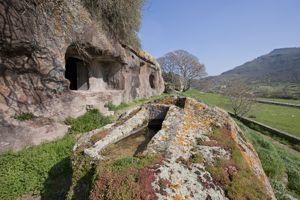
The domus de janas that make up this necropolis, one of the largest and most important in Sardinia, are excavated on the vertical wall and on the plateau of a trachytic outcrop - about 10 m high and oriented to S - and consist of about twenty burials arranged mostly at a certain height compared to the level of the countryside.
Chronologically, they can be framed in the Neo-Eneolithic period, between 4th and 3rd millennium BC, but the first phases of use can be traced back to the Culture of Ozieri (final Neolithic: 3200-2800 BC).
The hypogeums are only partially accessible, as the partial subsidence of the rock front has caused the destruction of some rooms and steps or pedalstones that allowed them to be reached.
The planimetric structure of the burials is single-celled or multicellular: three tombs of particular interest belong to this last type: the 'Tomb of the Cape', the 'Circular Gable Tomb' and the 'Chamber Tomb'.
The first, larger in size, comprises 18 rooms arranged, in a labyrinthine way, around two main rooms.
A rectangular atrium introduces the semicircular antechamber (diam. m 7.10) whose ceiling reproduces the radial joists of a semiconic roof.
On the back wall, the entrance door to the main cell (height 1.80 m) is opened, surmounted by a false rectangular lintel with marked relief.
The two rectangular cells behind it (m 6.80 x 4.10; m 8 x 8.60) are arranged in succession one after the other on the same axis. The rooms have two columns tapered upwards, while the reproduction of a false door is preserved on the left wall of the second cell.
The “Gable Tomb”, close to the previous one, has a first rectangular room (m 1.75 x 0.80) - characterized by the presence on the floor of three pits for offerings - which leads into the main circular cell (diam. m 3; height m 2.30). This second room has 15 pits for offerings on the floor, some of which were cut from one grave to the next, and two other small niches dug into the wall in front of the entrance.
The cone-shaped ceiling preserves the reproduction of a roof with radial joists. On the side walls there are access doors to two rooms added at a time after the first burial system.
The “Chamber Tomb” - whose original monumental entrance with staircase (width m 2) has collapsed due to the subsidence of the rock front - reproduces the architectural elements of a rectangular house.
An entrance pavilion (m 2.85 x 2.75) preserves three dimples in the floor and introduces into the larger, rectangular room plan (m 4.50 x 3.06 x m 2).
This second room has two pillars and a ceiling that reproduces a double-sloped roof, with a central beam and side joists. On the side walls of the compartment, a few cubicles arranged in pairs are spared.
Some other burials in the necropolis show architectural or symbolic elements: on the floor of one of the smaller tombs dug on the plateau of the outcrop, for example, a hearth is made with a circular ring in relief and a central dimple.
The necropolis was reused for a long period of time. In the Middle Ages, the “Tomb of the Cape” was transformed into a place of worship. On the walls of the two innermost rooms, frescoes of Christian subjects were made.
History of excavations
The site was the subject of archaeological investigation in 1916 by Antonio Taramelli.
Bibliography
A. Taramelli, "Fortezze, recinti, fonti sacre e necropoli preromane nell'agro di Bonorva", in Monumenti antichi dei Lincei, XXV, 1919, coll. 765-904;
A. Taramelli, "Foglio 193: Bonorva", in Edizione archeologica della carta d'Italia al 100.000, 16, Firenze, Istituto geografico militare, 1940, pp. 48-49;
A. Malatesta, "Il cosiddetto campanile della necropoli nuragica di S. Andria Priu (Bonorva)", in Rivista di scienze preistoriche, IX, 1954, pp. 105-113;
G. Lilliu, La civiltà dei Sardi: dal neolitico all'età dei nuraghi, Torino, ERI, 1975, p. 113 ss.;
V. Santoni, "Nota preliminare sulla tipologia delle grotticelle artificiali funerarie in Sardegna", in Archivio storico sardo, II, 1976, pp. 3-49;
E. Atzeni, "Aspetti e sviluppi culturali del neolitico e della prima età dei metalli in Sardegna", in Ichnussa: la Sardegna dalle origini all'età classica, Milano, Scheiwiller, 1981, pp. XXXII-XXXVI;
A. Foschi, "Bonorva (Sassari) Loc. S. Andrea Priu", in I Sardi, Milano, Jaca Book, 1984, pp. 287-289;
R. Caprara, La necropoli di S. Andrea Priu, collana "Sardegna archeologica. Guide e Itinerari", Sassari, Carlo Delfino, 1986;
M. Solinas-A. Boninu, La necropoli di Sant'Andrea Priu, Bonorva, Bonorva, Comune di Bonorva, 1999.
How to get there
There From the town of Bonorva, take the road to Bono and travel it for about 6 km, then turn right on an asphalted road that leads to the country church of Santa Lucia. Go through it and continue for another 500 meters until you reach, on the left of the road, the fenced area of the necropolis.
Structure category: archaeological area or park
Content type:
Archaeological complex
Usability: Open
Province: Sassari
Common: Bonorva
Macro Territorial Area: Nord Sardegna
POSTAL CODE: 07012
Address: SP 43 - località Santa Lucia
Telephone: +39 348 5642611 +39 079 867894
E-mail: santandreapriu@libero.it
Website: santandreapriu.mystrikingly.com
March 01 - March 31
Monday - Tuesday - Wednesday - Thursday - Friday - Saturday - Sunday
10:00 AM - 1:00 PM
Monday - Tuesday - Wednesday - Thursday - Friday - Saturday - Sunday
3:00 PM - 5:30 PM
October 01 - October 31
Monday - Tuesday - Wednesday - Thursday - Friday - Saturday - Sunday
10:00 AM - 1:00 PM
Monday - Tuesday - Wednesday - Thursday - Friday - Saturday - Sunday
3:00 PM - 5:30 PM
April 01 - April 30
Monday - Tuesday - Wednesday - Thursday - Friday - Saturday - Sunday
10:00 AM - 1:00 PM
Monday - Tuesday - Wednesday - Thursday - Friday - Saturday - Sunday
3:00 PM - 6:00 PM
Maggio - June
Monday - Tuesday - Wednesday - Thursday - Friday - Saturday - Sunday
10:00 AM - 1:00 PM
Monday - Tuesday - Wednesday - Thursday - Friday - Saturday - Sunday
3:00 PM - 6:30 PM
July - September
Monday - Tuesday - Wednesday - Thursday - Friday - Saturday - Sunday
10:00 AM - 7:00 PM
Information on tickets and access: In the winter months from November to February, the necropolis is open by reservation only by contacting the number +39 3485642611 well in advance, or by writing to the email santandreapriu@libero.it
Access mode: For a fee
Tickets :
Services information: The guided tour is included in the ticket price. For educational workshops, for groups of at least 15 people, it is advisable to contact the structure in advance to check the available offers, the costs, and to book.
Update
Services
 Teaching room
 Guided tours
Where is it
Bonorva, Necropoli di Sant'Andrea Priu Images number: 22
Video
Audio


 Facebook
 Twitter
 LinkedIn
 Whatsapp

 Print
Print
 E-mail



Comments