Subjects





The town of Ardara is located on a volcanic plateau on the eastern slopes of Montesanto. Santa Maria del Regno dominates the valley below, clearly visible to those who head to the town. A short distance away are the ruins of the Castillo Giudicale, seat of the kings of Torres, to which the church was attached.
Santa Maria del Regno stands out from the eyes of the visitor, not only for its scenographic position, but also for the material in which it is built. Made of basalt, it is a dark spot that looms over the volcanic plateau on which the town is located. One of the most important of the island's Romanesque architecture, it is striking for the grandiosity of its forms and for the contrast, inside, of the black basalt with the gold of the sixteenth-century polyptych placed on the altar.
It is a palatine chapel: built near the castle of Ardara, this church represented a privileged space for the rulers of the kingdom of Torres, who took an oath at its altar when they were awarded the office. The building (29 x 10 m high, about 16 m high) was begun in the eleventh century and completed in 1107, as can be seen from the epigraph consecrating the high altar. It has a three-aisle plan and is characterized by the absence of decorations and simplicity, as well as by its grandeur, all typical characteristics of the early Romanesque period in Sardinia. In the façade, divided into five mirrors by thin pilasters, the portal opens with a raised arch, and a mullioned window. Leaning against the N side, the square-shaped bell tower is incomplete due to collapses.
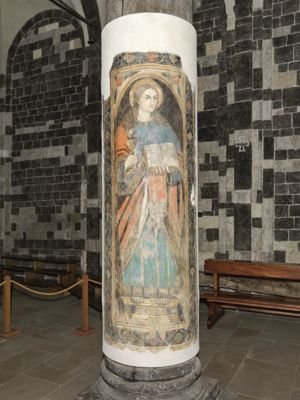
Inside, punctuated by cylindrical pillars that support arches, the side aisles have cross vaults, while the central aisle has a wooden roof. The cylindrical pillars house panels painted with a saint or an apostle, dating back to the 17th century and relocated to their place following restorations. In the apse part, the only exception to environmental austerity is the Ardara Main Altarpiece, a polyptych from the beginning of the 16th century.
History of studies
On Ardara there is a monograph by Francesco Tedde, published in 1985. The history of studies on the monument is extensive, starting with the voice edited by Vittorio Angius (1833), passing through the contributions of Canon Giovanni Spano (1860), Dionigi Scano (1907), Raffaello Delogu (1953), to the most up-to-date publications, including the files of Roberto Coroneo (1993) and Renata Serra (2004).
Bibliography
V. Angius, “Ardara”, in G. Casalis Historical, Statistical and Commercial Geographical Dictionary of the States by H.M. the King of Sardinia, I, Turin, G. Maspero, 1833, pp. 352-354;
G. Spano, “Ardara and his church, ancient palace of the judges of Torres”, in Sardinian Archaeological Bulletin, VI, 1860, pp. 17-23;
D. Scano, History of Art in Sardinia from the 11th to the 14th century, Cagliari-Sassari, Montorsi, 1907, pp. 111-121;
R. Delogu, The architecture of the Middle Ages in Sardinia, Rome, The State Library, 1953, pp. 106-109;
F. Tedde, Ardara capital of the magistrate of Torres, Cagliari, E.Gasperini, 1985;
R. Serra, Sardinia, series “Romanesque Italy”, Milan, Jaca Book, 1989, pp. 213-224;
R. Coroneo, Romanesque Architecture from the mid-1000 to the early '300, Nuoro, Ilisso, 1993, sheet 9;
R. Coroneo-R. Serra, Pre-Romanesque and Romanesque Sardinia, series “Italian Artistic Heritage”, Milan, Jaca Book, 2004, pp. 93-101;
R. Coroneo, Romanesque Churches of Sardinia. Tourist-cultural itineraries, Cagliari, AV, 2005, pp. 40-41.
How to get there
You leave the SS 131 at the junction for Ardara. After a few kilometers you reach the town. The church of Santa Maria or Our Lady of the Kingdom is located at one of the entrances to the town.
Content type:
Religious architecture
Province: Sassari
Common: Ardara
Macro Territorial Area: Nord Sardegna
POSTAL CODE: 07010
Address: piazza Nostra Signora del Regno, s.n.c.
Update
Where is it
Ardara, Chiesa di Santa Maria del Regno Images number: 7
Video


 Facebook
 Twitter
 LinkedIn
 Whatsapp

 Print
Print
 E-mail



Comments