Subjects





Sardinian *torrone* (nougat) is a confection where the name of a single production center—Tonara, in the Barbagia di Belvì region—has come to define the entire category across the island. The earliest records of production in Tonara date back to the second half of the 19th century, when the nougat was already recognized as a genuine local specialty. Alongside Tonara, which remains the primary hub, other historic production centers include Aritzo, Desulo, Guspini, and Pattada.
What distinguishes Sardinian *torrone* from other Italian varieties is the absence of sugar, which is entirely replaced by pure honey. The types of honey used vary according to the season and the area of harvest, with each imparting a distinct flavor profile to the finished product; bitter and intense strawberry-tree honey is particularly prized for the contrast it creates against the sweetness of the nuts. The other ingredients are egg white—which gives the mixture structure and a white color—and roasted nuts, added either whole or in pieces.
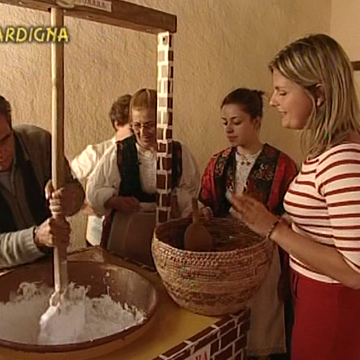
Traditionally, the production process took place in *su gheddargiu*, a large copper cauldron set upon an iron tripod (*trebini*) or a woven-brick stove known as *sa forredda*. The fire used to melt the honey was fueled by holly branches, chosen because they burn without smoke, thereby avoiding any alteration to the honey's aroma. Next, egg whites were incorporated using *sa moriga* (a stick made of heather or strawberry-tree wood) until a smooth, white mixture was achieved—also known as *sa moriga*—to which the nuts were then added. Finally, the warm mixture was poured onto a flat surface and cut into rectangular shapes while still pliable. The *torrone* makers of Tonara have formed an association and adopted a mark certifying the product's origin and adherence to the traditional recipe; to qualify for certification, the *torrone* must be produced in Tonara or by individuals from Tonara (up to the second generation).
Bibliography
F. Corona, Guida dell’Isola di Sardegna. Bergamo, Istituto Italiano d’Arti Grafiche, 1896.
S. Spiggia, Le Api nella Tradizione Popolare della Sardegna. Sassari, Carlo Delfino Editore, 1997, pp. 57-64.
Dolci in Sardegna. Storia e tradizione. Nuoro, Ilisso, 2011.
G. Marongiu, Mandigos, gustos e licanzas. Selezione di ricette della tradizione orale della Sardegna. Vol. 1, Cagliari, Agenzia LAORE, 2020.
Mandorlicoltura in Sardegna. Le varietà autoctone della Sardegna. Cagliari, Agenzia LAORE, 2021, pp. 40-57.
S. Paulis, Dolci in Sardegna. Nuoro, Ilisso, 2024.
Update
Texts

Author : Nori, Paolo
Year : 2018
Author : Nori, Paolo
Year : 2018
Results 2 of 1386276
View All
Video


 Facebook
 Twitter
 LinkedIn
 Whatsapp

 Print
Print
 E-mail
Comments