Subjects





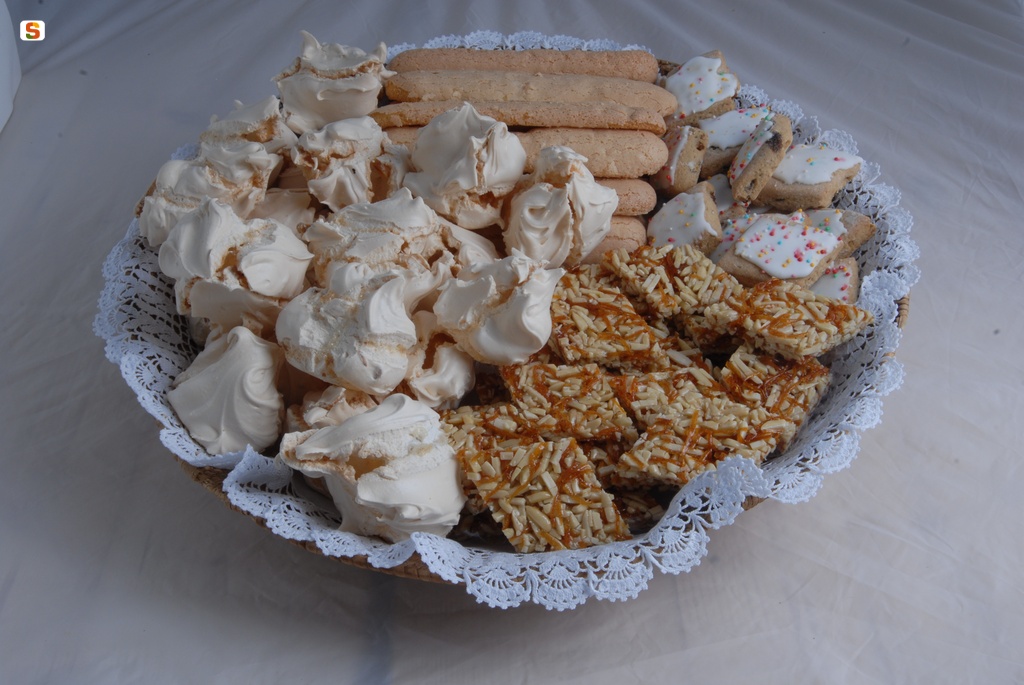
*Gattò de mendula*—also known as *catò*, *gattou*, or simply *gateau*—is a caramelized almond brittle flavored with lemon zest and juice. The introduction of the term (derived from the French word for "cake") is attributed to the Savoy era, when the Savoy court brought elements of continental aristocratic taste and vocabulary to the island. However, the recipe predates this period; some sources trace its origins to the Spanish rule, a time when preparations featuring nuts toasted with honey or *sapa* (grape must syrup) were already widespread on the island. The shift from *sapa* to caramelized sugar and the adoption of the diamond shape are more modern innovations.
The ingredients are almonds, sugar, and lemon, with the optional addition of honey in varying proportions depending on the recipe. The almonds—either sliced or left whole, depending on the specific variation—are lightly toasted before being incorporated into the caramel. The sugar is melted over low heat, sometimes with a spoonful of honey and a few drops of lemon juice to inhibit crystallization. Once the caramel forms, the almonds are quickly added and mixed in to ensure the caramel coats them evenly. The mixture is poured onto a marble or wooden surface moistened with lemon juice—which prevents sticking and adds flavor—and rolled out to a thickness of approximately one centimeter. It must be cut into diamond shapes before the confection cools completely.
For major ceremonial occasions, the brittle could be crafted into monumental, decorative structures such as towers, baskets, and architectural forms. This ceremonial role is documented in both ethnographic sources and literature, where the *gattò* is frequently associated with weddings. It is officially recognized as a Traditional Agri-food Product.
Bibliography
U. Dessy, Sardegna: segni della cultura popolare. Quartu Sant’Elena, Alfa Editrice, 1983.
Dolci in Sardegna. Storia e tradizione. Nuoro, Ilisso, 2011.
G. Marongiu, Mandigos, gustos e licanzas. Selezione di ricette della tradizione orale della Sardegna. Vol. 1, Cagliari, Agenzia LAORE, 2020.
Mandorlicoltura in Sardegna. Le varietà autoctone della Sardegna. Cagliari, Agenzia LAORE, 2021, pp. 40-57.
S. Paulis, Dolci in Sardegna. Nuoro, Ilisso, 2024.
Update
Images
Video
Audio


 Facebook
 Twitter
 LinkedIn
 Whatsapp

 Print
Print
 E-mail


Comments