Subjects





The almond is the most widely used ingredient in Sardinian pastry-making. Its presence on the island is documented as far back as the era of the *condaghe* (medieval administrative records), and its importance is confirmed by various place names in the Campidano region, such as Mendula, Ienna de Mendula, and Curria de la mendula. This widespread presence stems from the almond tree's compatibility with the island's Mediterranean climate; cultivation has never ceased, although local production today is insufficient to meet the needs of the entire confectionery supply chain.
The technique for making almond paste—obtained by grinding the kernel with sugar and flavoring it with orange blossom water—has Arab-Iberian origins. It reached Sardinia during the period of Spanish rule, integrating into an already established tradition of processing the fruit. From this basic technique, a wide variety of types have emerged, distributed geographically and distinguished by their shape, cooking method, and finish.
*Gueffus* (also known as *guelfos* in the Nuoro area and *sospiri* in the Logudoro region) are small, hand-molded almond paste pralines wrapped in colored tissue paper. The mixture consists of finely ground almonds, sugar cooked into a syrup, orange blossom water, and lemon zest. The exterior is rolled in granulated sugar. *Sospiri* from Ozieri are distinguished by the addition of honey to the mixture and a white glaze coating; they also have a flatter shape compared to their Campidano counterparts.
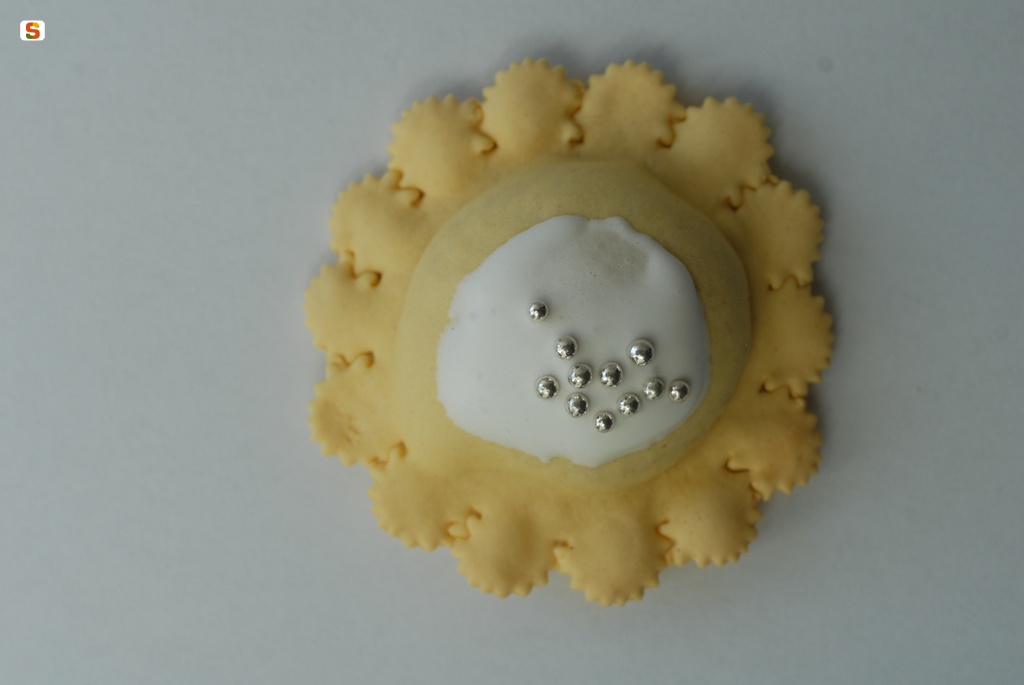
*Candelaus*, common in the Campidano region, belong to the category of *druccis finis* (fine pastries) due to the complexity of their preparation and decoration. They consist of a thin almond paste shell enclosing a soft, orange blossom-flavored filling, molded into shapes such as baskets, animals, or small containers. The surface is glazed and hand-decorated with royal icing.
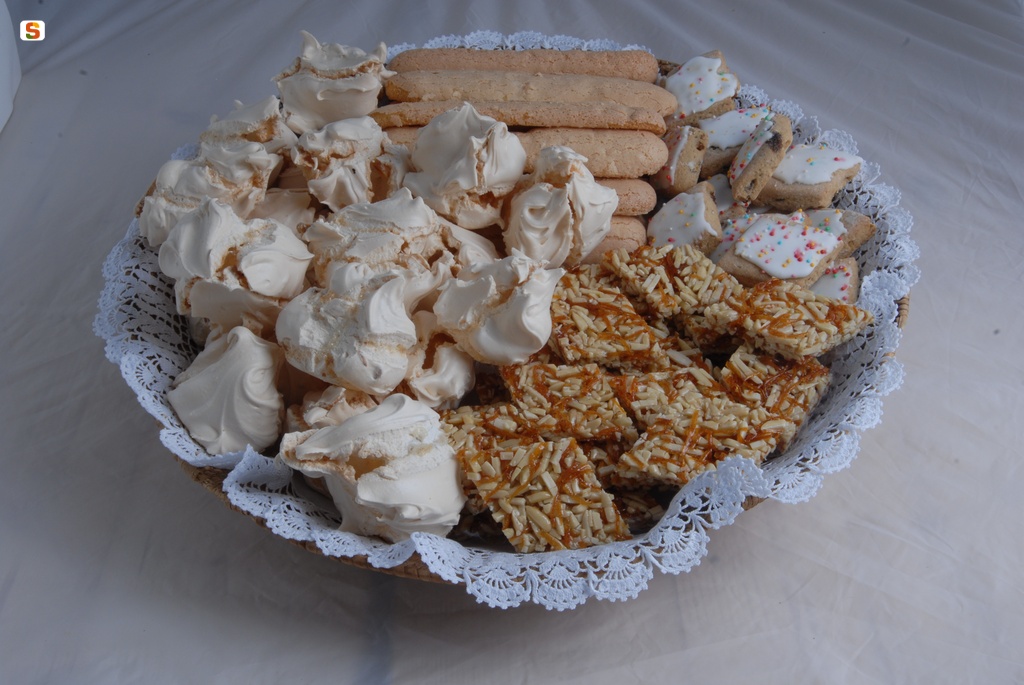
Amaretti are among the most widespread and accessible almond-based pastries. The dough consists of sweet and bitter almonds in varying proportions, sugar, and egg white. The bitter aftertaste comes from the bitter almonds and serves as a distinguishing feature compared to sweeter pralines.
*Pistoccheddus*, originating from Serrenti, are almond-paste biscuits with a drier texture; they are completely coated in white glaze and decorated with colored sprinkles (*tragera*). They belong to the same family of ceremonial pastries and are prepared for baptisms, communions, and weddings.
Bibliography
U. Dessy, Sardegna: segni della cultura popolare. Quartu Sant’Elena, Alfa Editrice, 1983.
Dolci in Sardegna. Storia e tradizione. Nuoro, Ilisso, 2011.
G. Marongiu, Mandigos, gustos e licanzas. Selezione di ricette della tradizione orale della Sardegna. Vol. 1, Cagliari, Agenzia LAORE, 2020.
Mandorlicoltura in Sardegna. Le varietà autoctone della Sardegna. Cagliari, Agenzia LAORE, 2021, pp. 40-57.
S. Paulis, Dolci in Sardegna. Nuoro, Ilisso, 2024.
Update
Images
Texts

Author : Conticini, Philippe
Year : 2016
Author : Montersino, Luca
Year : 2020
Results 2 of 1365732
View All


 Facebook
 Twitter
 LinkedIn
 Whatsapp

 Print
Print
 E-mail
Comments