Subjects





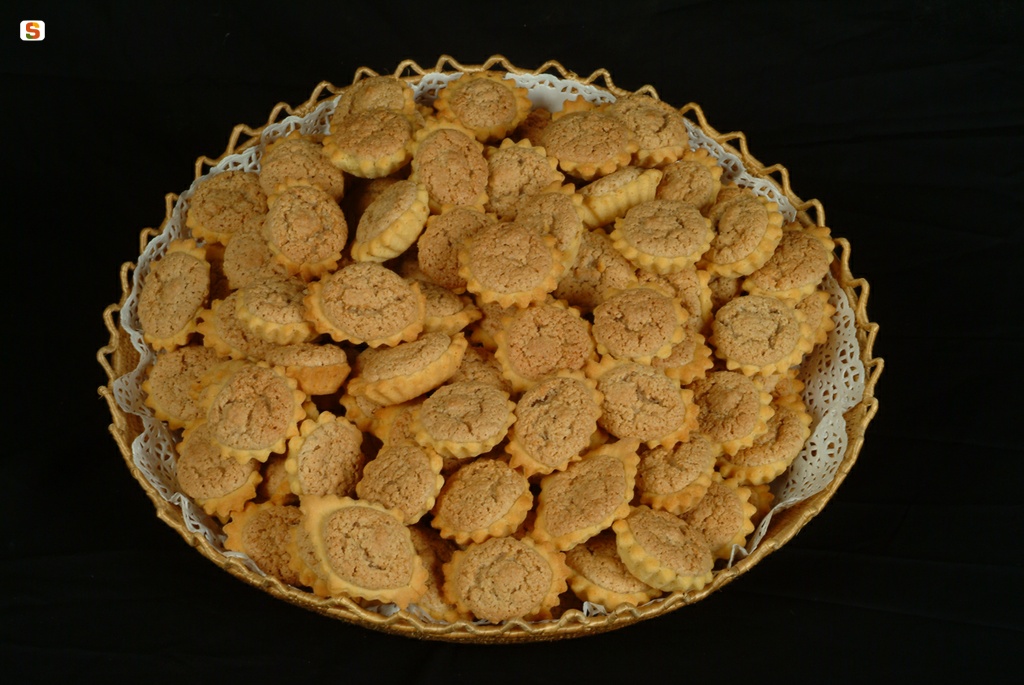
Amaretti (also known as *amaretus*, *amarettus*, or *amarettos*) are among the most widespread almond pastries on the island and represent an exception to the general rule of Sardinian confectionery. Indeed, they are among the few pastries not strictly tied to a single geographical area or specific occasion. They are found throughout Sardinia, and their consumption ranges from family ceremonies to everyday enjoyment.
The characteristic that distinguishes the Sardinian amaretto from versions found in other Italian regions is its texture: a slightly dry crust enclosing a soft center. This structure results from the ratio of ingredients and the coarseness of the ground almonds—factors that vary significantly across different family and local traditions. Typically, the amaretto contains no added flour or fats, making it a naturally gluten-free product. Flavorings are optional, though grated lemon or orange zest are among the most common additions. The bitter almond—from which the pastry takes its name—defines its flavor profile, determining the intensity of the aftertaste and balancing the sweetness of the sugar. Reducing or eliminating the bitter component yields a variant known in some parts of the island as *amaretto dolce* (sweet amaretto).
Oral tradition traces the origins of Sardinian amaretti to the Oristano area, specifically the towns of the Alta Marmilla region. Although the precise moment amaretti first appeared cannot be historically verified, the presence of almond pastries on the island is documented as far back as the era of the medieval *condaghes* (administrative records). While available year-round, in the festive calendar, amaretti are associated with Saint Anthony the Abbot and feature in the baskets of sweets prepared for winter ceremonies.
Bibliography
Dolci in Sardegna. Storia e tradizione. Nuoro, Ilisso, 2011.
G. Marongiu, Mandigos, gustos e licanzas. Selezione di ricette della tradizione orale della Sardegna. Vol. 1, Cagliari, Agenzia LAORE, 2020.
Mandorlicoltura in Sardegna. Le varietà autoctone della Sardegna. Cagliari, Agenzia LAORE, 2021, pp. 40-57.
S. Paulis, Dolci in Sardegna. Nuoro, Ilisso, 2024.
Update
Images
Texts
Video


 Facebook
 Twitter
 LinkedIn
 Whatsapp

 Print
Print
 E-mail


Comments