Subjects





“Currently only the 'Elephant Tower' can be visited, organized by the City of Cagliari - through: Monumenti Cagliari Soc. Coop.”
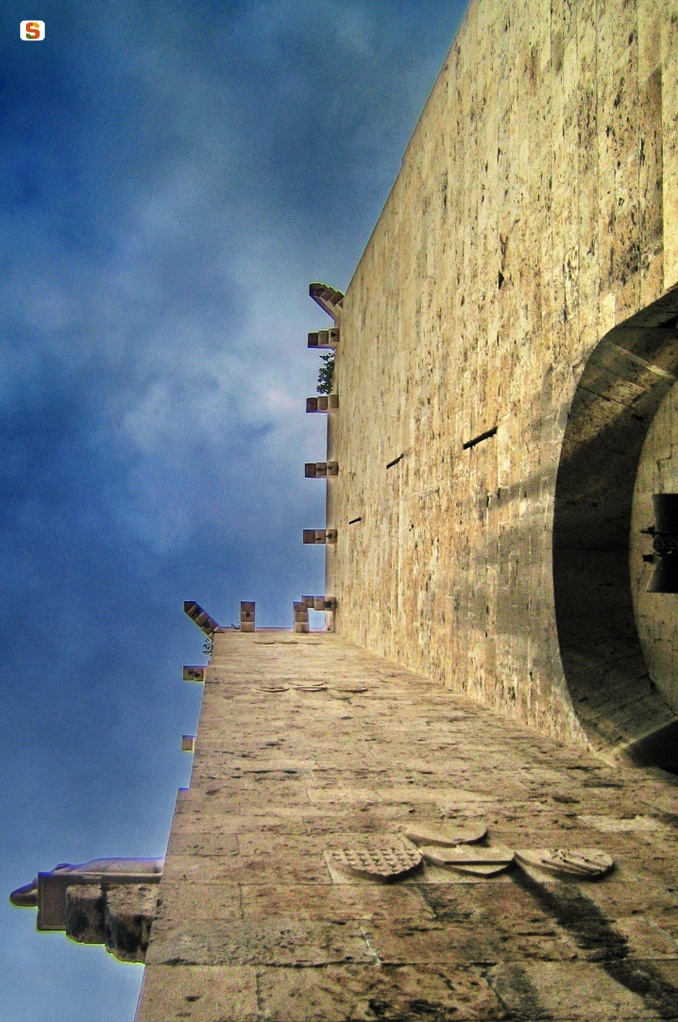
The towers of San Pancrazio and Dell'Elefante are considered one of the best examples of medieval Italian military architecture.
They were designed by Giovanni Capula and completed in 1307. They are located in the historic district of Castello, urbanized starting in 1217. The Castle was initially the seat of the Pisan colony and later of the highest civil and religious authorities.
In the centuries before the 13th century, the city of Cagliari had developed since the Phoenician-Punic and Roman ages with a series of settlements for different purposes, along the coastline from the Fangarium area to Capo Sant'Elia. In the Byzantine era, the coastal settlement was in sharp decline, in favor of the concentration of the population in the internal site of Santa Igia, close to the western lagoon, where the cathedral of Santa Cecilia and the Palace of the Judges of Cagliari stood. The hill of Castello, perhaps the seat of a temple in the pre-Christian era, was not inhabited.
The urbanization of the hill dates back to 1217, when Benedetta de Lacon-Massa, judge of Cagliari, donated the Castrum Calaris to Lamberto Visconti. The place became the seat of the Pisan colony, with the church of Santa Maria perched on the eastern side. The destruction of the judicial and episcopal citadel of Santa Igia, carried out by the Pisans in 1258, marks not only the end of the kingdom of Cagliari, but also the transfer of the bishop to the castle, so that the church of Santa Maria became a cathedral and inherited the title of the ancient one, dedicated to Saint Cecilia. From this moment on, the highest religious and civil authorities will reside in the Castle, the seat (in addition to the cathedral) also of the episcope, the ancient City Palace and the Royal Palace, today the seat of the Province.
Although Aragonese and Spanish control changed over the centuries, as well as in those of the Kingdom of Sardinia first and then of Italy, the current Cagliari district of Castello has maintained a fused urban pattern, characteristic of cities with a Tuscan municipal structure. The plan is divided into three parallel routes: the 'ruga mercatorum', today via La Marmora; the 'ruga marinariorum', via Canelles; the 'ruga fabrorum', via Martini. These streets were, like today, connected by crossbars and confluents to the N and S of the city.
In the early fourteenth century, fearing the imminent Catalan attack following the concession of the “Regnum Sardiniae” to James II king of Aragon, the Pisans strengthened the walls under the direction of the architect Giovanni Capula. The mighty walls were built in cantons coming from the Cagliari hill of Bonaria and equipped with towers with an L-shaped or circular plan. The tower of San Pancrazio in NE, with an epigraph that says it was built in 1305, and the Elephant tower in SO, dated epigraphically 1307, survive intact. The walls were also defended by other towers, one of which, the Torre dell'Aquila, is now incorporated into the Boyl Palace.
The walls have always been subordinated to the defensive function, therefore linked to the military evolution that brought changes to their structure. Until in the nineteenth century they were less and less useful for military purposes, but they did not interfere with the modern development of the city, planned at the foot of the Castle. Also for this reason, walls and towers have only been partially demolished, reaching relatively intact to the present day.
History of studies
Starting with the entry edited by Vittorio Angius (1836) for the Casalis “Dictionary”, studies on the city of Cagliari have been numerous. Canon Giovanni Spano (1861) describes it in his “Guide”, which is still fundamental today for the knowledge of the historic center. In the twentieth century, Dionigi Scano (1907), then Raimondo Carta Raspi (1933) suggested a study methodology, which continued after the war with Angela Terrosu Asole (1959). Evandro Putzulu (1976) explores the problem of the origins of the settlement in the Castle. Renata Serra (1976) dedicates her attention to Giovanni Capula, architect of the two surviving towers. The most up-to-date research was conducted in the Eighties by Franco Masala (1985), Emerenziana Usai and Raimondo Zucca (1986), Foiso Fois (1992), Roberto Coroneo (1993) and Marco Cadinu (2001).
Bibliography
V. Angius, voce "Cagliari", in G. Casalis, Dizionario geografico storico-statistico-commerciale degli Stati di S.M. il re di Sardegna, III, Torino, G. Maspero, 1836, p. 106;
G. Spano, Guida della città e dintorni di Cagliari, Cagliari, A. Timon, 1861, p. 9;
D. Scano, Storia dell'arte in Sardegna dal XI al XIV secolo, Cagliari-Sassari, Montorsi, 1907, pp. 345-380;
R. Carta Raspi, Castelli medioevali in Sardegna, Cagliari, 1933, pp. 22-33;
A. Terrosu Asole, "Cagliari. Ricerche di geografia urbana", in Studi Sardi, XVI, 1958-59, pp. 429-558;
E. Putzulu, "Il problema delle origini del Castellum Castri de Calleri", in Archivio Storico Sardo, XXX, 1976, pp. 91-146;
R. Serra, voce "Capula", in Dizionario Biografico degli Italiani, XIX, Roma, Istituto della Enciclopedia Italiana, 1976, pp. 272-273;
F. Masala, "La cinta fortificata, le torri, i bastioni", in Cagliari, Quartieri storici, Cinisello Balsamo, Amilcare Pizzi, 1985, p. 14;
E. Usai-R. Zucca, "Testimonianze archeologiche nell'area di Santa Gilla dal periodo punico all'epoca altomedievale (contributo alla ricostruzione della topografia di Carales)" in S. Igia, capitale giudicale. Atti del Convegno "Storia, ambiente fisico e insediamenti umani nel territorio di S. Gilla", Pisa, ETS, 1986, pp. 155-201;
F. Fois, Castelli della Sardegna medioevale, Cinisello Balsamo, Amilcare Pizzi, 1992, pp. 32-40;
R. Coroneo, Architettura romanica dalla metà del Mille al primo '300, collana "Storia dell'arte in Sardegna", Nuoro, Ilisso, 1993, sch. 171;
M. Cadinu, Urbanistica medievale in Sardegna, Roma, 2001;
G. Serreli, Tutti i castelli dei quattro regni, "Darwin. Quaderni", n. 1 (luglio-agosto 2006), pp. 104-109.
Structure category: Monument or Monumental Complex
Content type:
Fortified architecture
Usability: Open
Province: Cagliari
Common: Cagliari
Macro Territorial Area: South Sardinia
POSTAL CODE: 09124
Address: via Università, angolo Cammino Nuovo, s.n.c.
Telephone: +39 070 6777900
E-mail: info.beniculturalicagliari@gmail.com
Website: www.monumenticagliari.it/monumenti/3d819e94-0407-4488-8c09-e734ad0f0007 cagliariturismo.comune.cagliari.it/it/vivicagliari/torre-dellelefante
Facebook: www.facebook.com/monumentidicagliaripaginaufficiale
Information on tickets and access: Currently it is only possible to visit the Elephant Tower, as the Tower of San Pancrazio is temporarily closed to the public. For always updated information on opening hours and ticket costs, it is advisable to visit the dedicated web page of the municipality of Cagliari, or to contact the manager “
Access mode: For a fee
Update
Services
 Guided tours
Where is it
Cagliari, Torri di San Pancrazio e dell'Elefante Images number: 4
Images
Texts


 Facebook
 Twitter
 LinkedIn
 Whatsapp

 Print
Print
 E-mail


Comments