Subjects





The area where Santa Maria di Mesumundu is located is rich in both mineral and thermal waters. The church stands on the ruins of ancient Roman baths from the late imperial age. The Byzantine phase is attested by burials that have returned funeral kits consisting of gold, silver and bronze jewelry. In the 11th-12th century, the place probably hosted a Cassino Benedictine monastery.
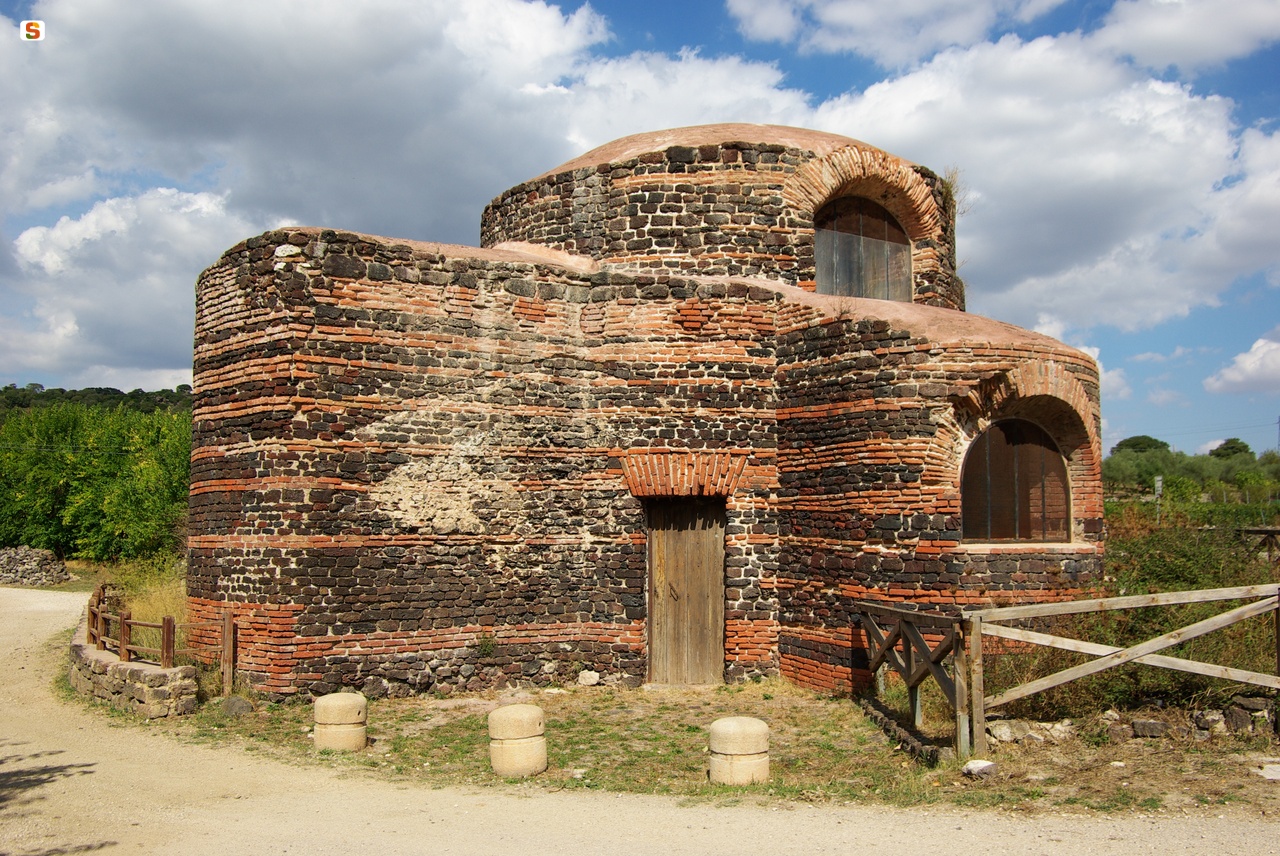
The church of Santa Maria di Mesumundu is one of the most fascinating monuments of medieval Sardinian architecture, due to its unique forms and the opus listatum construction technique, which alternates rows of red bricks with courses of small dark-colored basalt stones.
It is identified with that of Santa Maria di Bubalis, donated in 1065 by the Turritan judge Torcotorio Barisone I de Lacon-Gunale to the abbey of Montecassino. However, it was built in the Byzantine era, as evidenced not only by the surrounding burials, but also by the walls with alternating rows of terracotta brick and basalt, and was expanded during the judicial age, as evidenced by the apses in basalt ashlars, with the entrance that falls under the tax line. The discovery of an inscription dated to the 7th century provides an ad Quem term for the plant.
It consists of a central roundabout of considerable height, about 7 m, to which four differently shaped buildings are inserted. The whole takes on a vaguely cruciform shape, with the N/E arm 4 m long, in whose east wall a small apse opens. The N/O arm, of the same length, ends with a parabolic curved wall. At N/E and S/O there are two other apses, the first large in size, the second smaller.
The architectural forms are not the only peculiarity of this church. The use of terracotta bricks has made it possible to create large openings both in the central body and in the S/O apse. Different characters can be seen on the opposite side, relating to the interventions of the eleventh century, where the walls are made of basalt ashlars and limestone, implemented with a so-called “sack” technique. Another inconsistency is represented by the monophora, a narrow slit that is not compatible with the large openings on the S/O side. The apses facing E have an entrance receding on the tax wire.
History of studies
In the second half of the 20th century, the church was the subject of interest by art historians and archaeologists. Raffaello Delogu and Dionigi Scano, Renata Serra and Roberto Coroneo stand out among the first. Among the archaeological contributions, those of Guglielmo Maetzke on the pre-existences of the Roman age and of Roberto Caprara, who ascribed the church to the Byzantine era, stand out. A review of the monument was proposed by Alessandro Teatini (1996).
Bibliography
D. Scano, Storia dell'arte in Sardegna dal XI al XIV secolo, Cagliari-Sassari, Montorsi, 1907, pp. 217-221;
R. Delogu, L'architettura del Medioevo in Sardegna, Roma, La Libreria dello Stato, 1953, pp. 82;
G. Maetzke, "Siligo (Sassari). Resti di edificio romano e tombe di epoca tardo imperiale attorno a Santa Maria di Mesumundu", in Notizie degli Scavi di Antichità, XIX, 1965, pp. 307-314;
R. Caprara, "Tarda Antichità e Medioevo", in Il Museo Sanna in Sassari, Cinisello Balsamo, Amilcare Pizzi, 1986, pp. 169-184;
R. Caprara, "L'età altomedievale nel territorio del Logudoro Meilogu", in Il Nuraghe Santu Antine nel Logudoro Meilogu, Roma, 1988, pp. 397-432;
R. Serra, La Sardegna, collana "Italia romanica", Milano, Jaca Book, 1989, pp. 402-403;
R. Coroneo, Architettura romanica dalla metà del Mille al primo '300. Nuoro, Ilisso, 1993, scheda 31;
A. Teatini, "Alcune osservazioni sulla primitiva forma architettonica della chiesa di Nostra Signora di Mesumundu a Siligo (Sassari)", in Sacer, III, 1996, pp. 119-149;
R. Coroneo-R. Serra, Sardegna preromanica e romanica, collana "Patrimonio artistico italiano", Milano, Jaca Book, 2004, pp. 345-347;
R. Coroneo, Chiese romaniche della Sardegna. Itinerari turistico-culturali, Cagliari, AV, 2005, pp. 39-40.
How to get there
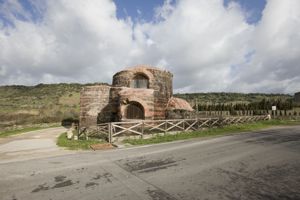
Leave the SS 131 near the Siligo exit. The church of Santa Maria di Mesumundu is visible from the road, on D. for those coming from S.
Content type:
Religious architecture
Province: Sassari
Common: Siligo
Macro Territorial Area: Nord Sardegna
POSTAL CODE: 07040
Address: SP 80
Update
Where is it
Images


 Facebook
 Twitter
 LinkedIn
 Whatsapp

 Print
Print
 E-mail


Comments